WCAG guidelines comparison: what WCAG 2.0 is, and which version binds you in 2026
Plenty of teams are told to meet WCAG without being told which version. The answer sits in the law or contract that reaches you, and each one names its own version and level.
Which WCAG version and level actually binds you?#
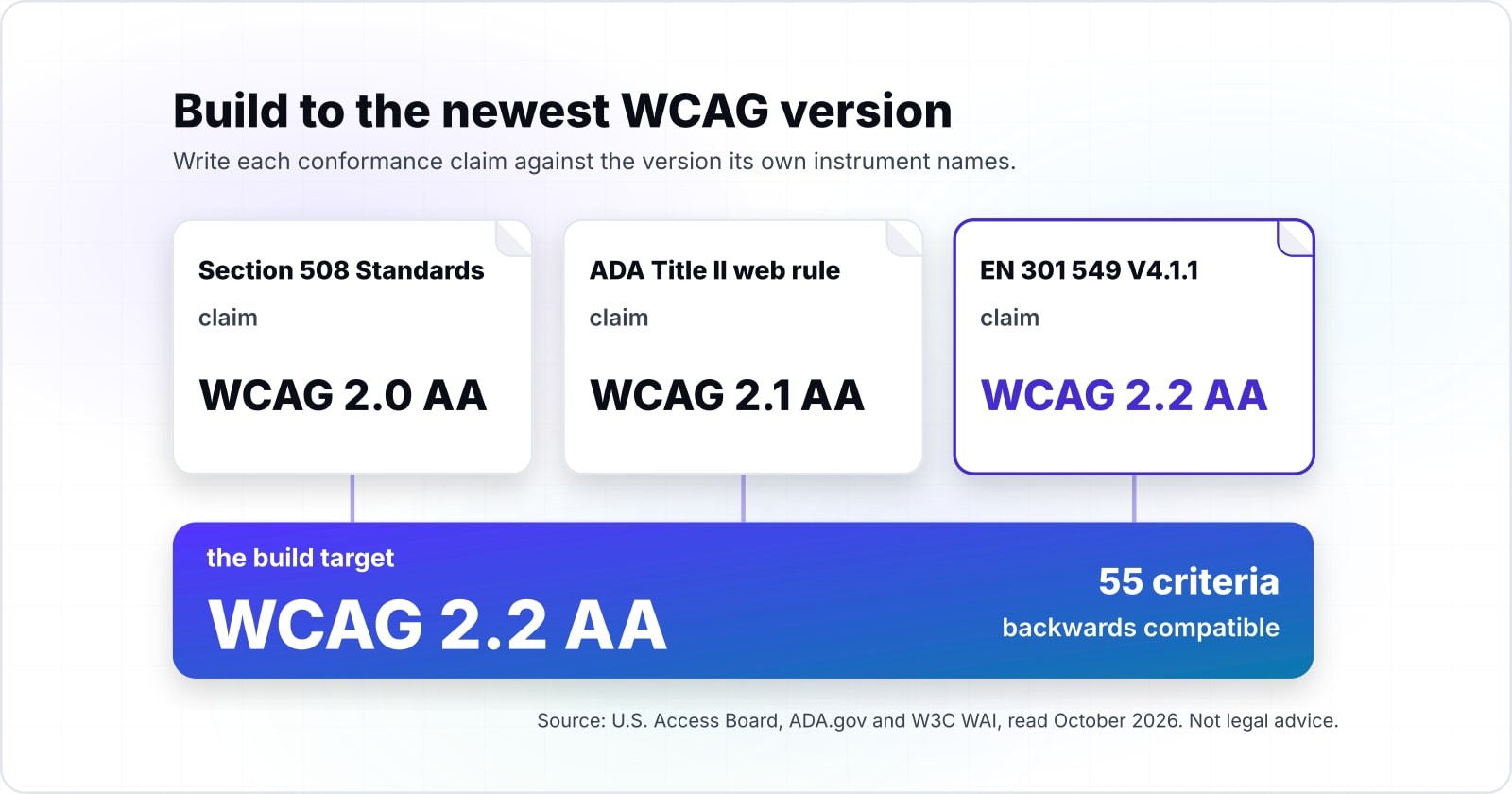
The instrument that applies to you names the version: the Section 508 Standards cite WCAG 2.0 Level AA, the ADA Title II web rule cites 2.1 AA, and EN 301 549 V4.1.1 cites 2.2 AA. An instrument here means a law, a rule, a standard or a contract clause. On its own, a guideline does not bind a team. Instead, it binds you only when an instrument that reaches you names it.
So a WCAG guidelines comparison is really a question about your instrument. For example, the U.S. Access Board's Revised 508 Standards text says "Electronic content shall conform to Level A and Level AA Success Criteria and Conformance Requirements in WCAG 2.0". By contrast, the US Department of Justice says on ADA.gov that state and local government "web content usually needs to meet WCAG 2.1, Level AA". In Europe, the W3C WAI (Web Accessibility Initiative) WCAG 2 Overview notes that "The 2026 version of EN 301 549 uses WCAG 2.2".
Three instruments, three versions, one level: that is the WCAG guidelines comparison that matters. Therefore, the first job is to find which instrument reaches you. The rest of the work follows from that.
| Instrument | Who issues it | WCAG version and level |
|---|---|---|
| Section 508 Standards | U.S. Access Board | WCAG 2.0 Level A and AA |
| ADA Title II web rule | US Department of Justice | WCAG 2.1 Level AA |
| EN 301 549 V4.1.1 | ETSI, CEN and CENELEC | WCAG 2.2 Level AA |
What is WCAG 2.0?#
WCAG 2.0 is the W3C Recommendation of 11 December 2008 that sets 61 testable success criteria under 12 guidelines and four principles: perceivable, operable, understandable and robust. A Recommendation is the Consortium's word for a finished, endorsed standard. A success criterion is one testable statement that content either meets or fails.
The WCAG 2.0 Recommendation of 11 December 2008 builds in layers. At the top sit the four principles. Under them sit the 12 guidelines, and the Consortium says plainly that "The guidelines are not testable". Instead, the testing happens one layer down. In the 2008 text, 25 criteria sit at Level A, 13 at AA and 23 at AAA, for 61 in all.
So when a contract asks for the "WCAG 2.0 standards", the "WCAG 2.0 guidelines" or the "WCAG 2.0 accessibility guidelines", it means this set of testable criteria. Its full title is Web Content Accessibility Guidelines 2.0. It does not mean a style guide or a checklist someone wrote later.
Then version 2.0 also became an international standard. ISO (the International Organization for Standardization) published it as ISO/IEC 40500:2012 in October 2012. However, ISO's catalogue page now lists ISO/IEC 40500:2012 as "Withdrawn", with a new version available: ISO/IEC 40500:2025. In the W3C's words, "ISO/IEC 40500:2025 is exactly the same as the October 2023 version of WCAG 2.2". As a result, the ISO route now points to 2.2, not 2.0.
The Consortium's overview page dates the three versions as follows.
- 5 May 1999
WCAG 1.0
Published as a W3C Recommendation, with checkpoints at Priority 1, 2 and 3.
- 11 December 2008
WCAG 2.0
61 testable success criteria under 12 guidelines and four principles.
- October 2012
ISO/IEC 40500:2012
WCAG 2.0 published as an international standard; ISO now lists it as withdrawn.
- 5 June 2018
WCAG 2.1
Adds 1 guideline and 17 success criteria.
- 18 May 2021
WCAG 1.0 superseded
The Consortium marks version 1.0 superseded.
- 5 October 2023
WCAG 2.2
Adds 9 more success criteria and removes 4.1.1 Parsing.
- 2025
ISO/IEC 40500:2025
Exactly the same as the October 2023 version of WCAG 2.2, in the W3C's words.
Source: W3C WAI guidelines overview page and ISO catalogue, accessed October 2026.
What does WCAG 2.0 compliance at Level AA mean?#
WCAG 2.0 Level AA compliance means a page meets all 38 Level A and Level AA success criteria and the five conformance requirements, judged on full pages and complete processes. Conformance is the Consortium's formal word for compliance. A conformance claim is a statement that a page meets it.
The WCAG conformance levels, often called WCAG compliance levels, stack. In the 2.0 Recommendation of 11 December 2008, Level A is "the minimum level of conformance". AA adds its own criteria on top of all of Level A. AAA adds more again. In addition, the Consortium advises against AAA as a site-wide rule, because "it is not possible to satisfy all Level AAA Success Criteria for some content".
Show data table
| Step | Change | Running total |
|---|---|---|
| Start | 0 criteria | 0 criteria |
| Level A | 25 criteria | 25 criteria |
| Level AA | 13 criteria | 38 criteria |
| Level AA claim | 38 criteria |
A WCAG 2.0 Level AA claim includes every Level A criterion, 38 in all.
The criteria are only the first of five conformance requirements in the 2.0 text. The other four are less well known:
- Full pages. A claim covers a whole page and "cannot be achieved if part of a Web page is excluded".
- Complete processes. Every step of a process must conform, such as each page from cart to checkout.
- Only accessibility-supported ways of using technologies. A feature counts only when assistive tools, such as screen readers, can work with it.
- Non-interference. A part that fails must not stop users reaching the other content on that web page.
A claim is optional, but once made it has a fixed shape. The 2.0 Recommendation of 11 December 2008 says "Conformance claims are not required". However, a claim you do make must carry its date, the guidelines title, version and URI, and the level met. Also, it must give a concise description of the pages it covers, such as a list of URIs. Even a conformance logo counts as a claim and needs the same parts.
In short, an automated scan that finds no errors is not a conformance claim. A scan tests some criteria on some pages. A claim, however, covers all 38 criteria, whole pages and whole journeys.
How does WCAG 1.0 differ from WCAG 2.0?#
WCAG 1.0 of 1999 graded checkpoints by priority under 14 guidelines written around HTML, while WCAG 2.0 grades technology-neutral, testable success criteria at Levels A, AA and AAA. The Consortium published version 1.0 on 5 May 1999. Its checkpoints carried Priority 1, 2 or 3.
Each priority said how badly a failed checkpoint would hurt. In the 1999 text, a developer "must satisfy" a Priority 1 checkpoint, "should satisfy" Priority 2 and "may address" Priority 3. The 1.0 levels were spelled out as "A", "Double-A" and "Triple-A", so a screen reader would speak them clearly. Version 2.0 kept the three-step ladder but moved it from checkpoints to criteria.
The Consortium's own comparison of the two sums up the change. In version 2.0, "each guideline has testable success" criteria, and those criteria are written to apply to any web technology. By contrast, most of the 1.0 examples were for HTML content. Version 2.0 moved the examples into separate techniques, which cover HTML, CSS, scripting, multimedia and WAI-ARIA.
In practice, version 1.0 binds almost nothing today. The Consortium marked it superseded on 18 May 2021. So the "WCAG 1.0 vs 2.0" question is mostly history. Its one lasting effect is structural, because every later version keeps the 2.0 shape of principles, guidelines and testable criteria.
| WCAG 1.0 | WCAG 2.0 | |
|---|---|---|
| Published | 5 May 1999 | 11 December 2008 |
| What is graded | Checkpoints | Testable success criteria |
| Scale | Priority 1, 2 and 3; levels A, Double-A, Triple-A | Levels A, AA and AAA |
| Structure | 14 guidelines | Four principles, 12 guidelines, 61 criteria |
| Technology | Most examples for HTML content | Any web technology; examples in separate techniques |
| Status | Superseded on 18 May 2021 | Cited by the Section 508 Standards |
What does a WCAG guidelines comparison show across 2.0, 2.1 and 2.2?#
Each version keeps the earlier criteria and adds more: WCAG 2.0 has 61 success criteria, WCAG 2.1 has 78, and WCAG 2.2 has 86 after retiring 4.1.1 Parsing. These totals come from counting the level markers in the three Recommendation texts.
The Consortium's overview page states the changes in one line each. First, version 2.1 adds 1 guideline and 17 success criteria. Then, version 2.2 adds 9 more. It published version 2.1 on 5 June 2018 and 2.2 on 5 October 2023.
The step to 2.1 is the one most teams forget. The Consortium's What's New page for 2.1 lists all 17, under one new guideline, 2.5 Input Modalities, for input beyond the keyboard. At AA, the seven new criteria start with 1.3.4 Orientation, 1.3.5 Identify Input Purpose, 1.4.10 Reflow and 1.4.11 Non-Text Contrast. Then come 1.4.12 Text Spacing, 1.4.13 Content on Hover or Focus and 4.1.3 Status Messages. Also, at Level A, the five are 2.1.4 Character Key Shortcuts, 2.5.1 Pointer Gestures, 2.5.2 Pointer Cancellation, 2.5.3 Label in Name and 2.5.4 Motion Actuation. Many of them deal with small screens, zoom and touch.
So the versions are not three standards. They are one growing set, and a WCAG guidelines comparison is a count of what each version adds at each level.
Show data table
| Dimension | WCAG 2.0 | WCAG 2.1 | WCAG 2.2 |
|---|---|---|---|
| Level A | 25 criteria | 30 criteria | 31 criteria |
| Level AA | 13 criteria | 20 criteria | 24 criteria |
| Level AAA | 23 criteria | 28 criteria | 31 criteria |
Level AA grows from 13 criteria in 2.0 to 20 in 2.1 and 24 in 2.2.
The AA column is the one that moves your effort. In those texts, it grows from 13 criteria in 2.0 to 20 in 2.1 and 24 in 2.2. Meanwhile, Level A grows more slowly, because 2.2 adds two at A and drops 4.1.1 Parsing.
What did WCAG 2.2 add, and what did it remove?#
WCAG 2.2 added nine success criteria, two at Level A, four at Level AA and three at Level AAA, and marked 4.1.1 Parsing obsolete and removed. The Consortium lists all nine on its What's New in 2.2 page.
Show data table
| Item | Value |
|---|---|
| Level A | 2 |
| Level AA | 4 |
| Level AAA | 3 |
Version 2.2 added four criteria at Level AA, more than at A or AAA.
The Consortium gives each of the nine a short aim, restated here:
| Criterion | Level | What it asks |
|---|---|---|
| 2.4.11 Focus Not Obscured (Minimum) | AA | a focused item stays at least partly visible |
| 2.4.12 Focus Not Obscured (Enhanced) | AAA | a focused item is fully visible |
| 2.4.13 Focus Appearance | AAA | the focus marker has enough size and contrast |
| 2.5.7 Dragging Movements | AA | any drag has a simple pointer option |
| 2.5.8 Target Size (Minimum) | AA | targets meet a minimum size or have space around them |
| 3.2.6 Consistent Help | A | help sits in the same place on each page |
| 3.3.7 Redundant Entry | A | no asking for the same data twice in one session |
| 3.3.8 Accessible Authentication (Minimum) | AA | no puzzle, recall or retyping to log in |
| 3.3.9 Accessible Authentication (Enhanced) | AAA | no recognising objects or images to log in |
Source: W3C WAI, What's New page for version 2.2, accessed October 2026.
In short, the pattern is clear. The new criteria target keyboard focus, touch and pointer use, and people with cognitive disabilities. For instance, the Consortium notes that some people "cannot solve puzzles, memorize a username and password, or retype one-time passcodes".
Version 2.2 also removed a criterion for the first time. In the 2.2 Recommendation, 4.1.1 Parsing reads "Obsolete and removed". The Consortium added notes to the 2.0 and 2.1 errata to match. So, for the WCAG 2.1 vs 2.2 question, the answer is nine added criteria and one removed.
Which laws and standards cite WCAG 2.0, 2.1 or 2.2 in 2026?#
As of October 2026, the Section 508 Standards cite WCAG 2.0, the ADA Title II web rule cites WCAG 2.1, and EN 301 549 V4.1.1 and ISO/IEC 40500:2025 carry WCAG 2.2. The U.S. Access Board writes the 508 Standards, and ETSI, CEN and CENELEC publish EN 301 549. As a result, each one sets a different criteria count.
Section 508 Standards (US federal technology). The U.S. Access Board issued the Revised 508 Standards on January 18, 2017. Its clause E205.4 binds federal electronic content to version 2.0 A and AA. So version 2.0 AA is still the legal floor for federal agencies and what they buy. That is where "WCAG 2.0 compliance" still matters most. The same clause excuses non-web documents, such as office files, from four criteria: 2.4.1 Bypass Blocks, 2.4.5 Multiple Ways, 3.2.3 Consistent Navigation and 3.2.4 Consistent Identification. Also, the Access Board's text leaves older technology alone if it met an earlier Section 508 standard and has not changed since January 18, 2018.
ADA Title II (US state and local government). The Department of Justice published its web rule on April 24, 2024, at version 2.1 AA. Then an interim final rule in the Federal Register of April 20, 2026 moved the dates. Under that 2026 rule, governments with 50,000 people or more must comply from April 26, 2027. Smaller governments and special district governments follow from April 26, 2028. The 2024 rule defines "total population" and "special district government" in 28 CFR 35.104, so each body can check which date is its own.
EN 301 549 V4.1.1 (Europe). ETSI, CEN and CENELEC, the European standards bodies, published EN 301 549 V4.1.1 standard in September 2026. Its clause 9 says version 2.2 AA conformance equals meeting clauses 9.1 to 9.4 and 9.6. In addition, the W3C notes that for the European Accessibility Act, "most organizations use WCAG and the European Standard EN 301 549". Under the European Accessibility Act, though, its own foreword sets a condition: "Once the present document is cited in the Official Journal of the European Union", compliance confers a presumption of conformity. Until that citation, V4.1.1 is the version to build to rather than the one the law presumes, as the European Accessibility Act enforcement guide explains.
ISO/IEC 40500. The 2025 edition is version 2.2, and the 2012 edition carrying 2.0 is withdrawn, per ISO's catalogue in October 2026.
Here is a worked example. Take one public website judged under each instrument, using the W3C criteria counts and the U.S. Access Board's 508 Standards. A federal agency site must meet version 2.0 Level A and AA, which is 38 criteria. Then, under the ADA Title II rule, a state site must meet 2.1 AA, which is 50. Finally, under EN 301 549 V4.1.1 from ETSI, CEN and CENELEC, the site builds to 2.2 AA, which is 55. So the same site faces 17 more criteria in Europe than at a US federal agency.
Show data table
| Item | Value |
|---|---|
| WCAG 2.0 | 38 |
| WCAG 2.1 | 50 |
| WCAG 2.2 | 55 |
A Level AA claim covers 38 criteria under 2.0, 50 under 2.1 and 55 under 2.2.
Build to WCAG 2.0 Level AA: 38 criteria
1 instrument applies. The newest version cited is WCAG 2.0, so a Level AA build covers 38 success criteria at Levels A and AA.
These are the instruments' own words, not legal advice, so confirm your own scope with counsel.
| Instrument | Cites | AA criteria | Status |
|---|---|---|---|
| Section 508 Standards | WCAG 2.0 AA | 38 | Applies |
| ADA Title II web rule | WCAG 2.1 AA | 50 | Not in scope |
| EN 301 549 V4.1.1 | WCAG 2.2 AA | 55 | Not in scope |
These are the instruments' own words, not legal advice, so confirm your own scope with counsel.
Which version should you build to when several instruments apply?#
Build to the newest WCAG version that any instrument in your scope cites, because later WCAG 2 versions keep every earlier criterion, so 2.2 Level AA work also covers 2.1 and 2.0. The Consortium's overview page says the versions are "backwards compatible", so content that conforms to 2.2 also conforms to 2.1 and 2.0.
In practice, the rule works in two steps. First, set the build target at the newest version any instrument cites. For a team selling to a US federal agency and into the EU, that is 2.2 AA, or 55 criteria by the Consortium's counts. Second, write each conformance claim against the version its own instrument names. For example, a claim under the U.S. Access Board's 508 Standards still names 2.0, even when the work met 2.2.
However, there is one wrinkle. Since 2.2 dropped 4.1.1 Parsing, a strict 2.0 claim once tested a criterion that 2.2 work skips. Still, the Consortium added notes to the 2.0 and 2.1 errata to address 4.1.1, so check your auditor reads them the same way.
As before, this is how the sources read, not legal advice. Your counsel decides which instruments reach you.
When is a WCAG version target not a fit for the job?#
A version target is not a fit when no instrument binds you yet or the job is design thresholds or a first audit, where the design and introduction guides help more. Three cases come up often.
First, if no law or contract names a version, the version question has no answer yet. In that case, start with the introduction to web accessibility, which covers why it matters before any rule does.
Second, if the job is design, a version count will not help a designer. Instead, the guide to accessible UI and UX design covers contrast, target size and focus as design choices.
Third, if the question is how much an audit costs, the criteria count is only an input. The website accessibility cost guide turns that count into audit scope.
| Case | Guide that helps instead |
|---|---|
| No law or contract names a version yet | Introduction to web accessibility |
| The job is design | Guide to accessible UI and UX design |
| The question is audit cost | Website accessibility cost guide |
Where do you go once the version is fixed?#
Once the version is fixed, the next questions are the design thresholds, the audit size and the European Accessibility Act scope, each answered in its own guide. The UI and UX design guide has the design thresholds. Then, for the cost of testing, see the accessibility cost guide. In Europe, the European Accessibility Act enforcement guide covers who is in scope. And if you want to know what happens when the floor is missed, read what an inaccessible website costs.
If you want a team to reach the level your instrument names, our accessibility compliance work covers it. If you need a claim tested against the right version, see accessibility testing. Still, the Recommendation texts linked above are enough to do the work yourself.