Custom ERP development for companies abroad: build, extend or buy
Spreadsheets and a strained system push most firms toward a new ERP. Whether you buy, extend or build depends on a few facts about how you cost, approve and staff your work.
Custom ERP development: should you build, extend or buy?#
Buy a packaged ERP when your processes match its standard, extend it when only a few workflows differ, and commission a custom build when costing, approvals, seat licences or data rules sit outside it. That is the whole decision. Next comes how to place your own company on it, one branch at a time.
First, the term itself. Gartner defines ERP as "the ability to deliver an integrated suite of business applications" that share one process and data model. So an ERP is not one screen. It is purchasing, stock, projects and finance agreeing on the same numbers.
Custom ERP software development means that suite is designed and built for one company, around the way that company already works. Buying means you adopt a product and change your process to fit it. Extending sits in between: you buy the product, then pay to add or change the parts that do not fit. Most build vs buy ERP advice stops at two options, so the third option deserves the same scrutiny.
Each branch is a fair answer for some firm. However, each one fails in a predictable way when it is chosen for the wrong firm. So it pays to take the branches in order, starting with the default that every other branch has to beat.
When does a packaged ERP fit your company?#
A packaged ERP fits when your costing, approvals and reporting already resemble the way the product works, so the project configures it rather than rewriting it. Configuration means setting options the vendor built in, such as approval limits, tax rules or a chart of accounts. Because the vendor maintains those options, they survive each new release.
That is the strongest case for buying. With a product, you inherit years of other companies' fixes, a support desk, and a market of consultants who already know the product. For example, a distributor that buys, stores and sells stock items is close to what most packaged products were shaped around.
Buying is not free of effort, though. One study looked at ERP adoption by Indian small and medium firms, published in Scientific Reports in October 2025. It found that the "Cost of implementation, training, and customization are significant." In practice, the licence is only the start of the bill. Training and process change cost real time on any branch.
A simple test helps. First, list the ten reports and approvals your managers use every week. Then ask a vendor to show each one in the product with settings alone, without new code. When eight or nine appear, buying is probably right, and the remaining gaps are small enough to live with.
Also check how you cost your work. A product that tracks cost per stock item will read your business well if you sell stock. However, it will strain if you price, budget and report by project.
Where does extending a packaged ERP get expensive?#
Extending a packaged ERP gets expensive at upgrade time, because every customisation has to be retested and often rebuilt each time the vendor ships a new release. A customisation here means code or scripts added to the product, beyond the settings the vendor supports.
Canada's business development bank, BDC, states the cost plainly in its guide to custom and off-the-shelf ERP, updated in August 2026. It notes that most ERP systems are upgraded once or twice a year. With a highly customised system, BDC says, "each upgrade will typically require the customizations to be redone." BDC adds that skipping the upgrade can cost you technical support.
So an extension is not a one-off build cost. Instead, it is a charge you pay again at every release, for as long as you run the product. The same BDC guide warns that heavy customisation also deepens your dependence on one vendor.
Research points the same way. A paper on self-adapting ERP systems was submitted to arXiv in January 2025. It calls customising an ERP "resource-intensive, time-consuming" work that "requires continuous adjustments as business demands evolve." That is the authors' framing of the problem their framework tries to solve, but the cost they describe is the familiar one.
But extending still wins in many cases. For example, if one approval form and two reports differ from the standard, extension is cheaper than a build. Meanwhile, if the gaps sit in costing, approvals and who logs in, every release reopens them. That is the point to look at the next branch.
Which operating facts push a company toward a bespoke ERP?#
Five facts push toward a bespoke build: per-project costing, deep approval chains, seat licences for occasional users, tools you must keep, and data you will not hand a vendor. Score your own company on each one before you talk to any vendor.
Cost tracked per project. Many products are built around the stock item: what it cost, where it sits, what it sold for. Instead, a contractor or a capital programme needs cost by project, by cost code and by stage. When that is the core of your reporting, it is a rewrite, not a setting.
Approval depth. A purchase in a capital programme may need a site lead, a project manager, a cost controller and a director, each with a limit. Packaged workflow tools handle a few levels well. However, past a certain depth the rules become custom code, and that code returns at every upgrade.
Occasional users. Site supervisors may only record a delivery or a stock issue. Yet on a per-seat licence, each of them is still a full seat.
Tools you keep. Often a firm will not give up a scheduling tool or a document system their staff trust. Therefore the ERP has to fit around those tools, not replace them.
Data comfort. Some companies are simply not comfortable putting their operating data inside a ready-made vendor's product, and that alone can rule a package out. For a firm in the European Union (EU), the European Commission's list of adequacy decisions, read in October 2026, sets which countries personal data can flow to without further safeguards. India is not on that list, so plan safeguards for any personal data a partner in India would see. This is general information, not legal advice.
Buy a packaged ERP
Your process already looks like the product, so buy it, configure it, and keep customisation small.
The two facts that decided it:
- No workflow differs from the standard, so a packaged product already encodes most of your work.
- Cost is tracked per stock item, which is close to what most packaged products were shaped around.
Answers pointing to a build: 0
When two or more of these facts apply, they usually tip the sum toward a build. One alone often does not. For instance, data comfort can be met by a package you host yourself, and one kept tool can be joined with a single integration.
How do seat licences for site staff change the sum?#
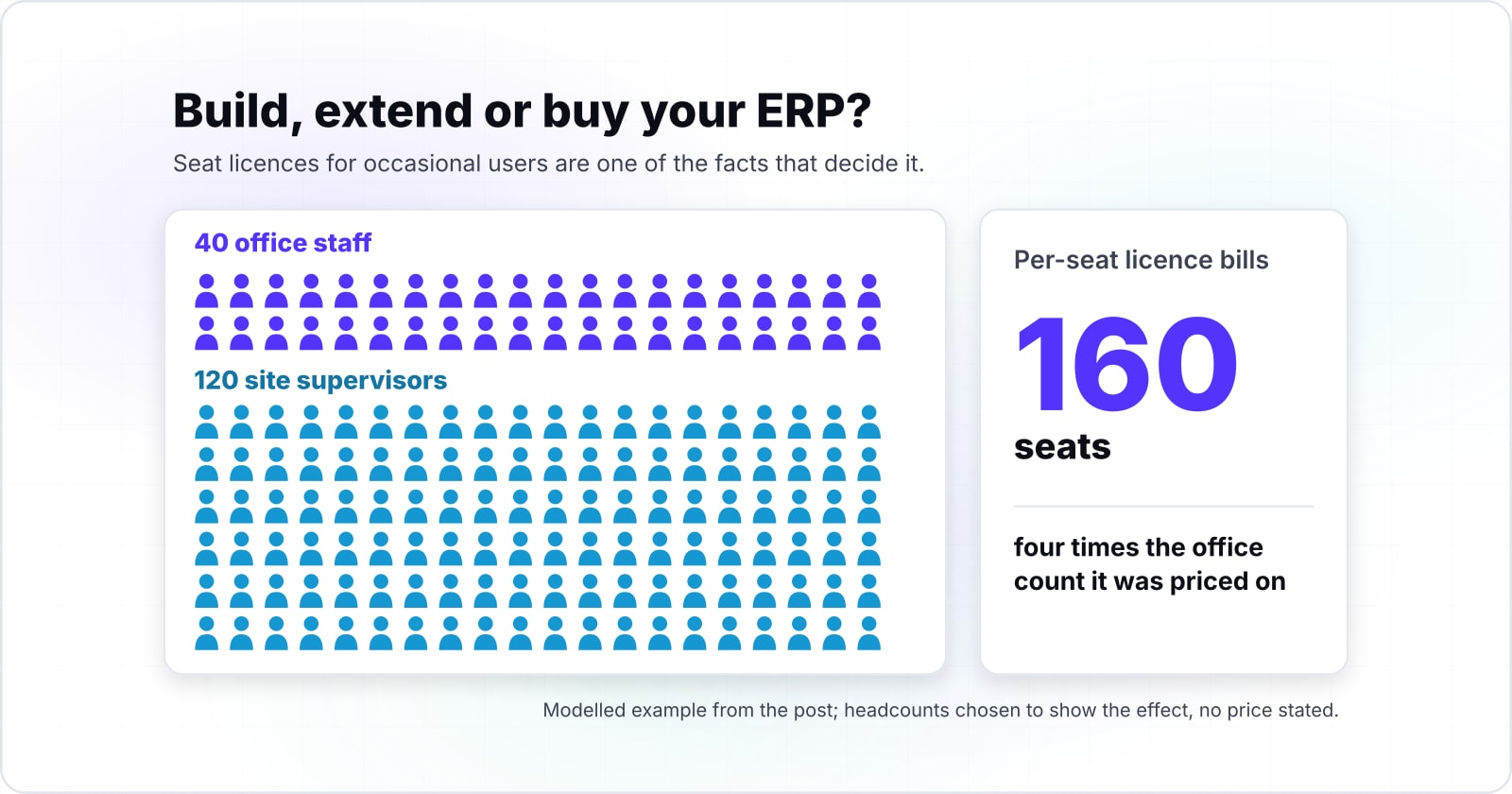
Per-user licences charge for every site supervisor who records a delivery, so a packaged ERP's running cost grows with site headcount in a way a bespoke build's does not. That one variable is easy to miss, because most firms price a package by counting office users.
AgileEngine, which builds custom ERP systems, argues in its custom ERP guide that "Subscription pricing scales with users and modules." RaftLabs, another custom builder, makes the same argument in its ERP cost guide. Since both sell builds, read their views as a vendor's claim and do the count yourself.
Here is a modelled example, with headcounts chosen to show the effect. Say a firm has 40 office staff, and 120 site supervisors who each log a few deliveries a week. On a per-seat licence, the package bills 160 seats, which is four times the office count it was priced on. Then, if the firm opens three more sites, the seat count rises again while office headcount stays flat.
Your paid seats on a per-seat licence
Enter your own office and site users who need ERP access. The defaults are the modelled example: 40 office staff and 120 site supervisors.
Total paid seats
160
- Multiple over the office count
- 4
Arithmetic from the modelled example in this section. Modelled, not measured.
Still, a bespoke system has running costs too. Hosting, support and changes all cost money, and the custom software cost guide covers what drives them. However, those costs do not rise each time you add a site supervisor. That difference matters most to firms with many occasional users and few heavy ones.
What did an outsourced custom ERP build actually cover?#
One construction and capital-expenditure business outside India chose a bespoke ERP covering project and cost control, procurement, and inventory with site materials, for the four reasons above. We built that system for them from India.
Their reasons were the ones named above. Cost had to be tracked per project rather than per stock item. Their capital expenditure (capex) approval workflow had more levels than a packaged workflow engine expressed without heavy customisation. Per-user licences for site staff made packaged options expensive at their scale. Finally, the system had to fit around tools they kept.
| Their operating fact | What a packaged ERP would have needed |
|---|---|
| Cost tracked per project rather than per stock item | A rewrite, not a setting |
| A capex approval workflow with more levels | Heavy customisation of the packaged workflow engine |
| Per-user licences for site staff | A full seat for every site user |
| Tools they kept | A system that fits around those tools, not one that replaces them |
The scope covered three modules. The first was project and cost control, so cost was tracked per project. Next came procurement, which carried purchases through the deeper capex approval chain. Then came inventory with site materials, for the stock held on each site.
The hard parts were not the screens. First, data migration out of the old tools. Second, finding the real approval and costing rules, which often differ from the written policy. Third, adoption by site staff. Then integration with the tools they kept.
Those four hard parts are worth planning for on any build. In particular, the real rules are hard to find, because people describe the policy and follow the exceptions. If you go on to brief a partner, the enterprise software development guide walks through the build steps after this choice.
How was the data migration staged on that build?#
On that build, master data such as items, vendors and cost codes was cleaned first, then moved in stages, with totals checked against the old records before cutover. Master data is the reference list every transaction points at. Cutover is the day the old system stops taking new entries.
Cleaning came first because every later record depends on it. A duplicate vendor or a retired cost code breaks the totals of every order that uses it. As a result, the stages moved on a clean base, and totals were checked against the old records before cutover. That is what happened on that one build; another company's data may call for a different plan.
And migration plans slip even at the largest scale. The United States Government Accountability Office (GAO) reviewed the Navy's move to one ERP in report GAO-26-107119, dated April 2026. In that report, GAO "identified at least 111 changes to Navy consolidation plans," including at least 49 system schedule delays.
Show data table
| Item | Value |
|---|---|
| Changes to the consolidation plans (at least) | 111 changes |
| System schedule delays among them (at least) | 49 changes |
Even at the Navy's scale, GAO counted at least 111 changes to the consolidation plans, including at least 49 system schedule delays.
Your migration will be far smaller than the Navy's. However, the lesson travels: plan the migration as its own stream of work, with its own checks, rather than a weekend copy at the end.
When is a bespoke ERP the wrong fit?#
A bespoke ERP is the wrong fit when a product on the market already matches your process, and then the honest scope says buy that product instead. Here are the three cases where we would point you elsewhere.
First, your process is standard. If you buy, hold and sell stock items, a packaged product already encodes most of your work. So buy it, configure it, and keep customisation small, as BDC advises.
Second, the gap is narrow. If one approval form or one report differs, extend the product or add a small custom tool beside it. A custom software build of one module next to a package you keep is a smaller thing to own than a full ERP.
Third, the system would have no owner inside your company. After launch, a bespoke ERP needs a person who decides what changes and when. Without that owner, a product with a vendor roadmap is the safer choice.
| Case | The better route |
|---|---|
| Your process is standard | Buy it, configure it, and keep customisation small |
| The gap is narrow | Extend the product or add a small custom tool beside it |
| The system would have no owner inside your company | A product with a vendor roadmap |
So a scope should be allowed to end with "buy". For the wider build versus buy arithmetic beyond ERP, the guide to custom versus off-the-shelf software goes further. When we scope an ERP, the answer can be a product on the market rather than a build from us.
How do you choose a custom ERP development company in India?#
Choose a custom ERP development company in India by asking for a scope that is allowed to end in buy, then brief every candidate with the same written RFP. A request for proposal (RFP) is the written brief every candidate answers, so their replies compare like for like.
The stakes justify that care. Gartner's ERP page, read in October 2026, says more than 70% of recently implemented ERP initiatives will fail to fully meet their original business case goals by 2027. The same page cites a survey finding that 75% of ERP strategies are not strongly aligned with business strategy.
Show data table
| Item | Value |
|---|---|
| Recent ERP initiatives that will not fully meet business case goals by 2027 (more than) | 70% |
| ERP strategies not strongly aligned with business strategy (survey Gartner cites) | 75% |
More than 70% of recent ERP initiatives are expected to miss their business case goals, so the first deliverable should be a scope.
Therefore the first thing to buy is a scope, not a build. Then ask each candidate how they would find your real approval and costing rules. Ask how they would stage the migration and check totals. Also ask when they would tell you to buy a product instead, and listen for a real answer.
The briefing work itself has its own guide. Our software development RFP template covers what to put in the brief and how to score replies. If you are still weighing where the team should sit, the nearshore, offshore and in-house comparison covers that choice.
Where should you go from here?#
If the fit check pointed to a build, the next step is a scope; if it pointed to buy or extend, the sibling guides below go further. Each branch has its own next page.
If you need a build, our ERP development team starts from your costing, approvals and data. We come back with a scope, or we tell you that a product on the market already fits and you buy that instead.
For buy or extend, start with the custom versus off-the-shelf guide. If your ERP must hand work to a warehouse or transport system, the supply chain management software guide covers those hand-offs.
Either way, the five facts above are enough to start. So score your company on them first, and the right branch is usually plain before any vendor calls.