How much does custom software development cost, and what will you really spend?
A price range cannot go into a plan when you are budgeting a first custom build. Here is how to turn one into a single figure for your own system, with every input traced to its source.
How much does custom software development cost?#
Most custom software projects cost between $30,000 and $100,000: 65.7% of respondents to the 2026 GoodFirms survey placed their typical project in that band.
So about one project in five sits above that band, and about one in seven sits below it.
Show data table
| Item | Value |
|---|---|
| Under $30,000 | 14.1% |
| $30,000 to $100,000 | 65.7% |
| $100,000 to $200,000 | 14.1% |
| $200,000 and above | 6.3% |
Two in three surveyed firms place their typical project between $30,000 and $100,000.
But a second source lands higher, and the gap is useful. Clutch collects verified client reviews. Its October 2026 pricing guide says "the average cost of a software development project is $132,480.29". However, an average sits above the typical case, because a few very large projects pull it up. The same pattern shows up again in the overrun data further down.
What moves a project from one band to the next? The GoodFirms survey names project complexity, the tech stack and AI features, scope creep, team makeup, security needs, time-to-market pressure, ongoing maintenance and location. In short, each of those changes either the hours or the hourly rate. That is where the next section starts.
So the honest answer has two parts. First, a typical build costs tens of thousands of dollars. Second, the build is only part of the bill. For a founder or CTO planning a first build, that second part decides whether the plan holds. The rest of this guide adds the parts most quotes leave out.
Where does the money in a custom software budget go?#
Nearly all of a custom software budget is paid time, hours times a rate, and 56.3% of firms in the 2026 GoodFirms survey bill $20 to $50 an hour.
However, that figure hides a wide spread at both ends, from small shops to firms that bill several times as much. The 2026 GoodFirms survey says firms in that band are concentrated in Eastern Europe, Latin America and Southeast Asia, where labour costs less.
Show data table
| Segment | Value (%) | Share |
|---|---|---|
| Under $20 an hour | 12.5 | 12.5% |
| $20 to $50 an hour | 56.3 | 56.3% |
| $50 to $100 an hour | 12.5 | 12.5% |
| $100 an hour and above | 18.7 | 18.7% |
More than half of surveyed firms bill $20 to $50 an hour.
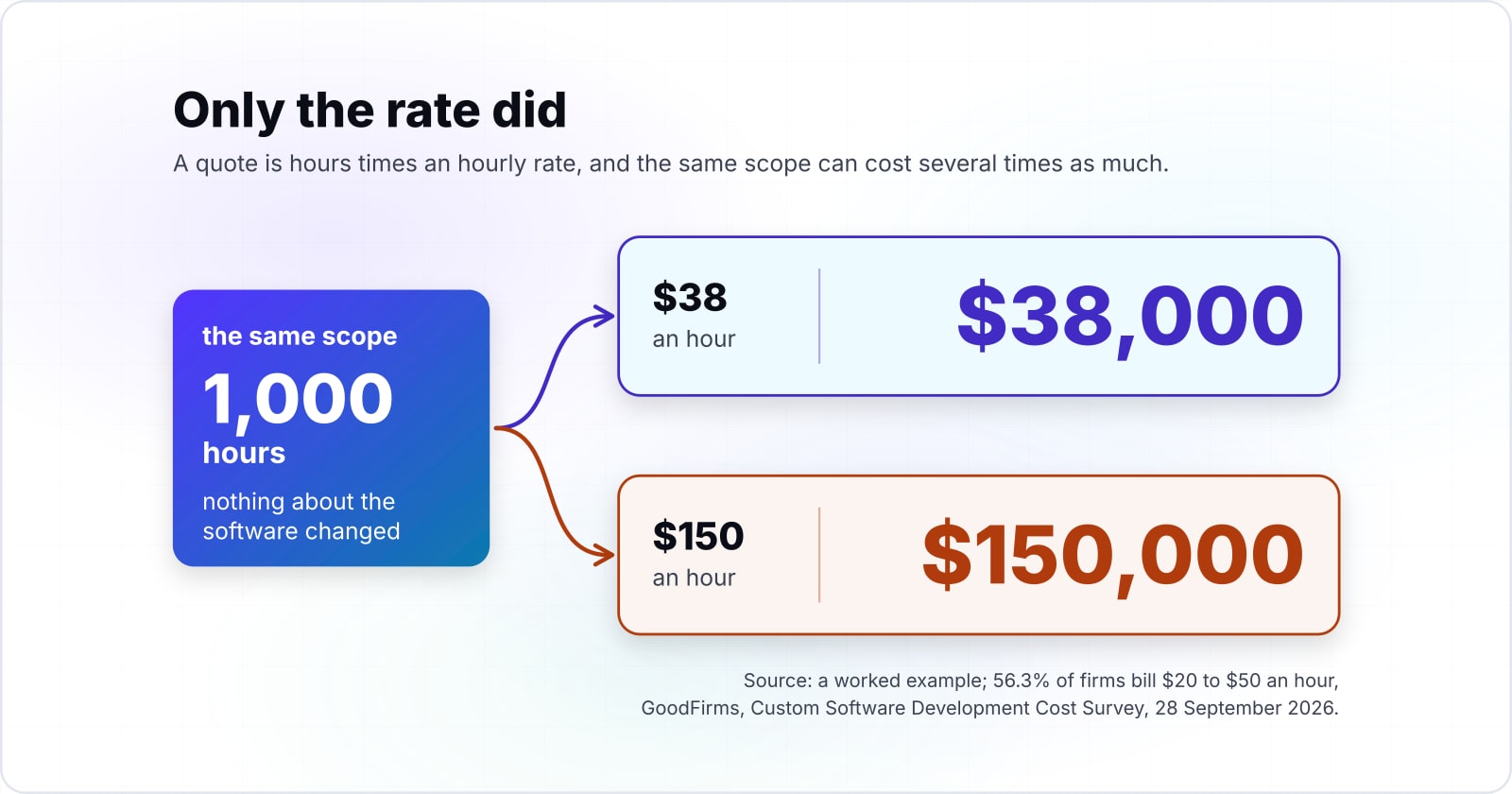
Because the quote is a multiplication, the rate alone can change the price several times over for the same scope. For example, say a scope needs 1,000 hours at $38 an hour, which comes to $38,000. Say the rate is $150 an hour instead, and the same scope costs $150,000. Yet nothing about the software changed between those two numbers. Only the rate did.
Clutch's October 2026 pricing guide adds a check on the time side. It says the usual timeline for a project "based on verified project reviews is about 13 months", at an average cost of $10,209.39 a month. Clutch also reports that firms "tend to charge a similar hourly rate no matter what technology they use". In practice, then, the language or framework rarely moves the rate. Instead, the rate follows where the team sits and how senior it is.
In particular, how the hours are billed matters less than how many there are. In the 2026 GoodFirms survey, 81.3% of firms bill on time and material, and 68.8% tie payments to milestones. So even a milestone contract is usually an hourly estimate underneath, split into stages.
If where the team sits is the big lever, it deserves its own comparison. The guide to nearshore, offshore and in-house teams works through that trade in detail.
What does the labour underneath the estimate cost?#
According to the Bureau of Labor Statistics, the median annual wage for software developers was $135,980 in May 2025, which sets the floor under any US estimate.
And the spread is wide here too. The BLS Occupational Outlook Handbook puts the lowest 10 percent below $82,460 in May 2025, and the highest 10 percent above $214,670. The handbook puts the median for software quality assurance analysts and testers at $104,300 in May 2025. It also projects jobs in these roles to grow 10 percent from 2025 to 2035. So the floor is not likely to fall.
$82,460
Lowest 10 percent earned less than
$135,980
Median
$214,670
Highest 10 percent earned more than
Half of US software developers earned more than $135,980 in May 2025.
| Option | US dollars a year, May 2025 |
|---|---|
| Lowest 10 percent earned less than | $82,460 |
| Median | $135,980 |
| Highest 10 percent earned more than | $214,670 |
Because pay is the biggest input, this number is a floor you can test any plan against. Say you want three developers for a year, an illustrative team. For example, at the BLS median salary for May 2025, that team costs about $408,000 in pay alone. That is before testing, design, project management or office costs. So if an in-house plan for a large system comes in far below that, something is missing from it.
The same floor also helps with outside quotes, such as the bids a software development RFP template with a completed example collects. When a quote implies a US team at a rate the median salary cannot support, ask why. Either the team sits somewhere else, or the hours are fewer than the scope needs. Neither is wrong on its own, but both are worth knowing before you sign.
How often does a software budget turn out wrong?#
In a 2022 Journal of Management Information Systems study of 4,677 IT projects, 40.0% cost more than their estimate and 10.6% cost more than double it.
The 2022 study is by Flyvbjerg and colleagues in the Journal of Management Information Systems. It gathered 5,392 IT projects completed between 2002 and 2014, with both the estimate and the actual cost for 4,677 of them. Of those, 1,870 cost more than estimated and 495 cost more than twice the estimate, in Flyvbjerg's 2022 data.
Show data table
| Item | Value |
|---|---|
| Came in at or under the estimate | 60% |
| Cost more than the estimate | 40% |
| Cost more than double the estimate | 10.6% |
Four in ten IT projects cost more than estimated; about one in ten cost more than double.
The surprise in the study is the shape, not the average. The authors write that "overruns and underruns are about equally frequent", so a typical project is not doomed. But the overruns have a fat tail, with many small misses and a few very large ones. And that tail is why an average overrun figure can mislead you.
The same 2022 study adds that estimates typically include "little contingency (up to 15%)". However, that is a thin cushion next to a tail of projects that cost more than double.
Then scope adds a second, separate risk. In the 2026 GoodFirms survey, 65.6% of respondents said "scope creep typically increased project cost by 10-25%". So a budget needs two named allowances: one for scope that grows, and one for the estimate being wrong.
How large should each allowance be? There is no single right number, because it depends on how settled your scope is. Still, a scope allowance below the 10% to 25% range in the 2026 GoodFirms survey assumes your project will behave better than most. Write the percentage down, and say why you chose it.
What does the software cost after it launches?#
The 2026 GoodFirms survey puts yearly upkeep at 10% to 20% of the build, so a $100,000 build reaches $150,000 to $200,000 by year five.
The GoodFirms survey is dated 28 September 2026. It says companies spend an average of 10 to 20% a year on post-launch maintenance, bug fixes and updates.
For example, take a $100,000 build, the top of the most common GoodFirms band. At the 2026 GoodFirms low end of 10% a year, the system has cost $150,000 by year five. At the survey's high end of 20% a year, it has cost $200,000, double the build.
Show data table
| Dimension | maintenance at 10% a year | maintenance at 20% a year |
|---|---|---|
| Launch | 100,000 | 100,000 |
| Year 1 | 110,000 | 120,000 |
| Year 2 | 120,000 | 140,000 |
| Year 3 | 130,000 | 160,000 |
| Year 4 | 140,000 | 180,000 |
| Year 5 | 150,000 | 200,000 |
Five years of upkeep adds half to all of the build cost.
The research literature points the same way, only more strongly. A 2013 review in Acta Informatica Medica estimates that "about 90% of software life cost is related to its maintenance phase". That share covers a system's whole working life, which often runs far past the five-year window above. So the five-year figure is a floor, not a ceiling.
Meanwhile, skipped upkeep costs money too, just later. The Consortium for Information and Software Quality (CISQ) put accumulated US technical debt at about $1.52 trillion in its 2022 report. Technical debt is the backlog of shortcuts that make every later change slower. When maintenance is cut to save money, that debt is usually where the money goes.
So the figure for a plan is the build plus at least five years of upkeep. The maintenance and support side of a system is not an extra, because over its life it is most of the cost.
How do you build a custom software estimate you can defend?#
Build the figure in five steps: scope, hours, an hourly rate band, a stated contingency, and annual maintenance, then report the five-year total rather than the build quote.
- Scope. List what the system must do at launch and what can wait. A short, fixed list is cheaper to estimate than a long, open one.
- Hours. Ask for an hours estimate per feature, not one lump sum. The custom software development timeline explains where those hours go, phase by phase.
- Rate band. Pick the 2026 GoodFirms rate band that matches where the team sits, and multiply it by the hours.
- Contingency. Add a stated allowance for scope growth, using the 2026 GoodFirms range of 10% to 25% as a guide.
- Maintenance. Add 10% to 20% of the build for each year you run the system, the 2026 GoodFirms range.
Here is the worked example, with every input traced. It starts from a $100,000 build, the top of the band where 65.7% of 2026 GoodFirms respondents place their typical project. It also uses the 2026 GoodFirms ranges of 10% to 25% for scope growth and 10% to 20% a year for upkeep.
In this worked example, the scope allowance puts the build at $110,000 to $125,000 before upkeep. In the example, five years of upkeep then adds $50,000 to $100,000, measured on the original build. As a result, the five-year figure in the example runs from $160,000 to $225,000. That sits above the $150,000 to $200,000 for a build that lands on its estimate, because the scope allowance is spent first.
Your five-year figure
Set the build estimate, the yearly upkeep rate and the scope allowance; it adds them into one five-year total.
Five-year total
$185,000
- Build
- $100,000
- Scope allowance
- $10,000
- Five years of maintenance
- $75,000
A model of the worked example above, not a measurement.
Finally, keep the overrun odds beside that range, not inside it. In the 2022 Flyvbjerg sample, 10.6% of projects cost more than double the estimate. So a plan that cannot survive a much larger build should be cut in scope, not padded. Then every input has a source, and anyone who doubts the total can work it out again. That is what makes the number defensible in a budget meeting.
If your scope is still too loose to list, the estimate will be loose too. A short product discovery phase exists to fix exactly that, before any build hours are counted.
When is custom software the wrong fit for the budget?#
Custom software is the wrong fit when a prepackaged product already does the job, because the five-year figure above then buys nothing a licence would not.
The U.S. Bureau of Economic Analysis counts three types of software as business investment: prepackaged software, custom software and own-account software. That split is a useful way to frame the choice, because each type solves a different problem. As a result, the cheapest is simply the one that fits the job.
First, if the workflow is common, such as payroll, email or basic accounting, buy the product. A licence shared by many firms will almost always beat a custom build of the same thing over five years. Second, if a platform gets you most of the way with settings and add-ons, configure it and build only the missing piece. Third, if the need is short-lived, such as a pilot, a lighter tool usually costs less than any build.
Custom software earns its cost when the workflow itself is what sets you apart, or when no product fits without heavy workarounds. The comparison of custom and off-the-shelf software works through that choice with the five-year view in mind. Then use your own five-year figure as one side of it.
Where should the estimate go next?#
With a five-year figure in hand, the next questions are how long the build takes, which firm should do it, and whether to buy instead.
| Next question | Where it is covered |
|---|---|
| How long will the build take? | The timeline guide turns hours into months. |
| Which firm should do it? | The guide on how to choose a custom software development company covers how to judge the firm that will spend the budget. |
| Should you buy instead? | The comparison of custom and off-the-shelf software works through that choice with the five-year view in mind. |
Fortunately, each of those has its own guide. The timeline guide turns hours into months. The guide on how to choose a custom software development company covers how to judge the firm that will spend the budget. And if the basics are still fuzzy, what custom software development is explains what the money buys and what you own at the end.
When you are ready to have a scoped system built, the custom software development page describes how that work runs. But none of it is needed to use the method above. The sources are public, the arithmetic is short, and a careful estimate built from them stands on its own.