Nearshore vs offshore vs in-house: which delivery model fits which work, by four numbers you can check
Most comparisons of the three models stop at adjectives. Two time zones, one federal wage table, a hiring benchmark and a quits survey are enough to test the choice for your own team before any rate card arrives.
Nearshore vs offshore vs in-house: which model fits which work?#
Pick in-house for core work that needs daily judgment, nearshore for collaborative work that needs live hours, and offshore for well-specified work that can wait a day for answers. In-house means your own employees. Nearshore means a vendor team a few time zones away, and offshore means one much further. Looi and Szepan studied 80 outsourcing customers in a paper posted to arXiv in February 2026. They draw the line at five hours: "nearshore locations are within five hours" of the customer.
The table below shows why that line matters. In practice, the hours a team shares with yours decide what work it can do well. So the rule above follows from the clock.
| Partner city | With a New York team | With a London team |
|---|---|---|
| Mexico City | 7 hours | 2 hours |
| Warsaw | 2 hours | 7 hours |
| Bucharest | 1 hour | 6 hours |
| Bengaluru | none | 2.5 hours |
As a result, the same Warsaw team is nearshore for a London team and offshore for a New York team. The label belongs to the pair of cities, not to the vendor.
How do you compare nearshore and offshore development companies?#
Compare nearshore and offshore development companies on shared hours, the attrition they report, how they hand work back, and who owns the code, before comparing any rate. A useful nearshore vs offshore development companies comparison puts the same four questions to every company:
Each answer is checkable, and the yardsticks follow for the first three. For example, the Looi and Szepan survey found nearshore projects did better on overall success, quality and schedule. They also had fewer communication problems. Meanwhile, a 2021 review of backsourcing, which means bringing outsourced work back in-house, looked at what makes leaving hard. Molléri, Lassenius and Jørgensen posted it to arXiv, and exit terms run through its cases. So a company that answers all four questions in writing is easier to judge than any case study.
How many working hours does a nearshore or offshore team share with yours?#
By standard UTC offsets (Wikipedia, October 2026), Mexico City sits 1 hour from New York and Bengaluru 10.5 hours, leaving 7 shared working hours and none. The rule is simple: every hour between two offices removes one hour from a shared 9-to-5 day. So nearshore development with time zone overlap is something you can compute. Take two offsets from the list of UTC offsets and subtract.
Show data table
| Item | Value |
|---|---|
| Mexico City | 1 h |
| Sao Paulo | 2 h |
| Warsaw | 6 h |
| Bucharest | 7 h |
| Bengaluru | 10.5 h |
| Manila | 13 h |
Mexico City and Sao Paulo sit within 2 hours of New York, while Bengaluru and Manila sit 10.5 and 13 hours away.
The same sum answers the nearshore vs onshore time zone benefits question. On the Wikipedia list, accessed 7 October 2026, Los Angeles sits at UTC minus 8. So it is 3 hours from New York and shares 5 hours of a 9-to-5 day. As a result, a team in Mexico City shares more of a New York day than a team in California does.
Your shared hours and in-house cost
Enter two UTC offsets and a working day to see the hours you share, and a salary to see its yearly cost with benefits.
Shared working hours a day
7
- Hours apart on the clock
- 1
- Salary plus benefits per year
- $198,511
Defaults: New York and Mexico City from Wikipedia's List of UTC offsets, accessed 7 October 2026; BLS May 2025 median wage and June 2026 wage share. Modelled, not measured.
Two limits apply. First, the figures use standard time, and summer clock changes move some pairs by an hour. Second, a team can shift its day to buy overlap. But a shift that runs for years tends to wear people out.
Why is salary only part of what an in-house developer costs?#
Benefits made up 31.5 percent of what US private employers spent per hour on full-time workers in June 2026, per the Bureau of Labor Statistics, September 2026. The U.S. Bureau of Labor Statistics Employer Costs for Employee Compensation release of 9 September 2026 puts wages at $36.97 an hour. It adds that "benefit costs averaged $17.03 and accounted for the remaining 31.5 percent."
Show data table
| Segment | Value (%) | Share |
|---|---|---|
| Wages and salaries | 68.5 | 68.5% |
| Benefits | 31.5 | 31.5% |
Benefits take nearly a third of what an employer spends on a full-time worker.
In short, the salary is about two thirds of the bill, and benefits carry the other third. Any in-house vs offshore software development comparison that sets a vendor rate beside a salary misses that third. Also, the share covers all full-time private workers, not developers alone. So treat it as a guide to the gap, not an exact figure.
What yearly figure should a vendor quote be compared with?#
At the Bureau of Labor Statistics median software developer wage of $135,980 for May 2025, the 31.5 percent benefit share lifts the yearly cost to about $198,511. The sum is the BLS median wage divided by the 68.5 percent wage share. That share comes from the June 2026 release of the U.S. Bureau of Labor Statistics. Then the result is what an employer pays for one median developer, before office space, laptops, tools and management time.
Show data table
| Item | Value |
|---|---|
| Median salary | 135,980$ |
| Salary plus benefits | 198,511$ |
Salary plus benefits comes to about $198,511, well above the $135,980 median salary.
So for offshore staffing vs in-house, set a yearly vendor quote beside the 2025 BLS-based $198,511, not beside the $135,980 salary. Also, check what the quote includes. If it covers equipment, cover for leave and a lead's time, it is closer to the full in-house cost than the salary alone.
How long does an in-house hire take before work starts?#
Ashby's 2026 hiring data puts the median time from application to hire at 34 days in the Americas and 35 in Europe, before any notice period. And that is only the time to a signed offer. In its EMEA recruiter report, Ashby adds that in Europe "the common notice period for existing roles is often between one and three months."
34 days
Americas
35 days
Europe, Middle East and Africa
Both regions sit at about the same median, before any notice period is served.
Show data table
| Option | median days from application to hire, past year, all roles |
|---|---|
| Americas | 34 days |
| Europe, Middle East and Africa | 35 days |
Technical roles take longer still. Ashby's 2026 recruiting operations benchmarks say "Technical roles require more time to fill (~15 days) than business roles."
As an illustrative sum, say 35 days plus 15 for a technical role plus a three-month notice: that comes to about 140 days. Meanwhile, a vendor with people already employed can often start sooner. So ask each one to name its start date in writing.
How high is attrition at large offshore IT services firms?#
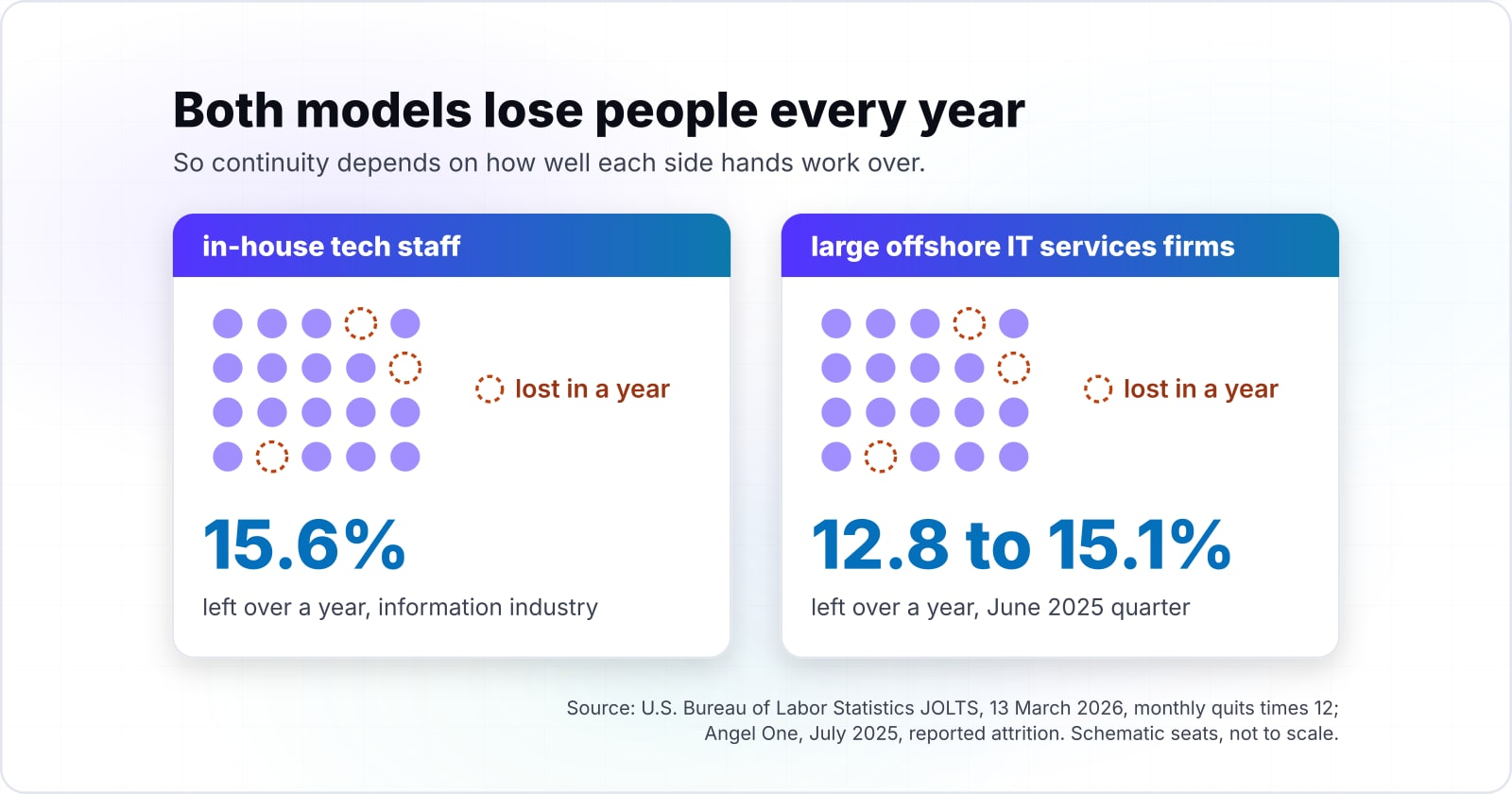
Large Indian IT services firms reported attrition between 12.8 and 15.1 percent in the June 2025 quarter, per Angel One, July 2025. Attrition here means the share of staff who left over a year. In Angel One's July 2025 round-up, HCL Tech held at 12.8 percent. Tata Consultancy Services (TCS) rose to 13.8, Infosys to 14.4 and Wipro to 15.1.
Show data table
| Item | Value |
|---|---|
| HCL Tech | 12.8% |
| TCS | 13.8% |
| Infosys | 14.4% |
| Wipro | 15.1% |
All four firms reported attrition inside a narrow band of 12.8 to 15.1 percent.
The newest filings sit in the same band. Outlook Business reported in July 2026 that TCS voluntary attrition was 13.6% for the year to June 2026.
Also, HR Katha reported in July 2026 that Infosys attrition rose to 13 percent on an annualised basis. However, the firms count attrition in slightly different ways. So read each figure with its basis.
How often do in-house tech staff quit?#
In the US information industry, the monthly quits rate fell from 1.8 percent in 2021 to 1.3 percent in 2025, per BLS JOLTS, March 2026. JOLTS, the Job Openings and Labor Turnover Survey, counts people who leave a job by choice each month. Since BLS publishes it by industry rather than by job, the information industry is the nearest public stand-in for in-house tech staff.
Show data table
| Dimension | Information | Professional and business services |
|---|---|---|
| 2021 | 1.8% | 3.4% |
| 2022 | 1.7% | 3.3% |
| 2023 | 1.4% | 2.6% |
| 2024 | 1.5% | 2.4% |
| 2025 | 1.3% | 2.3% |
Both industries saw fewer quits in 2025 than in 2021, and the information industry stayed lower every year.
In short, quits have fallen since 2021 but have not reached zero. The JOLTS table of the U.S. Bureau of Labor Statistics, published 13 March 2026, puts professional and business services at 2.3 percent a month in 2025. That group includes many service firms.
Is offshore attrition worse than in-house turnover?#
Times 12, the 1.3 percent monthly quits rate from BLS JOLTS, March 2026, is about 15.6 percent a year, close to the 12.8 to 15.1 percent vendors report. On the same JOLTS data, the same sum puts professional and business services at about 27.6 percent a year.
15.6%
Information
27.6%
Professional and business services
The information industry's yearly figure sits close to the 12.8 to 15.1 percent that large offshore firms report.
Arithmetic from the 2025 monthly average times 12. Modelled, not measured.
Show data table
| Option | percent of employment quitting in a year, 2025, as the monthly average times 12 |
|---|---|
| Information | 15.6% |
| Professional and business services | 27.6% |
Source: U.S. Bureau of Labor Statistics JOLTS, 13 March 2026
The sum is rough, because the same person can quit twice in a year. Also, quits leave out layoffs. Still, the two figures sit close enough to change the question. Both models lose people every year, so continuity depends on how well each side hands work over. That is why the handover matters more than the label.
How do you manage knowledge transfer when switching from an offshore team?#
Run the switch as a project with an owner, a written transfer plan and an overlap period, because the outgoing vendor's help decides how much knowledge survives. The backsourcing review by Molléri, Lassenius and Jørgensen (arXiv, April 2021) covers 26 cases in 17 papers. It is the closest published guide to knowledge transfer when switching from an offshore team to a new vendor or in-house team. Its cases suggest this order:
- Secure what you own. Before you give notice, put the code, repositories, cloud accounts and credentials in your own name.
- Contract the transfer early. The 2021 review advises a new contract with the vendor "as soon as possible to ensure commitment." In one case, missing exit terms cost two months of talks.
- Write a transfer plan. In one case "a plan was drawn up to guide the efforts required for knowledge transfer." Another planned the transfer in steps.
- Overlap the teams. Two cases delayed the end of the contract until the new team was ready, which kept operations running.
- Move both kinds of knowledge. Code, data and documents move by handover. The experience in people's heads moves only by working side by side.
Help from the old vendor matters most. For example, two cases in the 2021 review reported problems when the vendor did not assist with knowledge transfer. For an Eastern Europe team, the clock adds a limit, since Warsaw shares only 2 hours of a New York day in standard time (Wikipedia offsets, October 2026). So book the paired sessions into those hours early. Or move some of them to a London-based lead, who shares 7.
When is nearshore or offshore the wrong fit?#
Keep work in-house when it is the product's core, changes daily, or depends on knowledge nobody has written down, whatever the overlap hours say. Three cases, each with a better route:
For a single small task, none of the three is right. Instead, a freelancer may fit better, as the dedicated developer vs freelancer guide sets out.
Where do you go once the model is chosen?#
Once the model is chosen, the next decisions are the engagement shape, the vendor and the budget, and each has its own guide. The shape comes first: dedicated team vs staff augmentation explains who directs the work day to day. Then how to choose a custom software development company covers vetting. After that, what custom software development costs covers the budget beyond staffing. And for a split team, cross-functional team communication covers the habits that make the overlap count.
If you settle on a vendor model, the dedicated team and staff augmentation pages describe how those two shapes run. Still, the four numbers here are enough on their own. Two offsets, a wage table, a hiring benchmark and a quits rate will test any proposal you receive.