Dedicated team vs staff augmentation: which one a US company should buy
Adding outside software engineers looks like a headcount decision. It is really a question about one person on your side, and whether their week has room to direct more people.
Dedicated team vs staff augmentation: which one should you buy?#
Dedicated team vs staff augmentation comes down to one question: who on your side owns the technical direction and the plan, and has the hours to run it. Cost, speed and headcount matter too. However, they follow from that answer rather than decide it.
Here is the difference between staff augmentation and dedicated team models, in short. The Virginia IT Agency's IT contingent labor page defines staff augmentation as "Temporary IT contractors provided by staffing agencies to supplement internal agency staff". Once hired, those people join your process, and your manager directs them. A dedicated team is a small unit that works only on your product. Its own lead software engineer plans the work and answers to you for what ships.
So staff augmentation vs dedicated team is not a contest over who writes better code. Instead, it asks whose calendar absorbs the direction. In practice, most lists of staff augmentation pros and cons, and of dedicated team model pros and cons, describe one split from two ends. Because you steer it, augmentation is flexible. For the same reason, it costs your senior people hours. But a dedicated team saves those hours, because someone else steers. Then you have to trust that someone.
Who directs the work under each model?#
Under staff augmentation your own manager assigns and supervises the work, while a dedicated team takes direction from its own lead and answers to you on outcomes. So almost everything else in the comparison follows from that one split.
The Virginia IT Agency draws the split in its guide, Staff Augmentation or SOW: How to Decide. On the augmentation side, the guide says "Customer IT manager supervises the work". Also, the customer pays by the hours worked. On the statement of work side, "The firm manages all aspects of the project work activities". There, the customer pays when work products are delivered and accepted. So a dedicated team sits between the two. The firm runs the team and its daily plan, while you keep the product direction.
| Staff augmentation | Statement of work | |
|---|---|---|
| Who supervises the work | Customer IT manager supervises the work | The firm manages all aspects of the project work activities |
| What is defined up front | The specifics of the work are not defined | The work, deliverables and acceptance criteria are described |
| How it is paid | By the hours worked | When work products are delivered and accepted |
| Who employs and manages the people | The customer directs them across assignments | The consulting firm employs and manages them |
The state's staff augmentation user guide, updated August 2024, shows how hands-on that side is. The hiring manager writes the job requirements and reviews the resumes. Then the same manager runs interviews if wanted and picks the candidate.
Meanwhile, the U.S. Digital Service's TechFAR Handbook shows what an agency keeps with a contracted agile team. Its own product owner "will specify high-level requirements to the Agile team" and decides whether acceptance criteria are met. And you keep that role under both models. The real question is who does everything below it.
Does anyone on your team have room to direct more people?#
The test is the one Virginia's state IT agency puts to its own agencies before they pick a contract type: do you have staff to manage the work? If the person who would direct the new software engineers has no spare hours, augmentation moves the load onto them. In that case, a dedicated team is the safer buy.
First, name the person. In practice, it is a software engineering manager, a tech lead or, in a startup, the founder. Second, look at their last two weeks of calendar, not their title. Direction means tickets a new person can act on and answers within the day. It also means pull request reviews and an early no. And none of that shrinks because the new people are good.
On the client side, the people who direct outsourced work are mostly managers. Looi and Szepan of the University of Oxford Saïd Business School first published their survey of outsourcing customers in the International Journal of Business and Social Science in March 2021, and posted it to arXiv on 8 February 2026. Of their 80 qualified respondents, 25 were managers or project managers and 15 were product owners. Another 14 sat at CIO level, and only 7 were technical leads or architects.
Show data table
| Item | Value |
|---|---|
| Manager or Project Manager | 25 |
| Product Owner | 15 |
| CIO or similar executive level | 14 |
| Other | 13 |
| Technical Lead or Architect | 7 |
| Software Developer | 6 |
Managers or project managers were the largest group at 25 of 80, while technical leads or architects were 7.
Here is a worked example, with numbers chosen only to illustrate. Say one manager already directs 6 in-house software engineers, and you add 4 outside ones. Under staff augmentation, that manager now directs 10 people and owns all of their plan. Under a dedicated team, the 4 take direction from their own lead. Then your manager holds one delivery relationship instead of four new reports. Finally, put a number on the room. If the manager can free 4 hours a week, each new person gets 1 hour of direction under augmentation.
Run the test on your own lead
Set how many people your lead directs today, how many outside software engineers you plan to add, and the hours a week your lead can free. Illustrative worked example, not a measurement.
People your lead directs under staff augmentation
10
- People your lead directs under a dedicated team, plus one lead to talk to
- 6
- Free hours a week per added person under staff augmentation
- 1
With 6 people today, 4 added and 4 free hours, your lead directs 10 under staff augmentation, and each new person gets 1 hour of direction.
When is staff augmentation the wrong fit?#
Staff augmentation is the wrong fit when nobody on your side can give the new people direction every week, because the hours move to your busiest lead. It is also the wrong buy when your leads are at capacity, or when you need a whole product built.
The first case is plain: the plan has no owner. When there is no CTO, head of software engineering or tech lead with time to spare, added people wait or guess. New Jersey's Treasury spells out the ownership in its IT staff augmentation terms, live as of October 2026. "The Using Agency employee managing the specific staff augmentation engagement shall be responsible for ensuring that work products and deliverables are produced on time and in a quality manner." In short, the vendor supplies people and your employee owns the result.
The second case is a team at its limit. The people who would onboard someone are the same people who are behind. As a result, a new person mid-crunch costs review time before adding output. In the worked example above, a manager with 10 reports has the same week as one with 6.
The third case is a separate product with its own users, its own release and its own outcome. So that is not more hands on your roadmap. Instead, it needs its own plan, and the Virginia guide's statement of work column fits it better.
The plan has no owner.
With no lead who has time to spare, added people wait or guess.
The team is at its limit.
A new person mid-crunch costs review time before adding output.
It is a separate product.
Its own users, release and outcome need their own plan.
Staff augmentation is the right shape when your own lead will direct the work. It adds capacity inside your standup and your code review. If what you lack is the person who runs the work, look at a managed remote team with its own delivery lead. Then sprints, standups and review leave your week, and one person reports to you.
When is a dedicated team the wrong fit, and when is one developer enough?#
A dedicated team is the wrong fit when your own architects must stay in every decision, and one retained developer beats both when the gap is a single skill. It is also the wrong buy when strong leads want hands, not another plan.
Take a company with a capable head of software engineering, a clear architecture and a long backlog. If that company adds a separate team with its own lead, it pays twice for leadership. Then two leads negotiate over one codebase, and decisions slow down. Here the augmentation column is the honest fit, because the direction already exists.
The second case is narrower. Say the gap is one mobile developer for an existing app. But a whole team is too much for that. Instead, one retained software engineer who works your board and your definition of done fits better. Atyantik's page for dedicated developers describes that shape. It offers one retained software engineer on your product, with a standup every working day in your hours. The standup time is set at scoping. To weigh that seat against a freelancer or a W-2 hire, read our dedicated developer vs freelancer comparison.
A dedicated development team earns its place in the other case. You have product direction, but no one has the hours to run daily delivery. As its hire page publishes it, Atyantik's version has one lead software engineer you speak to yourself. Every developer starts inside a two-to-three-week pilot, judged on criteria written before the person starts. If a developer misses them, that developer is replaced and the pilot runs again.
- Before the start
Criteria in writing
The criteria are written before the person starts.
- Pilot
A two-to-three-week pilot
Every developer starts inside the pilot, judged on those criteria.
- If missed
A replacement
A developer who misses the criteria is replaced, and the pilot runs again.
What must the contract say about control, employment and code ownership?#
Under US rules the contract has to settle who controls how the work is done and who owns the code, because neither follows automatically from the model you pick. This section is general information, not legal advice. Have counsel review the agreement before you sign.
First, control. The Internal Revenue Service's common-law employee page says a worker is your employee "if you can control what will be done and how it will be done". Also, it says the substance of the relationship, not the label, governs. Its behavioral control page lists the evidence: instructions on when, where and how to work, evaluation and training. Under staff augmentation, your manager gives those instructions by design. Therefore the agreement should name the company that employs and pays the people. Then counsel can test your setup against the IRS's three categories of evidence.
| Category | The question the IRS asks |
|---|---|
| Behavioral | Does the company control or have the right to control what the worker does and how the worker does his or her job? |
| Financial | Are the business aspects of the worker's job controlled by the payer? |
| Type of relationship | Are there written contracts or employee type benefits, will the relationship continue, and is the work a key aspect of the business? |
Second, the code. The U.S. Copyright Office's Circular 30, revised August 2024, sets two tests for commissioned work. It must fall in one of nine listed categories, and it counts only "if the parties expressly agree in a written instrument signed by them". But a computer program is not on that list. However, when an employee writes code as part of regular duties, Circular 30 makes the employer the author. So when a vendor's employees write your code, the vendor starts as the owner.
| Kind of commissioned work | Listed |
|---|---|
| A contribution to a collective work | Yes |
| A part of a motion picture or other audiovisual work | Yes |
| A translation | Yes |
| A supplementary work | Yes |
| A compilation | Yes |
| An instructional text | Yes |
| A test | Yes |
| Answer material for a test | Yes |
| An atlas | Yes |
| A computer program | Not listed |
As a result, the words "work for hire" alone do not settle who owns your code. Look for a clause that assigns the copyright to you. The definitions in the Copyright Act, as Cornell's Legal Information Institute publishes them, count an assignment as a transfer of copyright ownership. Atyantik's hire pages publish that the IP is yours from day one, in your own repositories and cloud accounts. Whoever you hire, find that promise in the signed agreement.
Finally, write down the shape of the engagement. New Jersey's Treasury caps each IT staff augmentation request at a 12-month period in its terms, live as of October 2026. But your agreement does not need that number. It does need a stated length, a way to end and a plan for when a person leaves.
How do time zones change who carries the load?#
Time-zone distance adds management work to whichever side directs the team, so the hours of overlap are agreed at scoping rather than assumed. Under staff augmentation that work lands on your lead, while under a dedicated team it lands mostly on the team's own lead.
The evidence comes from the customer side. The Oxford survey by Looi and Szepan, first published in March 2021 and posted to arXiv on 8 February 2026, asked 80 outsourcing customers about success, cost, project management effort and communication. For teams in nearby time zones, its summary table lists "Less PM effort" and "Fewer communication problems". But for distant ones, it lists "More PM effort". The authors' chief advice is to favor nearshore for communication-intensive or agile projects.
That finding does not say to avoid distant teams. Instead, it shows where the cost goes. When a question waits overnight, your director answers it the next morning. Under augmentation, that director is your own lead. But a dedicated team's lead absorbs most of that waiting inside the team, and you meet at the agreed times.
A blocking question waits overnight.
Time-zone distance adds management work to whichever side directs the team.
Under staff augmentation, your own lead answers it.
The answer comes the next morning, from your calendar.
Under a dedicated team, the team's lead absorbs most of the wait.
You meet at the agreed times, set at scoping.
So treat overlap as a term, not a hope. Atyantik's staff augmentation terms hold the daily standup inside your working hours, with the time set at scoping before anyone starts. Whichever partner you choose, put the standup time, who attends and the reply time for blocking questions into the scope. For where the team should sit at all, read the guide to nearshore vs offshore vs in-house.
How do both models compare with outsourcing the whole project?#
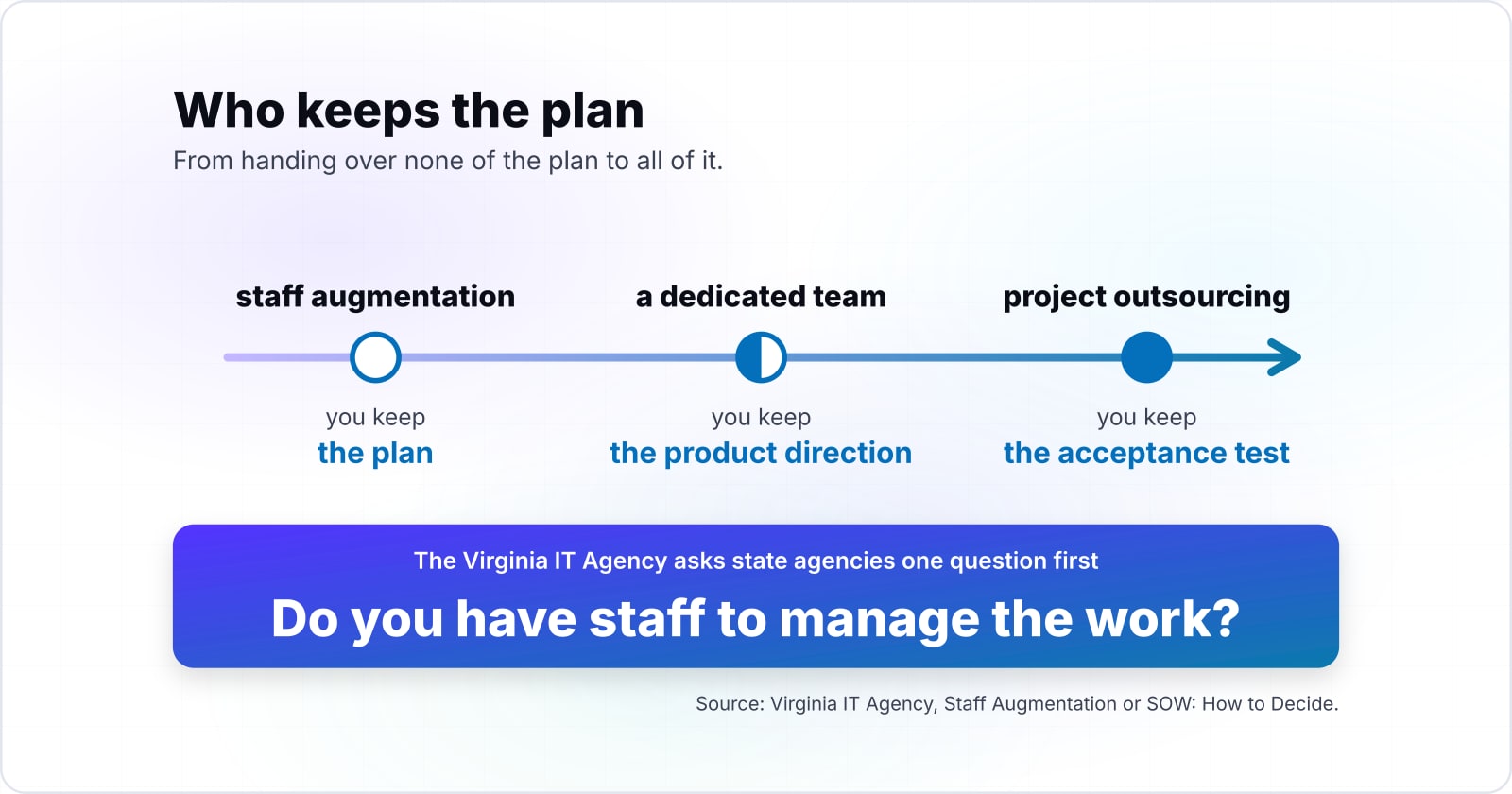
Project outsourcing goes one step further than a dedicated team: you buy accepted deliverables against a statement of work and hand over the plan as well. Staff augmentation, a dedicated team and project outsourcing sit on one line, from handing over none of the plan to all of it.
That is the plain answer to dedicated team vs staff augmentation vs outsourcing. The Virginia IT Agency's page says statement of work projects are "paid when deliverables are accepted by the agency." Also, its guide says the customer can describe the work, deliverables and acceptance criteria up front. As a result, project outsourcing suits work you can specify before it starts. But it suits work badly when the scope will be found during the build.
Read the line from left to right. Augmentation hands over the typing and keeps the plan. A dedicated team takes the daily plan, while you keep the product direction. Project outsourcing takes the plan as well, and you keep the acceptance test. In particular, each step right saves senior hours. In exchange, it asks you to write down more of what you want before work begins.
Which next step fits your team?#
Pick the model by who will own the plan next quarter, then read the guides on where the team sits, how to vet a partner and how to scope the work. The model follows from who owns the plan, and the next decisions are location, partner and scope.
First comes location. The guide to nearshore vs offshore vs in-house sets out what each choice does to cost, overlap and control. If the gap is a designer, how to hire UI/UX product designers covers the pass lines and a paid pilot on your own product. Then comes the partner, and the guide on how to choose a custom software development company covers what to check before you sign. If the plan goes to a dedicated team or a project, a software development RFP template helps you write the scope and the criteria.
If you already know the shape, Atyantik offers both: a dedicated development team with its own lead and staff augmentation inside your own process. Also, nothing here requires either. The test works with any partner, or with a hire of your own. Name the person who will direct the work, and look at their week.