Dedicated developer vs freelancer vs W-2 hire: the real choice for a US company
An hourly rate hides most of what one more developer costs. Look instead at what your company carries under each option: payroll tax, benefits, the classification test, who owns the code and who fills the seat when the person goes.
Dedicated developer vs freelancer vs W-2 hire: which should a US company choose?#
Choose on what your company carries, not the rate: a W-2 hire brings payroll tax and benefits, a 1099 freelancer brings classification risk, and a dedicated developer's employer carries both. In all, five things move between the options: payroll tax, benefits, classification risk, code ownership and replacement.
So a rate comparison hides most of the bill. For example, take a W-2 developer at the May 2025 BLS median salary. With June 2026 BLS benefits added, that seat costs about $196,555 a year. A 1099 contract takes that load off your books. However, it hands you a legal test that no contract settles alone.
"The substance of the relationship, not the label, governs the worker's status," says the IRS common-law employee page. In short, the dedicated developer vs freelancer question is about what your company is willing to hold.
$135,980
Median salary, May 2025
$196,555
Loaded with June 2026 benefits
At the BLS median, a $135,980 salary costs about $196,555 a year once benefits are added.
| Option | US dollars a year; the May 2025 BLS median wage, loaded at the June 2026 BLS ratio of 73.69 over 50.98 |
|---|---|
| Median salary, May 2025 | $135,980 |
| Loaded with June 2026 benefits | $196,555 |
| What moves | W-2 hire | 1099 freelancer | Dedicated developer |
|---|---|---|---|
| Payroll tax | Your company pays the employer share | The contractor pays both halves | The partner, as employer |
| Benefits | Your company | The contractor | The partner, as employer |
| Classification risk | None: the person is an employee | Your company, if the label fails the test | The partner, as employer |
| Code ownership | Follows the job | The freelancer's, until a signed written transfer | The partner's contract decides it |
| Replacement | You run the search again | You hold whatever they handed over | The written terms decide |
What is the difference between a W-2 employee, a 1099 contractor and a dedicated developer?#
A W-2 employee is on your payroll, a 1099 contractor runs their own business, and a dedicated developer is employed by a partner and works only on your product. So the first difference is who employs the person, and that decides who carries payroll, benefits and classification.
The IRS sorts the first two with three groups of facts. Its tax topic on contractors names them as "behavioral control, financial control, and relationship of the parties," in that order. In practice, the more you direct how and when the work is done, the closer the person sits to employee status.
Meanwhile, a dedicated developer is a third shape. The dedicated developer page defines it in four parts. First, one retained software engineer works on your product. Then, code and IP are yours from day 1. Also, a daily standup runs in your hours, and both sides agree the criteria before the start. Because the partner is the employer, its payroll carries the person, not yours.
What does a W-2 software developer cost beyond salary?#
Per hour worked, BLS puts total compensation for US private-industry professional workers at $73.69, against $50.98 in wages, so a $135,980 median salary loads to about $196,555 a year. In that table, benefits make up 30.8% of total compensation.
These figures come from the BLS Employer Costs for Employee Compensation release of 9 September 2026, for June 2026. Paid leave is the largest benefit line, followed by insurance and legally required benefits.
Show data table
| Segment | Value (dollars per hour worked) | Share |
|---|---|---|
| Wages and salaries | 50.98 | 69.2% |
| Paid leave | 6.78 | 9.2% |
| Insurance | 5.47 | 7.4% |
| Legally required and other benefits | 10.46 | 14.2% |
Wages are $50.98 of the $73.69 an employer spends per hour worked; benefits make up the other 30.8%.
The professional group is broader than software developers alone. Still, it is the closest public BLS series to the role. The salary side comes from the BLS Occupational Outlook Handbook, which gives the $135,980 median in May 2025.
How do you work out the loaded cost of your own hire?#
Multiply any salary by 73.69 over 50.98 and you get the BLS-loaded cost: $119,193 at the 10th percentile wage and $310,299 at the 90th. At the median, the same sum gives $196,555.
Show data table
| Item | Value |
|---|---|
| 10th percentile wage $82,460 | 119,193 |
| Median wage $135,980 | 196,555 |
| 90th percentile wage $214,670 | 310,299 |
At the BLS ratio, a software developer seat costs from $119,193 to $310,299 a year across the 10th to 90th percentile wages.
Loaded cost calculator
Enter the annual salary you would pay a W-2 hire to see its loaded annual cost at the BLS ratio and the employer share of Social Security and Medicare.
Loaded annual cost at the BLS ratio of 73.69 over 50.98
$196,555
- Employer Social Security and Medicare
- $10,402.47
Your salary, loaded at the BLS ratio, with the employer share of Social Security and Medicare. Modelled, not measured.
The ratio is an average, not a quote. Your own plan may run richer or leaner. However, it gives a public starting point you can check line by line.
What does a 1099 contract take off your payroll?#
A 1099 contract removes the employer's 6.2% Social Security and 1.45% Medicare share, $10,402.47 a year at the median wage, plus the benefits line. The Internal Revenue Service sets those rates on its payroll tax topic, with a 2026 wage base of $184,500 for the first one.
Across the BLS wage range, the employer share grows with salary.
Show data table
| Item | Value |
|---|---|
| 10th percentile wage $82,460 | 6,308.19 |
| Median wage $135,980 | 10,402.47 |
| 90th percentile wage $214,670 | 14,551.72 |
The employer share of Social Security and Medicare runs from $6,308.19 to $14,551.72 a year across the BLS wage range.
Instead, the contractor pays both halves. The Internal Revenue Service self-employment tax page, read in October 2026, gives the rate as 15.3%. That is 12.4% for Social Security and 2.9% for Medicare. As a result, a contractor's rate usually has that tax and their own benefits built in. So the rate looks high next to a salary, yet your payroll carries none of it.
What classification risk does a 1099 freelancer add?#
The IRS and the Department of Labor judge the working relationship rather than the contract's label, and the company carries the cost when a contractor is really an employee. What follows is general information, not legal or tax advice.
The IRS spells out the cost on its contractor or employee page. With no reasonable basis for the label, "you may be held liable for employment taxes for that worker," the page warns. The Department of Labor runs its own test too. "Employers are responsible for determining whether a worker is an employee under the FLSA [the Fair Labor Standards Act]," its misclassification page says.
Show data table
| Dimension | Employer share | Self-employed, both halves |
|---|---|---|
| Social Security | 6.2 | 12.4 |
| Medicare | 1.45 | 2.9 |
A self-employed contractor pays both halves: 12.4% for Social Security and 2.9% for Medicare, against the employer's 6.2% and 1.45%.
That federal test is in motion. The current regulation still applies, and the DOL fact sheet on employment relationships explains it. Meanwhile, a proposed rule published on 27 February 2026 closed for comments on 28 April 2026. If you are unsure, Form SS-8 asks the IRS to decide, and an employment lawyer can advise on your state.
Who owns the code a freelancer writes for you?#
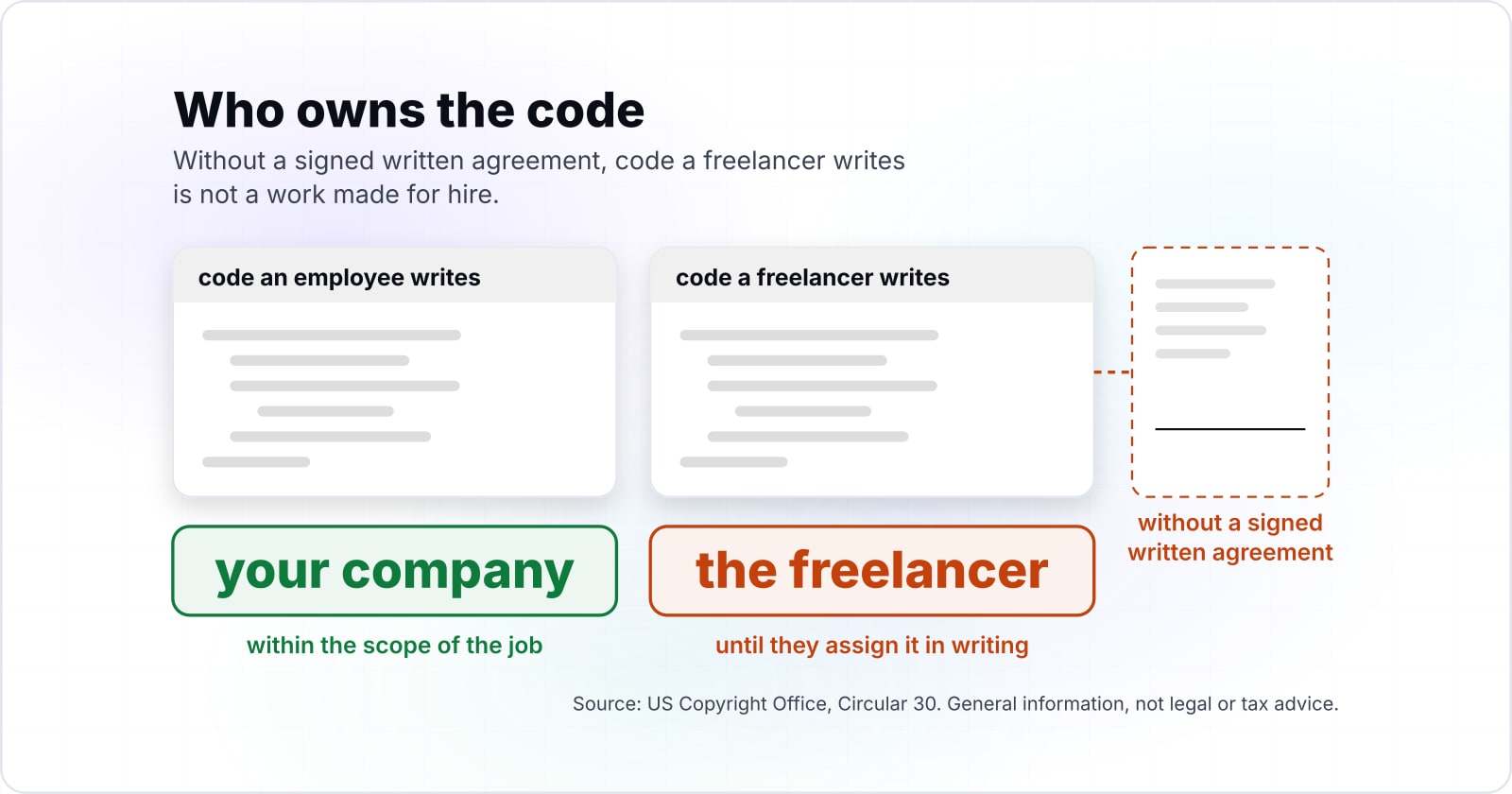
Without a signed written agreement, code a freelancer writes is not a work made for hire, so the freelancer owns it until they assign it in writing. By contrast, work an employee writes within the scope of the job belongs to the employer.
The rule comes from the US Copyright Office Circular 30. Employee work counts when it is "prepared by an employee within the scope of his or her employment," in the circular's words. A commissioned work qualifies only if it falls in one of nine listed categories and meets three more tests. "The agreement must be signed by all parties," the circular adds. Therefore, the safe habit is a signed written transfer of the code before work starts. As with classification, this is general information, not legal advice.
With a W-2 hire, ownership follows the job. With a dedicated developer, the partner's contract decides it. For example, the dedicated developer terms say "Code and IP are yours from day 1" in so many words. Either way, read the paper before the first commit.
What happens when the developer leaves?#
When a W-2 hire leaves you run the search again, when a freelancer leaves you hold whatever they handed over, and with a partner the written terms decide the replacement. Each option leaves a different gap.
A W-2 exit costs you the hiring loop and the lost months. A freelancer exit is lighter, but you keep only what was handed over. Also, the IRS lists "the permanency of the relationship" among its tests, so tying a freelancer to the seat like staff weakens the 1099 label.
With a partner, the written terms decide. "We replace a developer whose start goes wrong, against the criteria agreed before they began," the published terms read. They also say there is no written policy for someone who leaves after a year. So ask any partner what they commit to in writing, and what they do not.
| Option | What a departure costs | Who fills the seat |
|---|---|---|
| W-2 hire | The hiring loop and the lost months | You run the search again |
| 1099 freelancer | Lighter, but you keep only what was handed over | Nobody: you hold whatever they handed over |
| Dedicated developer | What the written terms decide | The partner replaces a start that goes wrong, against criteria agreed before it began; no written policy for someone who leaves after a year |
When is a dedicated developer the right choice?#
A dedicated developer fits when the product already exists, the work runs for months, and someone on your side already owns the technical direction. The dedicated developer option names its trade in one line, "One accountable name, and one throughput," and that is the real cost.
In practice, that suits a product with a roadmap that needs steady capacity. It also suits a team where one person already sets the direction. Time zones come up here too, and the overlap is agreed at scoping rather than fixed in advance.
However, one seat is not always the right shape. If you run a team with its own leads, staff augmentation extends it inside your process. If the product does not exist yet, a dedicated team brings design, build and testing at once.
When is a dedicated developer the wrong fit?#
Hire on W-2 when the role is core, permanent and needs someone who directs the work, and use a freelancer for a bounded deliverable with a clear end. Both cases beat a retained seat.
First, hire on W-2 when the person will own the architecture and stay for years. Their judgment is the asset, so keep it on your payroll. A retained developer works best when someone else points the work. "A retained software engineer with nobody to point them is the most expensive way to buy nothing," as the dedicated developer terms put it.
Second, use a freelancer for a scoped piece with a clear finish, such as an audit or a one-off integration. Then keep control light, set the deliverable rather than the hours, and sign the IP assignment before work starts.
| When | Better route |
|---|---|
| The role is core, permanent and directs the work | Hire on W-2 |
| A scoped piece with a clear finish, such as an audit or a one-off integration | Use a freelancer, set the deliverable rather than the hours, and sign the IP assignment before work starts |
Where to go next#
If the open question is location rather than model, or you are choosing the partner itself, two related guides pick up where this one stops. The engagement model is one of three linked choices.
For location, the guide to nearshore vs offshore vs in-house compares the three. For the firm itself, how to choose a custom software development company covers what to check. Also, what custom software development costs helps once the model is set. And if the seat is a designer rather than a software engineer, how to hire UI/UX product designers sets out the pass lines and a paid pilot. Because every figure above is public, you can rerun the sums with your own salary before you talk to anyone.