Micro frontends worth complexity only when deployment scale justifies the overhead
A micro frontend architecture promises independent releases for multiple teams. But most teams that tried it moved away, because they lacked the deployment scale it actually requires.
What are micro frontends?#
Micro frontends split a web application into independently owned and independently deployed pieces, each owned and released by a separate team, each running its own deployment pipeline. The browser puts them together into one user experience. Nx's official docs define it as "an architectural style where independently deliverable frontend applications are built into a greater whole." The phrase "independently deliverable" is what matters. Without a separate deployment boundary, you have a modular monolith, not a micro frontend system.
A micro frontend owns a vertical slice of the product: checkout, search, account settings, or any capability the team controls independently. The shared shell owns the frame, navigation, authentication context, and routing. Each piece builds, tests, and deploys separately, then plugs into the shell at runtime. This is the core trade. You gain independent release velocity. However, you also coordinate runtime integration, shared dependencies, and non-atomic deployments. Most teams discover this trade is not worth making.
When do micro frontends worth complexity: what are the real signals?#
Micro frontends reduce deployment friction and deployment-time coupling only when your team count and deployment frequency make the independence worth the complexity; a single team or a yearly release cycle gets no value from it.
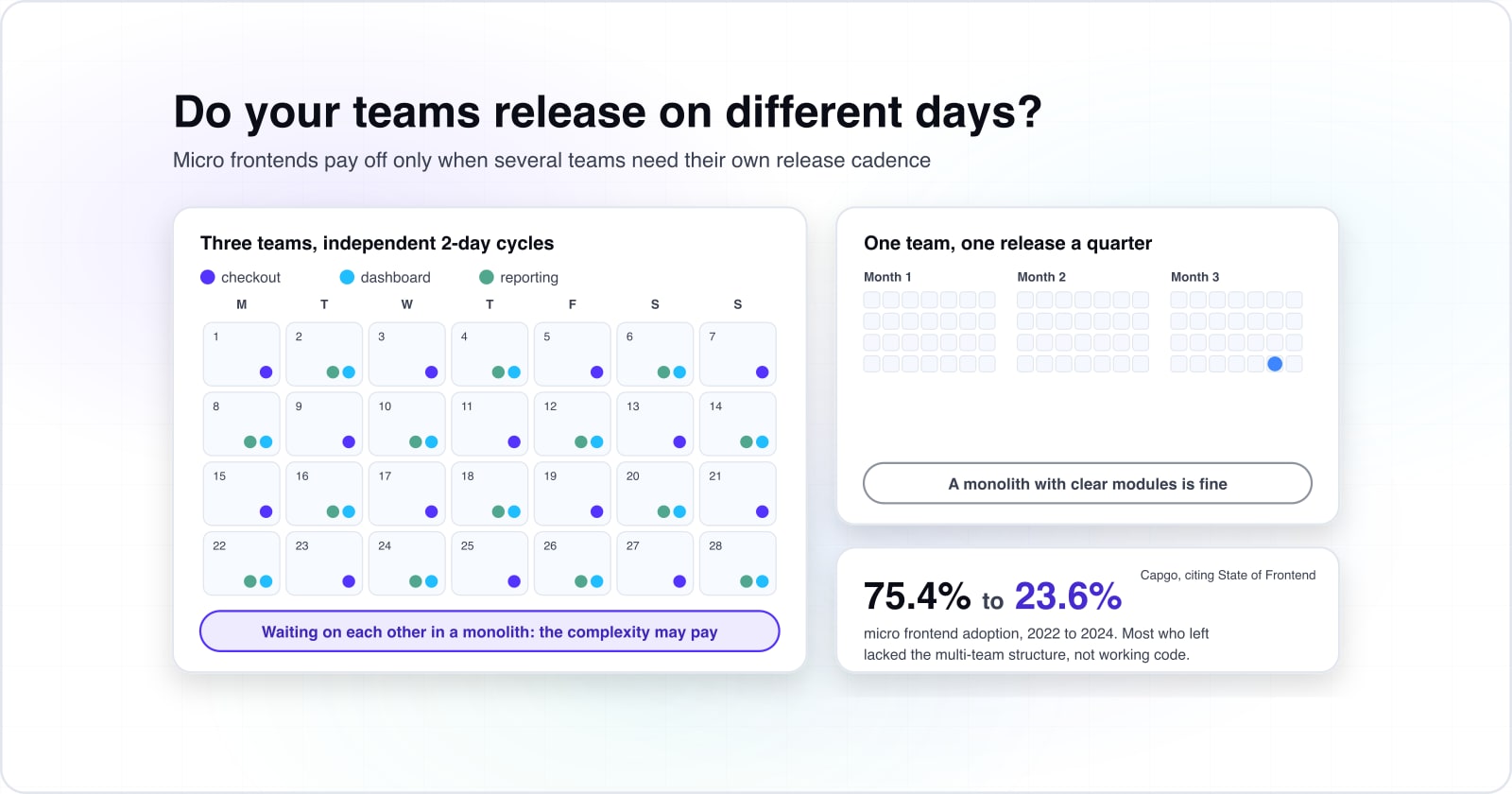
Consider the business case first. Say three teams ship checkout, dashboard, and reporting on independent 2-day cycles. Because they wait on each other in a monolith, lead time slows. So the micro frontend overhead might be worth it. However, if that same company ships every quarter with one team doing everything, a monolith is faster and simpler. Therefore, Nx's own documentation makes this clear. It states: "Avoid micro frontends when one team owns the whole frontend, because independent release solves a team problem you don't have." Further, the docs warn that if teams already deploy together or the app is small, you get only new runtime issues without faster releases. So before adopting, ask yourself whether your team structure actually justifies this complexity.
Balanced trade
Coordination cost roughly matches release velocity gain.
Coordination overhead: 10 hours/week
Release velocity gain: 8 hours/week
Ratio: 0.8x → Roughly balanced
Full comparison table
| Teams | Deploys/wk | Coordination (hr) | Release Gain (hr) | Verdict |
|---|---|---|---|---|
| 1 | 1 | 5.8 | 0 | Monolith is faster |
| 1 | 2 | 6 | 0 | Monolith is faster |
| 1 | 4 | 6.5 | 0 | Monolith is faster |
| 3 | 1 | 9.3 | 4 | Monolith is faster |
| 3 | 2 | 10 | 8 | Balanced trade |
| 3 | 4 | 11.5 | 16 | Balanced trade |
| 5 | 1 | 12.8 | 8 | Monolith is faster |
| 5 | 2 | 14 | 16 | Balanced trade |
| 5 | 4 | 16.5 | 32 | Micro frontends justify the cost |
| 10 | 1 | 21.5 | 18 | Balanced trade |
| 10 | 2 | 24 | 36 | Balanced trade |
| 10 | 4 | 29 | 72 | Micro frontends justify the cost |
This calculator uses an illustrative coordination-cost model calibrated to Nx and Module Federation operational patterns. Your team's actual overhead depends on testing discipline, shared-code governance, and deployment automation. Adjust this model to match your own deployment history.
Why did adoption fall from 75% to 23% between 2022 and 2024?#
In 2022, 75.4% of teams reported using micro frontends; by 2024, that fell to 23.6%. Not because the pattern failed, but because most teams discovered they didn't have the deployment scale that justifies it. A Capgo report, citing the State of Frontend survey conducted in September 2026, shows a hard market truth: teams that adopted the pattern moved away when the operational overhead exceeded the coordination savings.
Show data table
| Item | Value |
|---|---|
| 2022 | 75.4 |
| 2024 | 23.6 |
Adoption of micro frontends declined sharply as teams discovered they lacked the multi-team, multi-release-cycle structure the pattern requires.
Why did adoption fall so sharply? Teams who abandoned micro frontends had done the setup work. They built the federation layer, ran tests, managed shared code, and deployed on their own. Then they measured impact. Many found their release speed didn't justify the cost. For example, a team that ships on no schedule saw little value in independent release when it still waits for other teams on product dates. Also, a team with one product area gained nothing from splitting the monolith.
The pattern itself is sound. The implementation patterns work. However, the problem is a mismatch between the organizational structure and the complexity cost. Most companies don't have the scale to justify it. Therefore, this adoption reversal is what no other ranking page visualizes. Every guide lists the pros and cons; none show the market data revealing which teams actually keep the pattern after implementing it. So understanding this drift is critical before you commit to the complexity.
What are the hidden costs: coordination overhead and shared-dependency management?#
Micro frontends trade deployment coupling for coordination complexity: every piece needs its own build and deploy pipeline, its own testing, its own dependency versions, and a system to keep shared dependencies in sync. Therefore, three cost categories emerge from this trade.
- Coordination overhead: releases stop being atomic; a broken change to shared code only shows up when specific app versions meet in production.
- Bundle duplication: every tool you don't explicitly share gets copied into each app's own build, growing the download.
- Shared-dependency drift: a multi-repo setup lets code versions drift apart until two apps can't talk to each other at run time; Nx calls this "a top failure of micro frontends."
Coordination overhead: When teams deploy alone, releases are not atomic anymore. App code can be out of sync between releases. Because a broken change to shared code only shows up when specific app code versions meet in production, cross-team rules move from build-time checks to runtime checks. These runtime breaks nobody sees until users hit them. Nx's official docs list this as the first tradeoff. Also, when shared core code changes, every app is hit. Therefore, all releases stop until every app is done.
Bundle duplication: Each app builds its own copy of shared code unless you share them. Start with React and React-DOM as shared, then add a shared UI kit, then a messaging tool. Your shared code grows. But every tool you don't share copies in each app's build, making the download bigger. Nx says: "Start with a small set of shared code and expand it when you see duplication." For example, if you share five pieces of code across four micro frontends, each app still packs its own copy of everything else.
Shared-dependency drift: A monorepo fixes two of these issues by keeping every app build with the same code versions at the same time. However, a multi-repo setup lets code versions drift apart. When a tool or library changes its code between versions, it is a crisis. The checkout app uses v1. Meanwhile, the dashboard app uses v2. Then they need to talk to each other at run time. Nx calls this drift "a top failure of micro frontends."
The pattern's own makers put it plainly: the cost is justified only when team boundaries and release boundaries create real pain. However, for most companies, they don't.
When NOT to use micro frontends: are they worth the complexity for your team?#
A single team, a simple application, or an existing monolith that ships fast: these situations have zero need for micro frontends and only add coordination overhead by adopting it. Nx lists four reasons to skip it. First, one team owns the whole frontend, so independent release fixes a team issue you don't have. Second, your teams already deploy as one, and federation adds new runtime risks without removing any release block. Third, the application is small, so code chunks in one release give you code ownership without version drift. Fourth, you can't afford the ongoing coordination: shared code rules, cross-app testing, and rollback plans for non-atomic releases. This is why micro frontends worth complexity is so important to ask.
The adoption cliff from 75% to 23% (Capgo, September 2026) reflects teams discovering they fell into one of these four categories. They had the deployment infrastructure but not the deployment scale. Because the market has run this experiment, the data is clear. If your team structure and deployment frequency aren't pulling you toward independent releases, a monolith stays simpler and faster. Therefore, most teams should stay monolithic.
Which implementation patterns exist: Module Federation, single-spa, Nx, or Web Components?#
Micro frontends can be built with iframes (simplest, most isolated), Module Federation (webpack runtime sharing), single-spa (framework-agnostic composition), Nx (monorepo with independent apps), or Web Components (custom elements). Each pattern carries different tradeoffs.
| Pattern | Isolation | Code sharing | Framework mixing | Main tradeoff |
|---|---|---|---|---|
| Iframes | Full sandbox, no shared state | None, can't share code | N/A | Can't touch the page's DOM |
| Module Federation | Shares one page context | Runtime, shared deps load once | Not its purpose | Needs more coordination |
| single-spa | Shared page, mixed frameworks | Per-framework at runtime | Yes, by design | Grows the shared code surface |
| Nx | Monorepo, same build | Build-time, same versions | Not its purpose | Requires a shared repo |
| Web Components | Framework-free custom elements | No runtime needed | Yes, cross-framework | Less used in live systems |
Iframes are the most isolated. Each piece runs in its own sandbox with no shared state. But they carry cost and can't share code or touch the page's DOM. Therefore, Module Federation is webpack's way to share code at run time. Webpack's official guide explains it well: one app loads code another app shows at run time, and shared code like React loads once. Since federation shares at run time, it beats iframes. However, it needs more coordination.
Single-spa works with many frameworks. It lets you mix Angular, React, and Vue in one app. However, this grows the shared code surface and splits your team into groups that can't read each other's work. Therefore, Nx's official guide warns: "Agree on one set of adopted technologies per concern: UI framework, styling approach, and state management."
Nx is a monorepo approach. Each app builds on its own with its own build pipeline. Since every app builds with the same code versions, Nx stops shared-code drift. Web Components are custom elements in the WHATWG spec. They define parts that work across frameworks without a runtime like Module Federation or single-spa. So they're growing for framework-free pieces but are less used in live systems.
In order of how to pick, the official docs say: Nx for monorepos, Module Federation for webpack apps, single-spa for many-framework systems. Iframes are the fallback when run-time work is too much.
To pick between these, know your deployment rules. A monorepo like Nx gives you safety at build time: every app builds with the same code versions before any app goes live. So you find code mismatches at CI time, not at run time in production. This is why Nx teams see fewer deployment shocks. A multi-repo setup with Module Federation or single-spa trades that safety for the ability to host apps on different machines and deploy them fully alone. Pick Nx if your teams can commit to a shared folder and shared code management. Pick Module Federation if teams need separate releases but share a JavaScript runtime. Pick single-spa if teams use different frameworks and you'll accept the cost of multiple frameworks in the browser.
How do you start with official tooling documentation?#
If you've decided the deployment scale justifies micro frontends, start with the official documentation for the pattern that fits your build: Nx for monorepos, Module Federation for webpack apps, single-spa for framework-agnostic systems. The Nx documentation on micro frontend architecture covers setup and team scaling for monorepo-based systems. The Webpack documentation on Module Federation explains runtime module sharing, which shipped in webpack 5.0.0 on 10 October 2020. The single-spa getting-started overview covers framework-agnostic composition; the library's latest release, 6.0.3, is dated 29 September 2024.
For a monorepo, Nx lets you make a host app and remote apps with shared code. Adding a remote is an edit to a list, not a rebuild of all apps. For multi-repo systems with webpack, Module Federation lets each app say what it shares and what it needs at run time. So there's no one build command for these pieces. Instead, they deploy on their own. For many-framework composition, single-spa handles lifecycle and registry.
Agree on shared tools early. Each new framework grows the shared code surface. Therefore, shared code is where most teams break: mismatched versions become production issues.
What does a minimal Module Federation setup look like?#
A basic Module Federation setup: define a host app that loads remote apps at runtime, configure webpack to expose shared dependencies, and mount remote components in the host. Each application configures webpack's ModuleFederationPlugin to expose the modules it owns and import what it needs. At runtime, the host loads remote apps and mounts their components to the DOM.
// apps/checkout/webpack.config.js
const { ModuleFederationPlugin } = require('webpack').container;

module.exports = {
  mode: 'production',
  entry: './src/index',
  output: {
    path: path.resolve(__dirname, 'dist'),
    filename: 'bundle.js',
  },
  plugins: [
    new ModuleFederationPlugin({
      name: 'checkout',
      filename: 'remoteEntry.js',
      exposes: {
        './CheckoutApp': './src/CheckoutApp',
      },
      shared: {
        react: { singleton: true },
        'react-dom': { singleton: true },
      },
    }),
  ],
};

// apps/host/webpack.config.js
new ModuleFederationPlugin({
  name: 'host',
  remotes: {
    checkout: 'checkout@http://localhost:3001/remoteEntry.js',
    dashboard: 'dashboard@http://localhost:3002/remoteEntry.js',
  },
  shared: {
    react: { singleton: true },
    'react-dom': { singleton: true },
  },
});

// apps/host/src/App.jsx
import { lazy, Suspense } from 'react';

const CheckoutApp = lazy(() => import('checkout/CheckoutApp'));
const DashboardApp = lazy(() => import('dashboard/DashboardApp'));

export function App() {
  return (
    <div className="app">
      <nav>Navigation shared from host</nav>
      <Suspense fallback={<div>Loading...</div>}>
        <CheckoutApp />
      </Suspense>
      <Suspense fallback={<div>Loading...</div>}>
        <DashboardApp />
      </Suspense>
    </div>
  );
}
The host app says which remote apps it needs, and each remote says what it shares. The shared rules make sure React and React-DOM load once, even when many remotes run. This is the basic right setup. Production adds build tuning, version rules for shared code, and fallback for when a remote is down.
Once this works, the real work starts. Testing across all parts becomes key. You must test the full app with all micro frontends running before any team deploys. Otherwise, breaks show up in production. Rollback is not atomic anymore. If the checkout app breaks, only checkout rolls back. Meanwhile, other teams' new releases stay live. This makes version skew that only full testing catches. For a system with four micro frontends on different release dates, the testing space grows. When checkout v2.4 meets dashboard v3.1 and reporting v1.8, each mix must be tested before that state goes live.
The cost of this testing and work is what most teams find is not worth the release freedom the pattern gives. Teams that jump into micro frontends often start hopeful. They think independent releases will mean faster deployments. However, after months of work, they hit the real testing and work cost. Every update to shared code needs the full system tested. Every release brings version skew. Most teams find the pain they tried to fix (slow releases) wasn't the real issue. Instead, their issue was bad planning or unclear team lines. A monolith with good team splits and clear ownership solves both faster and simpler. So if your release speed doesn't bring enough pain to pay for this testing cost, a monolith is still the right choice.
What to read next#
If you're building an independent frontend deployment system, read how to choose between edge and origin deployment, how to render on Cloudflare, and SEO considerations for split frontends. These architectural decisions layer on top of the micro frontend pattern. For related reading, explore the What belongs at the edge post to understand the deployment boundary decisions. The React rendering on Cloudflare page covers rendering when frontend pieces compose at runtime.
For teams scaling across multiple frontend pieces and multiple deployments, the scale-optimize service covers the infrastructure this pattern assumes. The DevOps CI-CD page walks through the automation and testing disciplines required to make independent deployments safe.