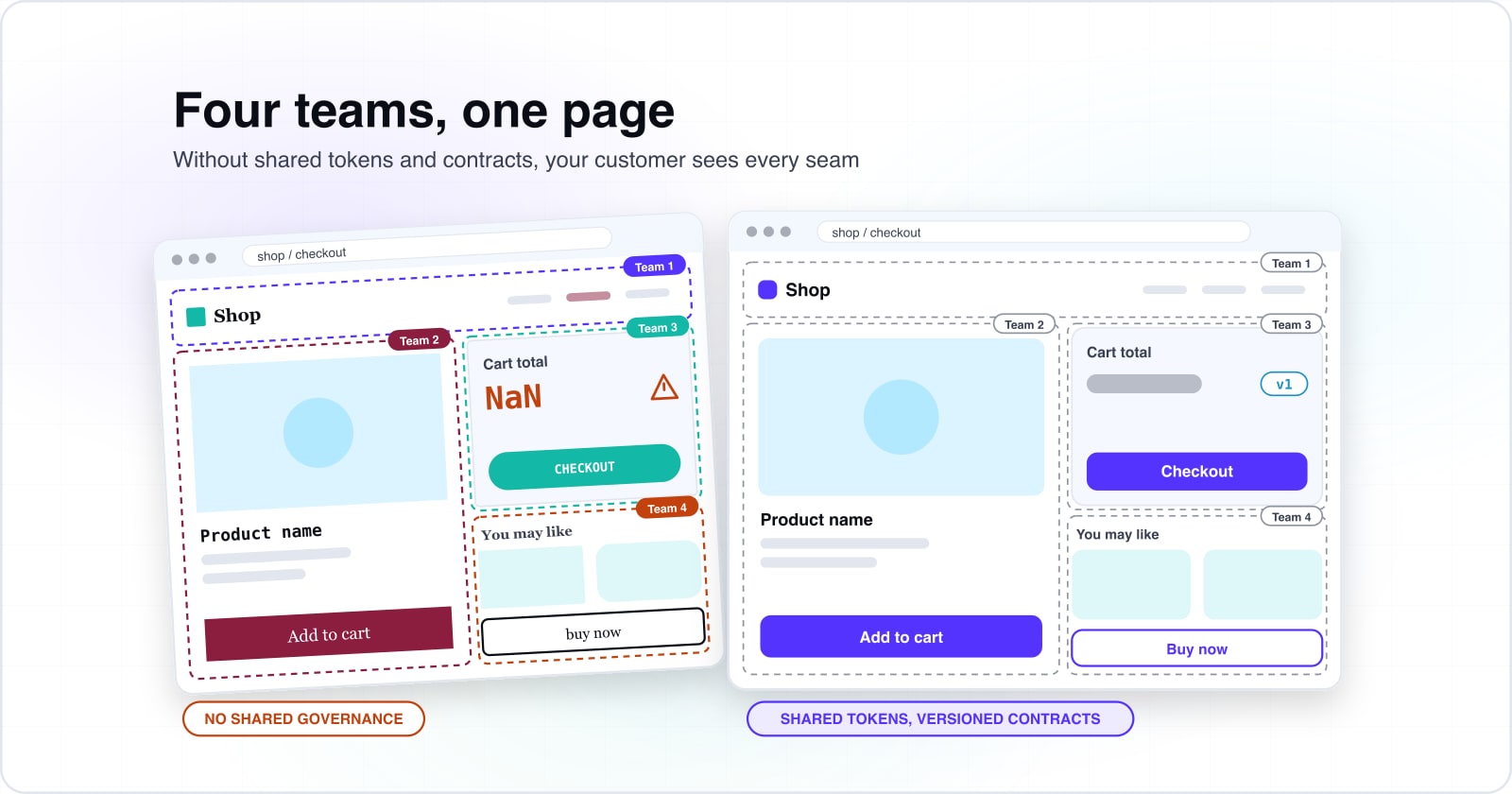
Micro frontends team autonomy governance: invisible discipline that makes autonomy work
Micro frontends let each team own its slice from code to deploy. Autonomy without governance is not speed; it is chaos. The invisible discipline that makes autonomy work demands shared design systems, API contracts, and observability.
What autonomy gains do micro frontends actually deliver?#
Each team owns a slice of the UI, frontend and backend, which accelerates development and reduces inter-team dependencies. Because of this ownership, the real gain is independent shipping: each team moves from shared deployment to owned deployment, deciding when to ship without waiting for other product teams.
According to Hashbyt's analysis of Netflix (March 2026), teams see real speed gains. Organizations reduce build time from days to minutes. They ship up to 50 percent faster with the same team size. Each micro-frontend is a full business domain that can ship alone. Since they're built for independent deployment, multiple teams work on separate parts at the same time.
Martin Fowler's article on Micro Frontends (2019, updated 2026) describes breaking up frontend monoliths into smaller pieces. This improves both impact and speed for software engineer teams. So the divided model cuts the need to coordinate while keeping the system solid through clear rules and governance.
Without shared governance, speed dies because teams that ship alone create hidden ties that surface under load. Independence without boundaries is broken pieces, not autonomy.
Why is independent shipping worth the governance investment?#
Teams that own their slice fully can deploy changes in hours instead of weeks, and reduce triage time when incidents hit their boundary. So the business value is speed. Because of this, each additional autonomous team compounds, shortening both feature delivery and incident recovery.
| Dimension | Coupled deployment | Independent deployment |
|---|---|---|
| Release cadence | Waits on a shared release train | Ships in hours, on its own schedule |
| Incident triage | Crosses teams before ownership is clear | Stays local: the owning team responds in minutes |
| Recovery as teams scale | A 20-person monolith moves as one unit | 20 software engineers in four groups recover faster |
When four teams ship independently, no release waits for three approvals. For example, if team one owns checkout and team two owns the cart, then team two ships the same day, not weeks later. So the work stays local when an incident hits team two because team two owns its slice, knows its contracts, and responds in minutes.
This compounds across teams, so 20 software engineers in four groups recover faster than a 20-person monolith. So the cost is governance, but the payoff is real because each team's independence shortens recovery time for all.
The tradeoff is clear: governance is expensive because shared design systems, API versioning, observability, and coordination all demand work and tools. But coupling costs far more because delayed features, wide incidents, and fear-driven freezes cost more than governance when teams scale.
How do shared design systems enforce governance across independent teams?#
Shared design tokens are not a convenience; they are the only scalable enforcement mechanism that prevents each team from inventing its own visual language. Teams that own their UI slice but use shared tokens stay visually coherent. But teams that skip shared tokens produce a fragmented experience and code.
Hashbyt's Netflix case study (March 2026) names the failure pattern clearly. Without teamwork, each team might build components with different styles, interaction patterns, and colors, making fragments. The solution is a shared design system with standard color palettes, font choices, and component libraries. Every team must use this base for its micro frontend.
- A shared token set: colors, spacing, and typography every team inherits automatically.
- Standard component libraries every team builds on instead of inventing its own.
- No per-team overrides: a token that does not exist in a team's namespace cannot be invented locally.
Shared libraries keep apps consistent because teams follow shared style guides with clear contracts. Users see apps that work the same way. Consistency improves how apps feel and cuts time on new work. Teams reuse what works.
The enforcement mechanism is not a committee but a shared token set. When the design system publishes new tokens, every team inherits the update. No team can deviate because the token does not exist in their namespace. This is how you scale visual consistency across teams.
How do API contracts protect team autonomy?#
Each team's slice needs a versioned API contract at every boundary: what inputs it accepts, what outputs it guarantees, and what it does when a contract breaks. Teams that respect contracts can change their internals without breaking teammates. Teams that do not produce hidden dependencies that surface under load.
A contract change, walked through
How team one and team two stay independent across a breaking change, using the cart-total boundary.
- Contract published
Team one publishes "cart-total returns cents." Team two builds on that guarantee.
- Format changes
Team one needs to change the format it returns.
- Version, not overwrite
Team one ships the new shape as cartV2, instead of changing cartV1 in place.
- Team two is unaffected
Team two keeps calling cartV1. Nothing breaks under load, and nothing surprises them.
Cam Jackson's micro-frontends.org (2016 onwards) describes cross-application communication as a critical boundary. Teams must build clear interfaces and APIs to keep things running fast and avoid conflicts.
Loose coupling through APIs is how this works. When team one publishes "cart-total returns cents," team two can build on that. If team one later changes the format, they make cartV2, so team two keeps using cartV1. This stops surprises under load.
Without API contracts, team two's code breaks silently. A cart-total that changes from integer to object does not error in JavaScript. It just changes value. The feature works in staging. But it breaks on users' checkout at scale when the system tries to multiply an object by quantity. This failure mode kills incident recovery speed.
What breaks when teams skip shared governance?#
When teams move fast without shared design systems or API contracts, failures become invisible until they cascade across team boundaries under production load. Failure patterns cluster around three axes: visual inconsistency breaking the user experience, API changes breaking hidden dependencies, and incident blast radius expanding across teams.
Three failure patterns, in the order they compound#
1
Visual inconsistency
Teams invent their own buttons, colors, and interaction patterns without a shared token set.
- Why 2 waits for 1This is the cheapest one to catch: a missing token shows up in review, not production.
2
Hidden API dependencies
A removed endpoint keeps being called by another team's code. The failure is invisible in testing; it only surfaces when a user hits the broken path.
- Why 3 waits for 2This is where governance actually gets tested, because nothing catches it until a contract breaks in production.
3
Expanding incident blast radius
A single change cascades through multiple teams before anyone finds the root cause. Triage becomes archaeology: figuring out which team owns what and who broke it.
Illustrative, drawn from the governance failure patterns described in this post.
When teams add buttons in burgundy and badges in teal (lacking shared tokens), the user sees broken products. So the team ends up managing 18 different buttons because the design system should prevent this.
On the API side, when team one removes a deprecated endpoint without telling teammates, team two's code still calls it. The failure is invisible in testing. So it only surfaces when a user hits a code path that needs both endpoints. Triage becomes archaeology: figuring out which team owns what and who broke it.
Incident blast radius expands when failures touch multiple teams. A single API change spreads through three teams before anyone finds the root cause, and a design mismatch frustrates customers. So each incident becomes a three-team investigation instead of a one-team fix.
How does observability cross team boundaries without breaking autonomy?#
Observability infrastructure is the difference between an incident hitting one team and an incident that requires five teams to triage simultaneously. As a result, teams that instrument their slice independently but emit to shared observability tools can trace incidents across boundaries without losing autonomy to a centralized ops team.
Hashbyt's Netflix analysis (March 2026) emphasizes this point because performance tools track bottlenecks. When team one's cart change impacts performance, the infrastructure shows it immediately, so both teams see their slice and can trace the interaction.
Shared instrumentation contracts are the answer. Every team measures three signals: latency at their boundary, error rates, and dependencies they call. Each team owns their dashboard.
One shared system, two independent teams#
Feeds in
Checkout team
Emits latency, error-rate, and dependency signals at its own boundary, on its own dashboard.
Feeds in
Cart team
Emits the same three signals at its own boundary, on its own dashboard.
The centre
Shared observability tooling
Ties latency, error-rate, and dependency signals together across every team's boundary.
Serves
Incident response
Gets a stitched causal trace, checkout's latency spike linked to cart's error spike, instead of two disconnected dashboards.
When incident response starts, the observability system ties signals together. An incident in checkout that cascades to cart shows as a latency spike in checkout, then an error spike in cart. Both teams see a clear causal link.
Without shared instrumentation, observability is just noise because every team has dashboards showing their own view but nobody sees how things connect. The incident becomes a mystery. But observability with shared contracts and shared tools makes triage fast: this boundary broke, this team owns it, and here is their dashboard.
Without shared instrumentation, observability is just noise because every team has dashboards showing their own view but nobody sees how things connect. The incident becomes a mystery. But observability with shared contracts and shared tools makes triage fast: this boundary broke, this team owns it, and here is their dashboard.
When are micro frontends the wrong fit? A monolith with clear modules#
Micro frontends pay off when the governance investment is smaller than the coupling cost; when coupling cost is low, they do not. So teams that are small, tight, or short-lived should stay in a monolith with clear boundaries.
An organization with 20 software engineers across four teams reaches the point where autonomy pays off. Coupling costs become visible through stacked delays, spread coordination, and split decisions, so governance costs drop. But a five-person team should stay in a monolith because governance costs (tokens, versioning, observability) cost more than coupling.
Before you commit, ask if your count justifies the cost. Because if your teams are small, if code is clear to one person, if delays are days not weeks, then a monolith costs less. Also, micro frontends are not new; they are a specific tradeoff for your scale.
What is your micro frontends team autonomy governance readiness at each scale?#
Assess your governance readiness across three axes. Choose the maturity level that matches your current state on each.
Intermediate readiness
Two axes at level 2 or higher, or any axis at level 3, but not all three at level 2 or higher
Next step: Raise observability from level 1 to level 2: it lets an incident be traced across team boundaries, so autonomous teams stay independent.
Your current state
Design Systems
Level 2
API Contracts
Level 2
Observability
Level 1
Readiness levels explained
| Readiness | When you are here |
|---|---|
| Foundation | Two or more axes at level 1 and none at level 3 |
| Intermediate | Two axes at level 2 or higher, or any axis at level 3, but not all three at level 2 or higher |
| Advanced | All three axes at level 2 or higher |
The next step is always your weakest axis. On a tie the order is design systems, then API contracts, then observability.
Maturity levels by axis
| Axis | Level 1 | Level 2 | Level 3 |
|---|---|---|---|
| Design Systems & Tokens | No shared design tokens; each team invents its own visual language | Basic shared tokens for colour and spacing; enforcement is light | Comprehensive token library with tooling; all teams bind to shared values |
| API Contracts & Versioning | API changes are internal to each team; no cross-team contracts | Documented API boundaries with semantic versioning; breaking changes are coordinated | API contracts are enforced with tooling; deprecation and migration paths are automated |
| Observability & Incident Response | Each team logs independently; incident triage is scattered across tools | Shared observability tools; teams emit independently but can trace across boundaries | Unified observability with automated alerting; incident response is coordinated by tooling |
This assessment model is calibrated to the governance demands that emerge as teams scale from 5 to 50 engineers across multiple independent product streams. Your team's actual readiness may vary based on deployment discipline, cross-team communication patterns, and incident recovery capacity.
Teams progress through three maturity levels across three governance axes: design systems, API contracts, and observability. Because these axes mature in parallel, the readiness self-check shows which axis your team should strengthen first as you scale from five to fifty software engineers.
At the five-team scale, your critical need is visual consistency because design tokens are the rule. Your design system should reach Level One. Publish a token set, three core components (button, card, input), and ban fixed colors. So this takes one owner and a weekly check.
At the ten-team scale, API contracts matter, so you need Level One: versioned endpoints, breaking-change policy, and deprecation timeline. You also need standards docs and quarterly audits. Because this prevents team one from breaking team two.
At the fifteen-team scale, observability becomes critical. You need Level One: three metrics per service (latency, errors, dependencies), dashboards per team, and runbooks. Because observability tooling respects boundaries, incidents resolve faster at this scale.
By thirty teams, you reach Level Two. Design tokens have 30+ components. API contracts have versioning strategies and rules for backward fit. Observability has automatic alerts and incident links. At fifty teams, you reach Level Three: design tokens are auto-enforced, API contracts are checked in CI, and observability is fully automatic.
What governance to build at each critical scale point?#
Governance investment is staged by team count, not all at once. Skip early investments and you pay for it at scale. Over-invest early and you waste effort on ceremony. The sequence is: tokens before process, documentation before tooling, visibility before rules. Each level stops the failure the last level cannot catch.
- Before 5 teams
Publish design tokens
A simple set in a repository, updated when everyone agrees. Stops visual chaos with the least cost, before you have a process, tool, or owner.
- By 5 teams
Write API contracts
Markdown files per API, with versions and timelines for old ones. Stops hidden dependencies.
- By 10 teams
Build a measurable component library
Add a linter for fixed colors. Stops drift, and costs less than a committee.
- By 15 teams
Create dashboards per team
Link alerts to on-call rotation. Set up incident correlation. Stops mysteries.
- By 30 teams
Check API contracts in CI
Make color lints fail the build. Drift stops before ship.
Before five teams, publish design tokens by creating a simple set in a repository updated when everyone agrees. This stops visual chaos with the least cost before you have a process, tool, or owner.
By five teams, write API contracts as markdown files per API with versions and timelines for old ones, so this stops dependencies.
By ten teams, build a component library you can measure. Then add a linter for fixed colors, which stops drift and costs less than a committee.
By fifteen teams, create dashboards per team. Link alerts to on-call rotation. Set up incident links, so this stops mysteries.
By thirty teams, check API contracts in CI. Make color lints fail the build, so drift stops before ship.
The critical insight: tokens before process, visibility before rules, because you should not build a process for what you could stop with a technical constraint. Also, do not automate rules until you can see the problem.
Next steps: implementation and decision#
The governance case stands; three paths onward depend on what you need next. Read Micro-frontends worth complexity to decide if autonomy pays off for your cost structure. Read how to choose an API style for each boundary for implementation details. Explore Design Experience and DevOps and CI/CD service pages for governance infrastructure.
If you are still deciding, use the framework of team count, coupling cost, and recovery time, because this compares governance cost to staying coupled.
If you are ready to implement, start with tokens because they cost the least and have the most impact. So do not start with contracts or tooling. Governance is not one decision but a staged cost, one at a time, only when failure becomes real.