PWA development Northern Ireland: offline coverage, iPhone limits, UK rules and how to judge progressive web app developers
Before you compare progressive web app developers, settle three facts about your own service: where your users lose signal, what an iPhone will let a web app do, and which UK rules touch the data it stores.
PWA development Northern Ireland: what should it cover in 2026?#
A progressive web app built for Northern Ireland should work offline, install on Android and iPhone, and meet UK privacy and accessibility rules before anyone picks a partner. MDN Web Docs describes the promise in one line. A PWA "can be installed on the device, can operate while offline and in the background", in MDN's words, read in October 2026. It also runs on many devices from one codebase. However, each part of that promise comes with a condition.
First comes offline, because mobile coverage in Northern Ireland varies by operator and by place. That variation means the offline layer decides whether the app is useful in the field. Second comes the iPhone, where Apple allows web push only for web apps on the Home Screen. Third comes the law, since the Information Commissioner's Office (ICO) applies its cookie rules to anything an app stores on a device. Also, public bodies must meet the accessibility rules on GOV.UK.
In short, good PWA development Northern Ireland firms can plan starts with those three questions, and only then does the choice of developer matter. The same order holds whether you shortlist local PWA developers or progressive web application development companies further away. Later, five questions make that choice something you can test.
What can a PWA do on Android and iPhone in the UK?#
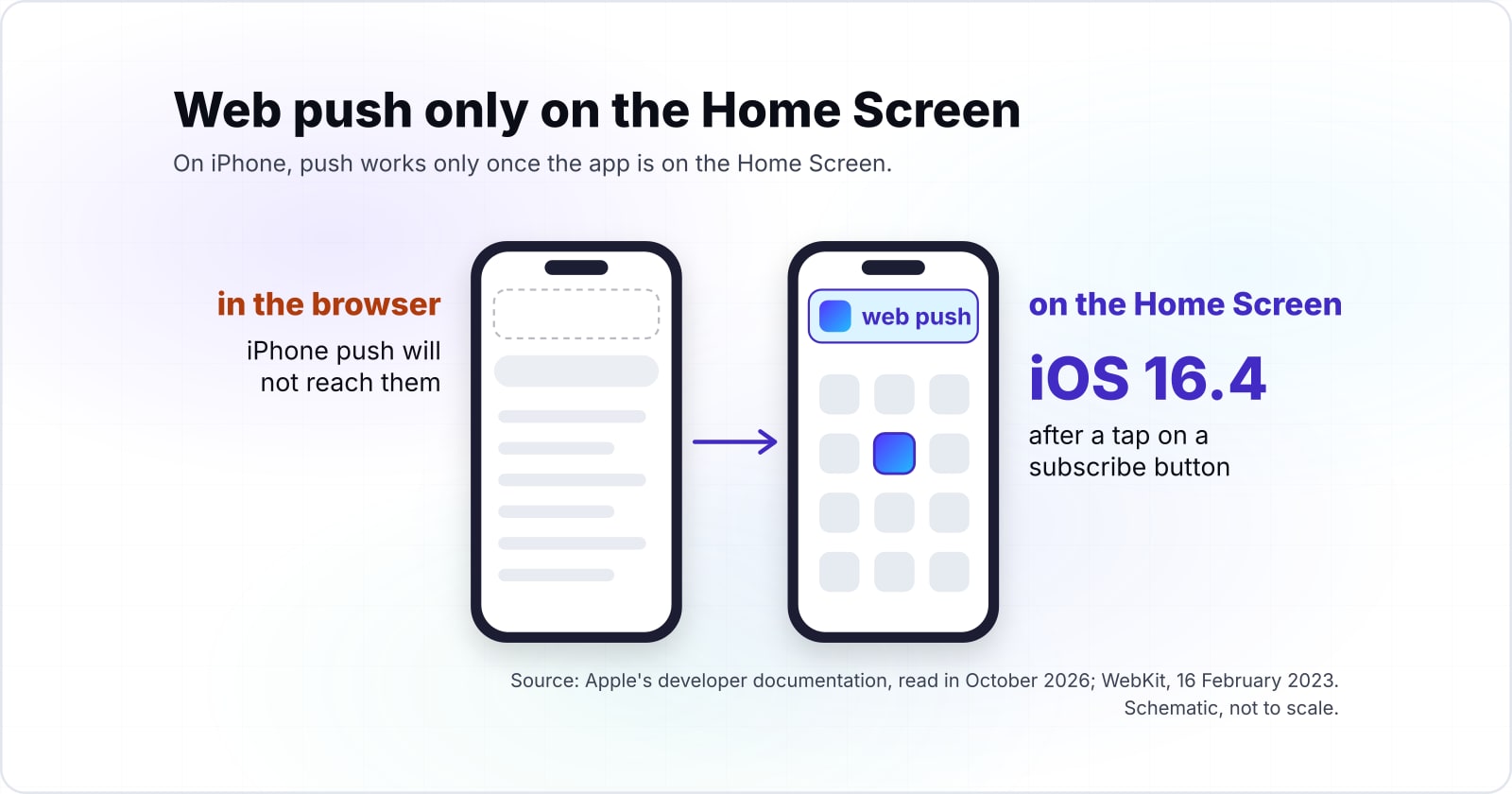
On iPhone, a PWA can send web push only after it is added to the Home Screen, which Apple's developer documentation, read in October 2026, dates to iOS 16.4. Apple's web push guide puts it plainly: "Add web push to Home Screen web apps in iOS 16.4 or later". Likewise, the Safari 16.4 release notes say: "Added support for Web Push in web apps saved to the home screen on iOS."
| Platform and browser | How a PWA installs | Condition to plan for |
|---|---|---|
| iPhone, iOS 16.4 or later | From the Share menu in Safari, Chrome, Edge, Firefox or Orion | Web push only after Home Screen install, and permission only after a tap |
| Android, Chrome with Google Mobile Services | As a real app, with a launcher and settings entry | None named in the install guide |
| Android, Samsung Internet on Samsung devices | As a real app, with a launcher and settings entry | None named in the install guide |
| Android, other browsers | A shortcut that opens the site in the browser | Not a real app install |
There is a second condition, which the WebKit team set out on 16 February 2023. A Home Screen web app can ask for push permission only after a direct action, for example a tap on a subscribe button. Also, Apple's guide warns that Safari revokes permission if a push arrives and the app shows nothing.
Android is looser, and MDN's install guide, read in October 2026, names two browsers that install a PWA as a real app. They are Chrome on devices with Google Mobile Services, and Samsung Internet on Samsung devices. Then the app gets an entry in the launcher and in system settings. Other Android browsers add a shortcut that opens the site in the browser. Meanwhile, on iOS 16.4 and later, MDN says Safari, Chrome, Edge, Firefox and Orion can all install a PWA from the Share menu.
What about the European Union and its 2024 rules? Apple's EU support page says it has changed iOS, Safari and the App Store since 2024. Those changes apply "in the European Union (EU)", to comply with the Digital Markets Act. Because Northern Ireland is part of the UK, those EU changes are not the frame for a service built there. In practice, plan to the UK behaviour above and test on a real iPhone.
Why does offline-first matter for an app used across Northern Ireland?#
The Department for the Economy fact sheet of July 2026 puts each operator's geographic 4G coverage between 90% and 97% of Northern Ireland. In other words, someone on a single network can lose 4G across a real share of the land, so the app must keep working without it.
Ofcom made the same point in its November 2025 Northern Ireland report. In Ofcom's words, "4G remains the backbone of mobile connectivity". So 4G, not 5G, is the signal to plan around. Also, geographic coverage is the right measure for anyone who works outdoors, because it counts land, not homes.
90%
Lowest-coverage operator
97%
Highest-coverage operator
Up to a tenth of the ground can sit outside one network's 4G, so the lowest figure is the planning input.
| Option | % of Northern Ireland's landmass with that operator's 4G |
|---|---|
| Lowest-coverage operator | 90% |
| Highest-coverage operator | 97% |
Source: Department for the Economy, 2026
Why does one network matter more than the total? Because a phone uses the network its SIM is on. A field team on one contract sees that operator's map, not the best of all four. Therefore the lowest single-operator figure is the honest planning input. Note too that the fact sheet does not name which operator sits at each end of the range. So ask your own operator for its map. The Department for the Economy's July 2026 range is all the fact sheet gives.
How much of Northern Ireland can sit outside one network's 4G?#
As a worked example, an operator covering 90% of the landmass with 4G leaves up to 10% of Northern Ireland without that network's 4G signal. The rule is simple: subtract your operator's geographic 4G figure from 100. The result is the share of ground where the app must queue work instead of sending it.
Plan the offline queue
5
forms a week could start outside 4G
Ground outside 4G: 10%
Queue each form on the device.
Geographic 4G coverage by operator, 90% to 97% of Northern Ireland: Department for the Economy fact sheet, July 2026. Modelled, not measured.
Show data table
| Item | Value |
|---|---|
| Highest-coverage operator | 3 |
| Lowest-coverage operator | 10 |
The lowest-coverage operator leaves up to 10% of the ground without its 4G, the highest 3%.
Say a team sends 50 forms a week, spread evenly across the ground it covers, as an illustrative case. On a 90% operator, the low end of the July 2026 range, about 5 of those forms could start in a gap. On a 97% operator, the figure falls to about 1 or 2. However, real work clusters around roads and towns, so treat the result as a ceiling for planning, not a forecast.
What does the app do with those forms? A PWA can save each one on the device, then send it when the signal returns. For instance, MDN's Service Worker API page covers this layer. A service worker is a script that sits between the app and the network. MDN says it is meant, among other things, to build offline experiences. A plain responsive site has no such layer, so a form sent from a gap simply fails.
Does near-complete outdoor coverage remove the need for offline support?#
Outside-premises coverage is high in Northern Ireland, yet the fact sheet measures signal outside buildings, not inside them or along every rural road. The same July 2026 fact sheet reports 4G from all four operators outside 98% of premises. It also reports 5G from at least one operator outside 99% of premises, at the High Confidence level.
Show data table
| Item | Value |
|---|---|
| 4G from all four operators | 98 |
| 5G from at least one operator, High Confidence | 99 |
| 5G from at least one operator, Very High Confidence | 97 |
| 5G standalone from at least one operator, High Confidence | 92 |
| 5G standalone from at least one operator, Very High Confidence | 83 |
Outdoor coverage at buildings is high, yet 5G standalone falls to 83% at the Very High Confidence level.
Those figures describe where a signal reaches outdoors at a building. However, a person inside a warehouse, a farm shed or a clinic basement is not outdoors. Meanwhile, a driver between premises is on a road the premises figure never measured. That is why the geographic figure, not the premises figure, sets the offline requirement.
Also, in that July 2026 fact sheet, the 5G figures drop as the confidence level rises. They fall from 99% to 97%, and further for 5G standalone. So a plan that assumes 5G everywhere does not match the Department for the Economy's July 2026 data.
Are Northern Ireland's mobile coverage gaps closing?#
The Shared Rural Network raised 4G from all four operators in Northern Ireland from a 79% baseline to an 85% obligation, which leaves gaps a PWA must still handle. The Department for the Economy fact sheet of July 2026 says delivery in Northern Ireland completed in 2024. Under the same programme, coverage from at least one operator was set to rise from 97% to 98%.
Show data table
| Dimension | Baseline | Obligation |
|---|---|---|
| From at least one operator | 97% | 98% |
| From all four operators | 79% | 85% |
Even at the obligation, 4G from all four operators covers 85% of the area, so gaps remain.
So the programme meant to close the gaps has finished. Even so, the all-operator target stopped at 85% of the area, per that July 2026 fact sheet. Waiting for the networks is therefore not a plan. Instead, build the offline layer once, and better coverage will simply make it fire less often.
Does fixed broadband change the case for a PWA?#
Fixed broadband is strong in Northern Ireland, yet the July 2026 fact sheet still counts about 6,500 premises unable to reach 10 Mbit/s, down from about 7,600. In the Department for the Economy's words, the earlier count was "just over 7,600 last year".
about 7,600
The previous year
about 6,500
July 2026
About 6,500 premises still sit below 10 Mbit/s, so caching and small downloads still pay.
| Option | premises unable to access 10 Mbit/s broadband |
|---|---|
| The previous year | about 7,600 |
| July 2026 | about 6,500 |
Source: Department for the Economy, 2026
Most offices and homes have fast lines, and Ofcom's November 2025 report even says Northern Ireland leads the way on full fibre. Even so, the slow lines that remain make caching and small downloads worth building in from the start. A PWA that caches its own screens loads them from the device on the second visit. As a result, someone on a slow rural line waits for data, not for the whole app.
In particular, the cache that rescues a slow line also speeds up repeat visits on a fast one. The Web Vitals guide explains how Google measures that speed.
Should you build a PWA, a native app or a responsive site?#
Choose a PWA when one codebase must install, work offline and send push; choose native when the service needs App Store presence or device features the web lacks. In short, the choice follows from what your service needs. Match that list against what each option can do on both platforms.
| need | responsive site | PWA | native app |
|---|---|---|---|
| works from a link, no install | yes | yes | no |
| installs to the home screen | no | yes, on Android and iOS 16.4 or later | yes |
| keeps working offline | no | yes, through a service worker | yes |
| push notifications on iPhone | no | only after Home Screen install | yes |
| listed in the App Store | no | possible, per store rules | yes |
| one codebase for every device | yes | yes | no, one per platform |
Source: MDN Web Docs and Apple Developer documentation, read October 2026.
Then add one caveat on storage from MDN's storage quotas page. It says "The data stored in the browser by an origin is best-effort by default". In practice, that means the browser may clear it when space runs low, unless the app asks for persistent storage. So a PWA that queues forms offline should send them as soon as it can.
If a PWA fits, the React PWA build guide shows how one is put together.
Which UK rules shape a PWA build?#
PECR governs what a PWA stores on a device, UK GDPR governs the personal data it syncs, and public bodies add the 2018 accessibility regulations and WCAG 2.2. This section maps those rules to a build and is not legal advice. The ICO and GOV.UK pages linked here are the authority.
First, for storage, the ICO's cookies guidance, read in October 2026, covers the Privacy and Electronic Communications Regulations (PECR). It says regulation 6 applies to anyone who stores information on a device "by any method". So a service worker cache or local storage is in scope, not only cookies. There is an exception for storage that is essential to a service the user asked for, such as a basket. In the ICO's terms, storage that is only helpful or convenient still needs consent. Also, the ICO's storage and access technologies guidance covers web storage directly and lists further exceptions, including one for statistical purposes.
Second, for sync, queued forms may carry names, addresses or health details. In that case UK GDPR applies to how they sit on the phone and how they are sent. So ask where the data rests and for how long.
Third, for accessibility, the GOV.UK guidance says the Public Sector Bodies Accessibility Regulations 2018 came into force on 23 September 2018. The same guidance says public sector sites and apps should meet WCAG 2.2 at level AA and publish an accessibility statement. For private firms the rules differ, yet the same standard is a sound target. The accessible single-page apps guide covers the patterns an app-like interface often breaks, and the WCAG compliance service describes audit work.
How do you evaluate a PWA development company?#
Ask a PWA development company to show a service worker it wrote, its offline sync design and its iPhone push test plan, because a brochure site never needed them. Skill shows in things you can inspect and plans you can test. Five questions do the job:
Show us a service worker you wrote.
Expect real code, and an account of what it caches and when.
How does a form sent offline reach the server?
Expect a queue on the device, a retry on reconnect and a plan for duplicates.
How will you test push on an iPhone?
Expect a Home Screen install and a permission request tied to a tap. Then expect a check that every push shows a notice, as Apple's guide requires.
What do you store on the device?
Expect a list, with each item marked essential or needing consent.
Which WCAG 2.2 level will you meet?
Expect AA, tested with tools and by hand.
Does the developer need to be based in Northern Ireland? Not for the code; working hours and data handling matter more. For example, Atyantik is a software engineering company based in India, with no office in Northern Ireland. India Standard Time runs five and a half hours ahead of the UK in winter. In summer the gap is four and a half hours, so a Belfast morning overlaps an Indian afternoon.
Code you can read before any call matters more than location. Atyantik maintains ReactPWA, and its GitHub page calls it "An upgradable boilerplate for Progressive web applications (PWA) with server side rendering". GitHub shows the repository was created in June 2017 and last updated in July 2024. Ask any company for code you can open. The guide to choosing a software development company adds contracts and handover.
When is a PWA not a fit?#
Apple's web push guide lists push, notifications and badges for Home Screen web apps, but it does not list Bluetooth or background location. So if the service needs either on iPhone, build native. Otherwise, prove the feature on a test device before committing.
Likewise, some users will never add the app to the Home Screen, and iPhone push will not reach them. In that case, email or a text message may serve better. Also, a service that is a set of pages people read once needs no install. A fast responsive site is enough there, because offline support would add work few people use.
Where do you go from here?#
If a PWA fits, the build guide and the SEO checks are the next reads, and the service pages cover mobile app development and React hiring. Each route serves one outcome of the decision above.
To see how a PWA is built, read the React PWA guide. Then, to check that the app can still be found in search, see the PWA SEO checks, which cover rendering and indexing. If the answer was native after all, the mobile app development page covers that route. Finally, if you have a plan and are comparing web app development services to build it, React developers is the hiring route. Still, the MDN, Apple and ICO pages linked above are enough to decide on your own.