MVP development cost drivers: what sets the price of a first version
You have a validated idea, a fixed runway and three quotes that do not agree. Much of the gap between them is scope, and scope is the part of the bill you get to decide.
What are the MVP development cost drivers, and what do the public ranges say?#
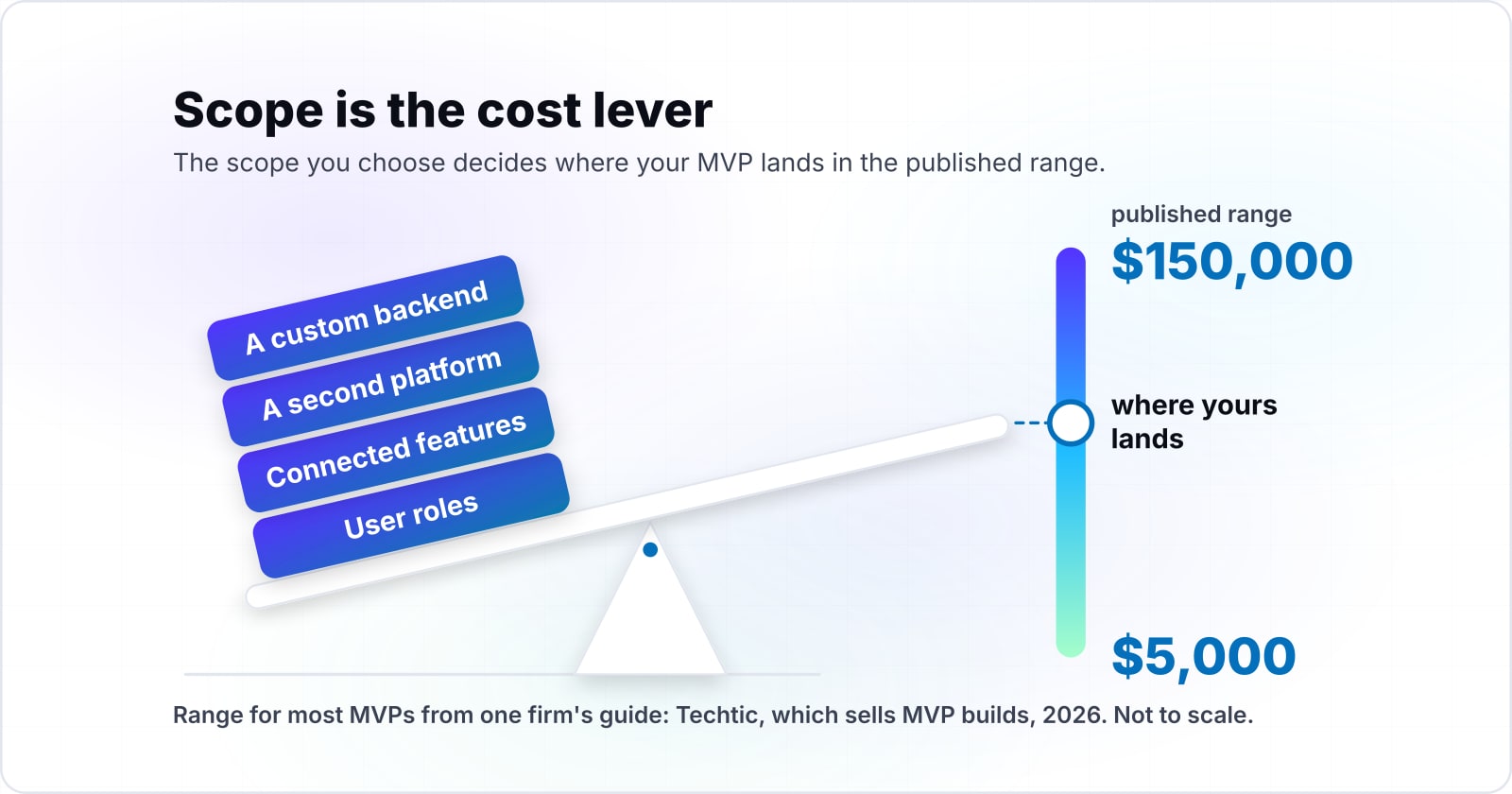
Techtic's 2026 guide, read in November 2026, puts most MVPs between $5,000 and $150,000, and the scope you choose decides where yours lands. Techtic sells MVP builds, so this is one firm's view of the market. Also, the range is very wide, and it is not careless. It runs from a simple product with one feature to a complex build with many integrations.
However, products that handle money or health records can run higher, to $250,000 and up. HIPAA, the Health Insurance Portability and Accountability Act, is the United States law on health data. Techtic's 2026 guide puts health and finance MVPs at $80,000 to $250,000 and up, while a fintech MVP there more typically runs $50,000 to $150,000 and up. In the same 2026 guide, HIPAA-compliant health MVPs usually cost $150,000 to $350,000. On top of the core build, Techtic's 2026 guide says HIPAA compliance alone typically adds $20,000 to $80,000. Then the same 2026 guide puts a secured environment with access control, encryption and audit logs at another $15,000 to $50,000.
| Item | Low end | High end |
|---|---|---|
| Most MVPs | $5,000 | $150,000 |
| HIPAA compliance adder | $20,000 | $80,000 |
| Security environment adder | $15,000 | $50,000 |
Because the spread is so wide, a range alone cannot price your product. It can only tell you that scope is doing the work. So our proof is a case study, not a range. A startup came to us with a rough prototype, 10 weeks left to hit an investor milestone and no developers in house. As the MVP case study records, the scope and delivery plan were agreed in the first 5 days. After that, the founder decided what waited in a demo and scope review every week. The first production-ready version shipped in 9.5 weeks. In short, the date held because the founder cut scope in each review, while back end and front end tracks ran in parallel from week 1.
Why do two published ranges disagree for the same kind of MVP?#
AddWeb Solution's 2026 guide prices a medium MVP at $20,000 to $45,000, while Chop Dawg's starts a focused MVP at $25,000, because each tier hides a different scope. Neither number is wrong. Instead, they describe different products under similar names.
A tier label such as simple or medium names no scope, so ranges from different publishers cannot be compared tier for tier. AddWeb Solution's 2026 guide splits its range into three tiers. Simple runs $8,000 to $20,000 there, and medium runs $20,000 to $45,000. AddWeb's complex or AI-native tier runs $45,000 to $100,000 and up, where AI-native means built around artificial intelligence (AI) features. Those AddWeb ranges assume an offshore or hybrid team. For a US build of the same scope, the same AddWeb guide says costs generally run two to three times higher. But Chop Dawg's 2026 guide uses two tiers instead, with no simple tier at all.
Show data table
| Dimension | Low end | High end |
|---|---|---|
| AddWeb simple | 8,000 US$ | 20,000 US$ |
| AddWeb medium | 20,000 US$ | 45,000 US$ |
| AddWeb complex | 45,000 US$ | 100,000 US$ |
| Chop Dawg focused | 25,000 US$ | 60,000 US$ |
Chop Dawg's focused tier starts above AddWeb Solution's simple tier and ends above its medium tier.
Both publishers sell MVP builds, so each range is that firm's own view of the market. Each also reflects its own team, location and way of working. For example, AddWeb Solution frames its figures as costs "with an efficient delivery model". That is a claim about how the firm works, not a market fact.
Therefore, the useful question is never which range is right. Instead, ask what each tier assumes is inside it. One firm's medium may include payments and a second platform, while another firm's focused tier may not. Until two quotes list the same features, comparing their totals compares two different products.
Which choices make an MVP cost more or less?#
Integrations, a second platform and extra user roles are three levers a founder controls, and Chop Dawg's 2026 guide puts a complex cross-platform MVP at $75,000 or more. Each adds work that a first version can often defer. Compliance is a fourth cost driver, but for a regulated product it is a floor rather than a lever. Also, Techtic's 2026 guide calls scoping "the single biggest lever on cost", and AddWeb Solution's 2026 guide calls the build model "the biggest lever on total cost".
Chop Dawg's 2026 guide draws the line clearly. In Chop Dawg's 2026 guide, a focused, single-purpose product costs $25,000 to $60,000. Then the same 2026 guide's $75,000 to $150,000 MVP, in Chop Dawg's words, "adds a custom backend, a second platform done natively where it matters, and a few connected features". So that gap is three named additions, and a custom backend is the server side of an app.
| Tier | Low end | High end |
|---|---|---|
| Focused MVP | $25,000 | $60,000 |
| Complex cross-platform MVP with a custom backend | $75,000 | $150,000+ |
- Integrations. Each outside system, such as a payment provider or a customer database, adds setup, testing and failure handling. One is often essential, while a third is often a nice-to-have.
- A second platform. Shipping on the web and on phones means two front ends to build and test. If your first users sit at a desk, the web alone may answer the question.
- User roles. An admin view, a manager view and a customer view are three products sharing one database. Also, every extra role adds permission rules to test.
- Compliance. Rules on health, payment or personal data add work before the first feature, as the Techtic adders show. Unlike the three levers above, it is a floor for a regulated product, not a choice to defer. The section on when a lean first version is the wrong fit covers it.
In short, these MVP development cost drivers sit beside rate and team location, which move the price too. AddWeb Solution's 2026 guide puts a US build of the same scope at two to three times its offshore or hybrid ranges. Still, any team has to build the second platform, so a driver you defer saves money at any rate.
How does scope work as the cost lever, and what does a first version leave out?#
An MVP is a product with just enough features to gather validated learning, so a feature that teaches nothing new is cost you can cut. That is how a 2016 study of software startups by Nguyen-Duc and Abrahamsson, published by Springer, defines it. The study describes MVPs as "products with just enough features to gather validated learning" about the product.
Every feature in a first version should earn its place by testing an assumption, and everything else waits. So write your assumptions down first. For example, "people will pay monthly for this report" is one assumption. And "managers will check the dashboard every week" is another. Then keep only the features that test them.
The same 2016 Springer study quotes one startup's chief executive with a blunt rule. "Don't spend your whole development budget, before finding that you need another iteration." In other words, a first version should leave room in the budget for the second one. If version one spends it all, nothing is left for what the users teach you.
In our case study, the first 5 days went into the scope and delivery plan. Then, in a demo and scope review every week, the founder decided what waited, while back end and front end were built in parallel. As a result, whatever did not fit the ten weeks went to a later release, not into the build.
What does a slipped milestone cost per week?#
At Clutch's review-based average of about $10,209 a month, as of November 2026, each week a first version slips costs about $2,356 in build spend alone. A slipped week has a price in build spend before it costs any runway.
Clutch's pricing guide, updated 21 September 2026, puts the average monthly cost of a software project at about $10,209, from verified reviews. In particular, that is Clutch's average across all the projects it reviews, not an MVP figure. Multiply that Clutch figure by twelve and divide by fifty-two, and it works out to about $2,356 a week. So on Clutch's figure, a four-week slip is about $9,424, and a twelve-week slip is about $28,271.
Price a slipped milestone
Set the weeks slipped and your monthly build spend; the defaults are a four-week slip and Clutch's review-based average of about $10,209 a month, updated 21 September 2026.
Build spend lost to the slip
$9,424
- Build spend per slipped week
- $2,356
Arithmetic on Clutch's average monthly project cost; an estimate, not financial advice.
Your own monthly spend will differ from the average. However, the shape holds for any team. A slip costs the build spend for those weeks, and it also burns runway that no build can return.
Runway, the months of cash a startup has left, is the larger cost for most founders. When an investor milestone is missed, a round can wait, and salaries keep running while it does. Although that second cost is real, it depends on your own burn rate, so it has no public figure.
Also, a slip can grow. A new feature requested in week six can cost more than one week. That is because it pushes testing, fixes and launch work back with it. The case study records a related cost. Because its back end and front end were built in parallel against an agreed contract, in its words "a late change costs more than it would in a build done one half at a time".
When is a clickable prototype the cheaper first step?#
A Figma Professional full seat costs $16 a month billed annually in November 2026, so the tool is the small part of a prototype's cost. When the open question is whether people understand and want the flow, a prototype answers it before any code is paid for.
A clickable prototype is a set of designed screens linked by hotspots. A tester taps through the flow as if it were real. Viget, an agency that builds MVPs, describes in a January 2023 article prototypes like these as built in a design tool like Figma, needing "no code to be written". And the same January 2023 Viget article, pricing its own clients' MVPs, puts a clickable prototype at $10,000 to $50,000. At Clutch's average, even Viget's low end equals several weeks of build spend. So the seat is only the tool, not the design work. Monthly billing is covered in a Figma staff reply on Figma's forum, dated 6 September 2026. In that reply, the same seat billed monthly costs $20.
Show data table
| Item | Value |
|---|---|
| Professional | 16 US$ |
| Organization | 55 US$ |
| Enterprise | 90 US$ |
A Professional full seat is the cheapest of the three, at $16 a month.
A prototype is the right first step when your doubts are about the flow. Can people find the main action? Do they understand what the product does from the first screen? Would they hand over an email address to try it? Those questions need screens, not a database.
However, a prototype cannot answer every question. It cannot show whether people will pay, whether the data is reliable or whether the product holds up under real use. If those are your open questions, a prototype only delays the build. In that case, skip it and spend the time on a smaller first version instead.
When does a no-code build beat writing code for a first version?#
Bubble's manual lists its Growth plan at $119 a month billed annually in November 2026, which suits a first version with standard flows and few integrations. No-code tends to be cheaper while the product is standard flows on one platform, and in our judgement the saving tends to reverse once custom logic or deep integrations arrive.
Bubble is a no-code platform, a tool for building working web and phone apps by arranging parts on screen instead of writing code. Bubble's pricing manual was read in November 2026. It notes that "Prices are listed per month." There, Bubble's web-only plans billed annually in November 2026 run $32 for Starter, $119 for Growth and $349 for Team. Billed monthly, the same Bubble plans cost $39, $134 and $399.
Show data table
| Dimension | Billed annually | Billed monthly |
|---|---|---|
| Starter | 32 US$ | 39 US$ |
| Growth | 119 US$ | 134 US$ |
| Team | 349 US$ | 399 US$ |
Each Bubble plan costs less a month when billed annually.
However, the plan is not the whole cost. Bubble's manual also meters each plan in workload units, its measure of the work Bubble does to power your app. So an app that does heavy processing can outgrow its plan as users arrive. Also, someone still has to build the app.
No-code wins when the first version is mostly forms, lists, accounts and standard payments on one platform. It also wins when the founder can build it alone and the question is whether anyone signs up. But code wins when the product's value is a custom calculation, a data pipeline or a deep link into another system. There, the platform's limits become the product's limits.
Then there is the move later: a no-code MVP vs custom build choice is also a choice about what happens if it works. Since rebuilding a working no-code product in code is a second project, plan for it rather than discovering it. For the wider question of building against buying a tool that exists, see custom software versus off-the-shelf software.
When is a lean first version the wrong fit?#
A lean first version is the wrong fit when a regulator, a payment network or an enterprise contract decides what launch must include before any learning starts. In those cases, budget the required launch scope as a full build and keep the lean rule for everything above it.
In practice, three cases come up most often:
- Regulated data. A product handling health records has a floor it cannot go below. Techtic's 2026 guide puts the HIPAA adder alone at $20,000 to $80,000, and that work cannot wait for version two. Better route: budget the compliance layer as fixed, then cut features above it.
- Payments and money movement. A payment network sets security rules before a single transaction runs. Better route: use a payment provider that carries most of those rules, and keep your own scope small around it.
- An enterprise contract. A large customer may require single sign-on, audit logs and uptime terms on day one. Better route: treat the contract's list as the launch scope, plan it as a full build, and test new ideas only beyond it.
In Chop Dawg's 2026 guide, a first version with a custom backend and a few connected features sits in a $75,000 to $150,000 band. Even so, that guide still calls it an MVP. Only scope beyond that band is, in Chop Dawg's words, "no longer an MVP; it is a full build". At that point, plan it as one.
Even here, the lean rule still applies above the floor. A 2021 study of 40 software startups by Nguyen-Duc, Kemell and Abrahamsson examined the tactics behind software development activities, using key events from each startup's journey. It found that MVP work tends to be associated with effectual logic, which starts from the means at hand rather than a fixed goal. By contrast, testing work tends to follow causal, goal-first logic. In our reading, that split suits a regulated product well: plan the required part, and stay flexible on the rest.
How do you turn public ranges into a number for your own first version?#
Clutch's review-based average project in November 2026 is about $132,480 over 13 months, so price an MVP from its own feature list, never from an average. An MVP estimate is built from its own scoped feature list. The general budget question is answered in our post on how a full software budget breaks down.
Clutch's pricing guide, updated 21 September 2026, puts the average project at about $132,480 and the usual timeline at about 13 months. However, that describes a full project, not a first version. A first version scoped to a few core features can sit well below it. That is why an average is the wrong place to start.
$132,480
Average software project
$10,209
Average monthly cost
The average project is a full build over about 13 months, not a scoped first version.
| Option | US dollars, review-based averages, cents dropped |
|---|---|
| Average software project | $132,480 |
| Average monthly cost | $10,209 |
Instead, build the number up from your own list:
- Write the assumptions the first version must test, one line each.
- List the features that test them, and nothing else.
- Mark each driver on that list: the integrations, platforms and roles you could defer, and the compliance work you cannot.
- Ask two or three teams to estimate the same written list, so their totals compare like with like.
- Price a slip with the calculator above, so you know what one lost week costs at the monthly spend you pick.
Finally, compare the quotes against the published tiers only after the lists match. If one quote sits far below the rest, ask which driver it left out. And if one sits far above, ask which driver it added. For how long the build itself should take, see the custom software development timeline.
Where should you go next with your first version?#
Set the scope first, then read how long a build takes and how to choose who builds it. The next step after pricing a first version is scoping it, then timing it, then choosing who builds it.
If the scope is still open, product discovery is the stage where that list gets cut before any estimate means much. For the timing question, read how long a software build takes. When you are ready to compare teams, read how to choose a software development company. Also, if you want a team to scope and build the first version, our MVP build service covers that work.
But none of that is required. The public ranges, the MVP development cost drivers and the slip arithmetic above are enough to price a first version yourself. Write the list, mark the drivers, and the quotes will start to agree.