Microsoft-Decision-1 Foundry decision automation: which calls to hand over, and what they return
Most teams make the same small calls hundreds of times a day. Here is how to find the ones a scoring model can take, keep people on the rest, and check the payback on your own numbers first.
What does Microsoft-Decision-1 do for a business?#
Microsoft-Decision-1 is a decision-scoring model in Microsoft Foundry that answers bounded questions about a record with a typed result and a probability, so the software you already run can act or escalate. In short, it is a decision scoring model for business workflows. Microsoft's how-to guide, updated 9 October 2026, says the model "returns a typed, numerical decision" rather than a written reply. Crypto Briefing reported that Microsoft announced it on 9 October 2026.
The guide offers three question types, and each one maps to a common business call.
| Question | Type | What comes back |
|---|---|---|
| Is this true? | noul | A probability from 0 through 1 |
| Which option is it? | choice | One selected option and the probability for each option |
| How much? | score | A value on an ordered scale and the probability for each level |
Source: Microsoft Learn, Deploy and use Microsoft-Decision-1, 9 October 2026.
However, what it does not do matters just as much. It gives no free text and no explanation of its choice. Therefore it suits a step where software needs a clean answer, not a paragraph.
Which decisions in your operation are a fit for Microsoft-Decision-1?#
A decision is a fit when it repeats at volume, picks from a known set of answers, and costs little to send to a person when the model is unsure. Microsoft's guide, updated 9 October 2026, says the model "works well for high-volume workflows". Those are flows that act on a probability, an option or a score.
So to automate repetitive business decisions with AI, run three questions on each manual call.
Volume
First, does it happen many times a day?
Known answers
Second, is the answer one of a fixed list, a yes or no, or a point on a scale?
Safe hand-off
Third, if the model is unsure, can a person pick it up without harm?
Then sort by the count. Three yes answers mean automate. Two yes answers usually mean assist, where the model suggests and a person confirms. Otherwise, keep the call human. For example, "which team owns this ticket" passes all three. Meanwhile, "should we sign this supplier" fails the first and the third.
Where does Microsoft-Decision-1 Foundry decision automation pay off by industry?#
Across e-commerce, finance, logistics, customer service and enterprise operations the pattern repeats: a routing, gating or ranking call that people make many times a day. So you find Microsoft-Decision-1 use cases by the shape of the decision, not the industry. Microsoft's October 2026 guide lists gates and filters, classification and routing, ranking and prioritization, grading, and choosing a model or tool.
In e-commerce, a gate can check whether a support reply promises a refund before it goes out. That example comes from Microsoft's own guide. For customer service, a choice question routes each ticket to billing, technical or account teams.
Logistics teams can rank delivery exceptions by severity with a score question. Then the worst ones reach a person first. Enterprise operations come next. Crypto Briefing reported in October 2026 that Microsoft is trialling the model for incident response and quality control.
Finance needs more care. For instance, an invoice can be routed to the right approver by the model. However, the guide says credit decisions about people need "meaningful human review", so a loan call stays with your team.
| Operation | Decision | How it is asked |
|---|---|---|
| E-commerce | A gate checks whether a support reply promises a refund before it goes out | Gate |
| Customer service | A choice question routes each ticket to billing, technical or account teams | Choice question |
| Logistics | Rank delivery exceptions by severity, so the worst ones reach a person first | Score question |
| Enterprise operations | Incident response and quality control, where Microsoft is trialling the model | Reported trial |
| Finance | Route an invoice to the right approver; a loan call stays with your team | Routing, with meaningful human review |
How does Microsoft-Decision-1 plug into the systems you already run?#
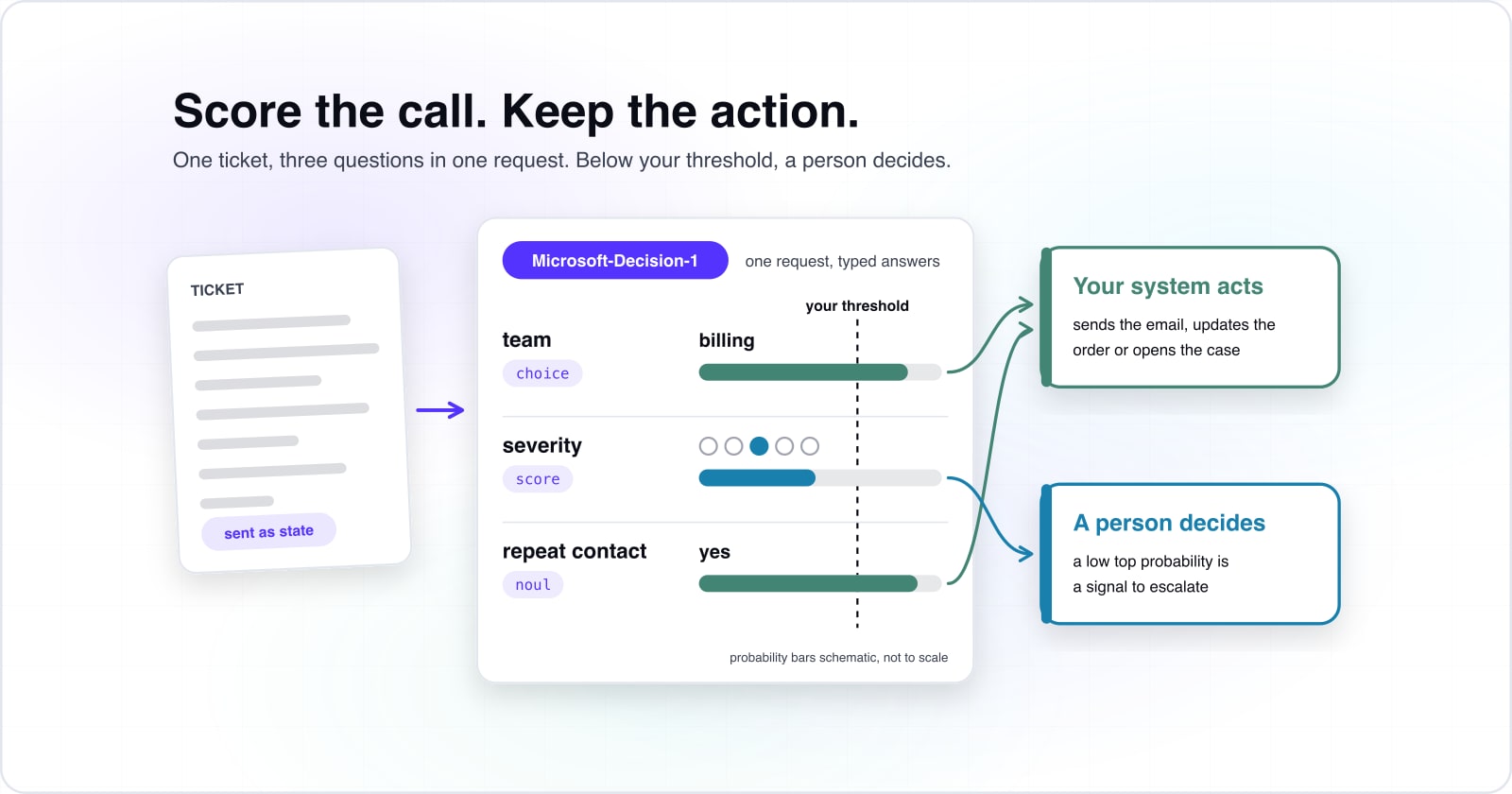
The call sits beside your existing software: your system sends the record as state, gets a typed decision back, and still carries out the action itself. So your help desk, order system or ERP keeps doing the work, and only the judgment moves. An ERP, or enterprise resource planning system, is the software that runs orders, stock and finance.
Microsoft's guide describes the request in plain terms. The state can be text or structured data. Then it asks one or more named questions. The answers come back under the same names, so your code reads them directly.
Also, related questions on one record can share one request. In Microsoft's example, one ticket gets a team, a severity and a repeat-contact check together. In short, nothing is replaced. Your system still sends the email, updates the order or opens the case.
How do confidence thresholds keep a person on the decisions that matter?#
Set a threshold for each decision from the cost of a wrong call, send everything below it to a person, and keep people as the final word on decisions about individuals. Microsoft's guide says to "use a low top probability as a signal to escalate the decision to a person or another model."
The guide also suggests an abstention option, such as "cannot tell". Because of that, the model can say it is unsure instead of guessing. The guide is firm on decisions about people, such as credit, jobs, housing, health and legal matters. There, use it for "decision support with meaningful human review." We cover the confidence dial in more depth in how small AI models make real-time decisions.
How much volume can each Microsoft Foundry quota tier carry?#
Microsoft Foundry allows Microsoft-Decision-1 between 60 and 900 requests per minute by subscription tier, which is 86,400 to 1,296,000 requests a day at a sustained rate, as of October 2026. Those limits come from Microsoft's quotas and limits page, updated 6 October 2026, which lists requests per minute (RPM) by tier. In short, even the lowest tier carries more daily decisions than most single workflows produce.
Show data table
| Item | Value |
|---|---|
| Tier 1 | 86,400 |
| Tier 2 | 216,000 |
| Tier 3 | 324,000 |
| Tier 4 | 518,400 |
| Tier 5 | 720,000 |
| Tier 6 | 1,296,000 |
Even Tier 1 carries 86,400 requests a day at a steady full rate.
| Tier | Requests per minute (RPM) |
|---|---|
| Tier 1 | 60 |
| Tier 2 | 150 |
| Tier 3 | 225 |
| Tier 4 | 360 |
| Tier 5 | 500 |
| Tier 6 | 900 |
As a result, Tier 1's limit of 60 per minute on Microsoft's October 2026 quotas page gives 86,400 requests a day. That assumes perfectly even traffic. However, real traffic comes in bursts, so plan for your busiest minute rather than the daily average. When the limit is hit, Microsoft's guide says to retry with exponential backoff or request more quota.
How do you measure the return before you commit?#
In a worked example of 2,000 support tickets a day, the return is the share of tickets that clear your threshold multiplied by the minutes a person spent triaging each one. Because your own numbers differ, measure them in a shadow run before anything goes live.
Say, for this example, each ticket asks three questions in one request, so the desk sends 2,000 requests a day. That sits far under the 86,400 a day that Microsoft's quotas page, updated 6 October 2026, allows at Tier 1. Now say, as an illustrative assumption, that 70% of tickets clear your threshold. Also say triage took a person three minutes each.
In this modelled example, 1,400 tickets a day then skip manual triage. That saves 4,200 minutes, or 70 hours a day. The other 600 still go to people, and that is by design.
Hours of manual triage returned per day on your own numbers
Put in your decisions a day, the share that clears your threshold and the minutes a person spends on each; it returns the hours returned per day and the share still sent to people.
Hours returned per day
70 h
- Share still sent to people
- 30%
The defaults are illustrative, not measured. Change them to your own.
Your own clearance rate is unknown until you test it. So follow Microsoft's advice to validate on data that represents your use case, and to check results against labelled examples.
When is Microsoft-Decision-1 the wrong tool?#
Use a rules engine when the policy is already exact, a generative model when the task is to write or explain, and keep people in charge of consequential decisions about individuals. First, a rules engine wins when your policy is a fixed formula. One example is "orders over a set value need approval". It is cheaper to run. It is also easier to audit. However, it cannot weigh a messy free-text message, which is where a scoring model helps.
Second, a large language model wins when the task is to write. Microsoft's guide is direct on this point. It says to "use a generative LLM instead when the application needs to create, summarize, rewrite, or explain content." However, it returns prose, not a typed answer, so your code has more to check. You can also pair them, using the scoring model to route and the writing model to reply. Our post on when a small typed model beats a general one weighs that trade.
The guide also lists known limits you should plan around.
| Limit | What Microsoft's guide says |
|---|---|
| Fairness | Don't use its scores as the sole basis for decisions about individuals |
| Wording sensitivity | Scores can change based on how you phrase or order questions and options |
| Reliability | Calibration is strongest on familiar task types |
| Harmful content | It might miss subtle harmful content or flag benign content |
Source: Microsoft Learn, Deploy and use Microsoft-Decision-1, 9 October 2026.
One warning deserves its own line: "Poorly framed questions still return scores." Also, the speed and accuracy results Microsoft published at launch are self-reported, as Crypto Briefing noted in October 2026.
What is the first step for your team?#
Start with one high-volume decision your team already makes, run the model in shadow beside them, and compare its scores with what your people chose.
- Step 1
Pick one decision
For example, pick the call your team makes most often, such as ticket routing.
- Step 2
Run it in shadow
Then run the model beside them for a few weeks. Do not act on its answers yet.
- Step 3
Compare and set the threshold
After that, compare its choices with theirs and set the threshold where the two agree on the calls that matter.
- Step 4
Switch on above the line
Only then should you switch it on for the share above the line.
If your decisions live in older software, adding AI to an existing system without breaking it covers that path. For a built example of classify-then-route, see routing form submissions with AI. When you want help, our teams handle integration with your existing software, AI-augmented development and ongoing maintenance and support. Still, Microsoft's how-to guide is enough on its own to run your first test.