TypeSafe AI Jev vs LLMs: when a small typed model fits your enterprise
A small typed model can be many times faster and cheaper than a frontier LLM, but only on work whose every possible answer can be written down first. The question for an enterprise is which of its workloads have that shape, and which still need a model that reasons in the open.
Why is TypeSafe AI Jev vs LLMs 40-200x faster and 40-400x cheaper than frontier LLMs?#
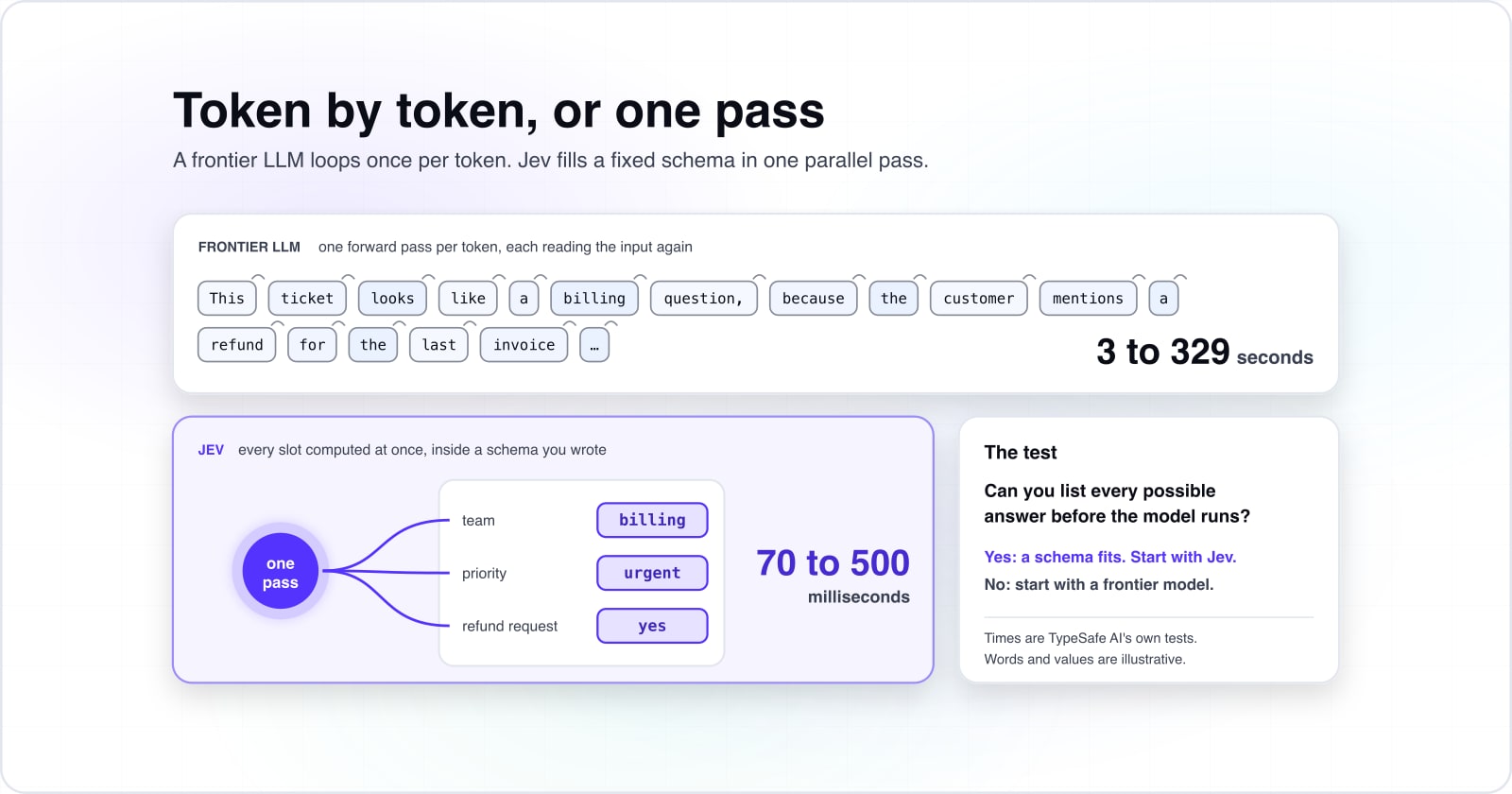
Jev trades autoregressive token-by-token generation for parallel inference and schema-constrained output, eliminating the latency and cost of frontier LLMs on structured tasks, but sacrificing reasoning flexibility. A frontier LLM writes its answer one token at a time in a loop, so its latency and its bill both grow with the length of the answer. Jev never writes text, because it fills in typed slots you defined in advance, all at once, in a single pass.
The mechanism is easy to picture. When a model must produce N tokens one after another, it runs N forward passes, and each pass reads the whole input again. When the answer shape is fixed, a model can compute every slot in one pass. So the loop disappears, and with it most of the latency and most of the compute.
In practice the vendor's own figures make the range clear. TypeSafe AI's launch post puts the full response time of frontier models at 3 to 329 seconds on its System One tests. Jev answers the same tests in 70 to 500 milliseconds, by TypeSafe AI's own figures. That is where its "40x to 200x faster" range comes from. The 193.6x figure on its homepage is the high end of those tests, and TypeSafe AI says so itself.
The cost side has two parts. First, Jev charges only for input tokens, and output tokens are free, and second, the input price itself is very low. TypeSafe AI lists Jev at $0.042 per million input tokens, which is $42 per billion. By contrast, Anthropic's pricing page lists Sonnet 5 at $2 per million input tokens and $10 per million output tokens as of September 2026. So on input alone the list price gap is about 48 times, and output tokens widen it from there.
| Input (per M tokens) | Output (per M tokens) | Output type | |
|---|---|---|---|
| Jev | $0.042 | Free | Typed decisions |
| Sonnet 5 | $2 | $10 | Prose text |
How much can enterprise save by using Jev for classification and routing at scale?#
For say 10,000 routing decisions a day, Jev runs at under a dollar a day where a frontier model at its published list price runs near $50, which frees budget for higher-value work. The arithmetic is simple, and it is an illustration, not a benchmark. Assume each decision reads say 2,000 input tokens and returns 100 output tokens. At the frontier list price above that is about $40 of input and $10 of output a day, so about $50. On Jev the same input costs about $0.84 a day, and the output costs nothing.
The gap grows with volume, because the per-decision cost is fixed. Suppose an intake pipeline handles say 300,000 queries a day. Then the frontier bill is about $1,500 a day and the Jev bill is about $25 a day. Over a year that is roughly $540,000 of difference on one pipeline, on list prices. Volume discounts on either side would move it.
Return on that saving depends on three things. They are how many decisions you run, how much of the frontier bill was output tokens, and how well your task fits a schema. For routing and classification, all three favour Jev. But for open-ended work the comparison never starts, because Jev cannot run the task. So the saving is real only for the share of your workload that has a fixed answer shape. The first job is to measure that share.
For example, take a support desk that routes tickets to the right team. You need speed because the customer is waiting. You need low cost because every ticket is a decision, and accuracy because a wrong route is a second wait. A model that answers in under half a second at a fraction of a cent per ticket changes what you can afford to automate. And the money you save funds the software engineering work that matters more. That work is testing accuracy on your own tickets and tuning the schema.
Or take message classification at an email security firm. The question is fixed: phishing, spam or legitimate. For say 50,000 messages a day at 1,000 input tokens each, the frontier list price is about $125 a day. Jev is about $2 a day. If the question changes to "summarise this thread and list the action items", the shape is no longer fixed. Then a frontier model is back in the picture.
Show data table
| Item | Value |
|---|---|
| 10K decisions/day (frontier) | 50 |
| 10K decisions/day (Jev) | 0.84 |
| 300K decisions/day (frontier) | 1,500 |
| 300K decisions/day (Jev) | 25.2 |
The per-decision cost is fixed, so savings grow with volume.
What is TypeSafe AI Jev and how do System One models differ from frontier LLMs?#
TypeSafe AI's Jev is a System One model: a small, typed model trained on RLCD (Reinforcement Learning for Calibrated Decisions) to produce structured, schema-constrained output without autoregressive hallucination risk. Jev returns typed decisions, not prose, and the name comes from psychology. There, System One is fast, automatic thinking and System Two is slow, deliberate reasoning. TypeSafe AI released Jev in September 2026 in early access.
A System One model commits to a schema before it runs. Then it computes a decision that fits that schema, and nothing else. A frontier LLM is System Two by design: it reasons step by step and discovers the shape of its answer while writing it. That flexibility is what makes it good at reasoning. But it is also what makes it slow and costly when the answer shape was known before you started.
So System One is not a replacement for System Two, but a different tool for a different job. The vendor's own framing is simple: LLMs produce words for people, and Jev produces typed decisions for software. That is a useful test to keep in mind when you look at your own workloads. To price and bound one before it takes traffic, see System One models for enterprise AI: cost per document, the confidence threshold and what your code must refuse.
| System One (Jev) | System Two (frontier LLM) | |
|---|---|---|
| Thinking style | Fast, automatic | Slow, deliberate reasoning |
| Answer shape | Fixed by a schema before it runs | Discovered while writing |
| What comes out | Typed decisions | Words |
| Who reads it | Software | People |
How does parallel inference make Jev 40-200x faster than autoregressive frontier LLMs?#
Frontier LLMs generate text token-by-token in a loop, causing latency and cost to scale with output length; Jev generates all tokens in parallel within a schema, hitting speed and cost limits before generation even starts. The difference is in the architecture, not in the size of the model alone. An autoregressive model writes one token, reads the whole input plus that token, then writes the next. So for an answer of N tokens, that loop runs N times.
Jev is non-autoregressive. It predicts every typed answer in one forward pass. So there is no loop, no chain of dependencies, and no wait for the previous token. Because latency no longer scales with output length, a ten-field answer and a one-field answer take about the same time. And because compute is fixed per query, the cost per decision is fixed too. The floor is set by model size and hardware, not by how much the model has to say.
The trade-off is exactly what you would expect. Jev cannot write a sentence it has not seen the shape of. But it can fill every slot in a schema you define. That is what classification, routing and extraction need. When the answer is a category, a yes or no, or a fixed set of fields, the loop was never doing useful work.
Show data table
| Item | Value |
|---|---|
| Jev | 285 |
| Frontier LLMs | 166,000 |
Parallel inference computes all answers at once. Autoregressive generation writes one token per forward pass.
How does RLCD training give Jev calibrated confidence instead of hallucinated text?#
RLCD (Reinforcement Learning for Calibrated Decisions) trains Jev to output confidence scores for each decision rather than text, so it avoids hallucination and can route to a frontier model when confidence is low. Each answer comes with a probability that the model is right. When that probability falls below a threshold you set, say 0.7, the case escalates to a frontier model or to a person. So the uncertain cases get the expensive reasoning, and the clear cases do not.
Compare that with how a text model fails. A frontier LLM can hallucinate because it writes free text. So it can invent a field, misquote a source or return malformed output. Jev only ever returns a value from the schema, so a malformed answer is impossible by construction. But it can still be wrong. TypeSafe AI is careful on this point. Jev cannot hallucinate a malformed answer, but it can absolutely disagree with the reference answer. A type-safe wrong answer is still wrong, which is why the confidence score matters.
Together, the two properties give you a two-tier design for high-volume, low-stakes decisions. Most cases stay on Jev, fast and cheap. The uncertain ones escalate to a frontier model, slower and costlier but able to reason. So you pay frontier prices only for the hard cases. And you get a measured confidence on every decision instead of a guess.
What do independent evaluators and real-world projects say about Jev's claims?#
Independent evaluators confirm Jev's latency and pricing but qualify the multiplier claims and note accuracy gaps. The Kingy AI review benchmarks Jev at lower latency than frontier models and confirms the 48x input price advantage. Pere Pages' analysis on pearpages qualifies the speed multipliers (193.6x is against the slowest baseline) and notes that the tests were written by TypeSafe AI's own team. ActionBox Cloud's enterprise testing finds the latency numbers hold on real workloads but notes that accuracy varies by task class and baseline data quality.
Real-world projects show where a constrained model fits. Browser Use uses Jev for element selection and action routing on web automation, which has a fixed schema of UI actions: "route this click to button A or button B". The jev-trader trading agent executes buy and sell decisions at high frequency, with the schema fixed to "buy, sell or hold". Flowtivity uses Jev to route service requests to the right team, a classification decision. None of these claims more than what the fixed schema allows. So the independent coverage and the project list both draw the same line: latency and pricing gains are real when the output shape is fixed.
| The vendor's claim | Multiple | Measured against |
|---|---|---|
| Speed, low end of the range | 40x | Frontier LLMs on TypeSafe AI's own System One tests |
| Speed, homepage figure | 193.6x | The slowest baseline, the high end of those tests |
| Cost, homepage figure | 444.6x | Frontier LLMs, a high-end figure on the same tests |
Which enterprise workloads fit a constrained model?#
Real projects demonstrate the fit for constrained models: routing UI actions, executing trades every 300ms, classifying service requests at 40k decisions a month. The test is whether you can list every possible answer before the model runs. If you can, the task has a fixed schema and a constrained model fits. If you cannot, the model has to discover the answer shape. That is reasoning.
Jev fits the fixed-schema side. Form routing asks "which team?". Message classification asks "spam, urgent or routine?". Intent detection asks "is this a refund request?". Data extraction pulls a name, a date and a phone number into named fields. Validation checks whether a record fits a schema. Sentiment picks positive, neutral or negative. Entity extraction finds the people, places and companies in a document. And every one of these asks the same thing. Which of the known answers fits this input?
Frontier models fit the open-ended side. Analysis, narrative writing, multi-step reasoning, creative work and complex judgement all need the model to work out the answer's shape. So a constrained model has no room to do them. The vendor's own list agrees. It names verifiable problems, agents and creative writing as work that stays with LLMs. And it names "smart if-statements" inside ordinary software as the work Jev is built for.
In the end the boundary is the schema. If you can write the outputs down before you run the model, start with Jev. If the outputs depend on reasoning through the input, start with a frontier model. For how a decision like this fits a larger system, see the enterprise software development guide. And for what happens when a fixed process meets an open-ended one, see why CRM projects fail.
What your decisions would cost on each model
Put in your own decisions a day and token counts. It prices them at the list prices above, and lets you pass a share of decisions from Jev on to a frontier model, the two-tier design described earlier.
Difference over a year
$17,943
- Frontier model, per decision
- $0.005
- Frontier model, per day
- $50
- Jev, per day
- $0.84
- Share of the frontier bill saved
- 98%
List prices from September 2026, not a benchmark. Change them to your own.
When not to use Jev: the real limitations of a System One model#
Constrained models lose accuracy on complex reasoning, multistep analysis, and novel patterns; if a task requires open-ended judgment or involves reasoning chains, a frontier model is non-negotiable. Jev is the wrong tool for reasoning, multi-step analysis, novel patterns and any judgement outside its training domain. For example, a model trained to answer "is this email spam?" will sort ordinary email well. But it has no way to reason about a new kind of attack that does not look like the ones it learned.
Accuracy also varies by task shape. So measure it on your own data before you trust a vendor number. A binary decision is the easiest case. Then a ten-way route is harder, because the classes crowd each other. And a long extraction, such as every clause in a contract, is harder still. It needs an understanding of structure that a one-pass model does not build. Where a mistake is expensive, in medical triage, legal review or fraud decisions, use a frontier model or a person. Or use both tiers, so Jev picks the candidates and a frontier model checks them.
Avoid Jev, too, when the output shape is not known in advance. The model would have to decide what to extract as well as where to put it. Avoid it for anything a customer reads as a conversation. If your customers expect a chatbot that explains its reasoning, Jev will disappoint them. If they expect a form router that sends their request to the right team in under a second, it is a strong fit. And read the vendor's figures the way TypeSafe AI itself suggests. The homepage numbers are the high end, and the tests were written by the vendor's own team. And the frontier comparison used a wrapper that TypeSafe AI says is slower and costlier than a plain LLM call.
| Task shape | Where it belongs |
|---|---|
| A binary decision | Jev: the easiest case |
| A ten-way route | Jev, once accuracy is measured on your own data |
| A long extraction, such as every clause in a contract | Harder still for a one-pass model; measure before you trust it |
| A costly mistake: medical triage, legal review, fraud | A frontier model or a person, or both tiers |
| An output shape not known in advance | Not Jev |
| Anything a customer reads as a conversation | Not Jev |
Where should I go next to evaluate other AI models and architectures?#
To evaluate other constrained or small models, use the schema-based decision framework above; for architectural guidance on routing and escalation patterns, see the enterprise architecture posts. The method works for any vendor, not just this one. First, list the decisions your systems make at volume and mark the ones with a fixed answer shape. Second, price the frontier version of each on list prices, output tokens included. That is where the gap sits. Third, run a small typed model on a sample of your own data, and measure accuracy and confidence before you believe a headline multiple. Cloudflare's 9 October 2026 launch post calls Clef fully Jev-API compatible. So the same test applies when choosing between Clef, Clef-flash and Clef-omni.
For building the routing and escalation layer around a model like this, see our enterprise software services and our full-stack development page. For the broader design questions, read the enterprise software development guide. And for the vendor's own receipts, the TypeSafe AI launch post publishes its tests, its caveats and its pricing in one place. The documentation is enough to decide, and you do not need a sales call to do it.