How to hire UI/UX product designers and test the work before you commit
Every portfolio you open looks polished, and you cannot tell good design from good styling. That is a normal place for a growing company to start, and it can be fixed before the first interview.
How to hire UI/UX product designers when you cannot judge design yourself?#
Write three to five pass lines before the search, read portfolios for the decisions they explain, and replace the unpaid test with a paid pilot on your own product. Each move covers a gap that taste would otherwise fill. First, the pass lines say what good means for your product. Second, the portfolio read tells you whether a person can explain a choice. Then the pilot shows whether they can make good choices on your problem, with your team, in your tools.
In short, every later step gets judged against one sheet of paper. So you stop asking "do I like this?" and start asking "did this meet line three?" And even a founder with no design training can answer that second question.
Also, the order matters as much as the moves. First the lines, then the budget, then the portfolios, then the pilot, and finally the first month. However, hiring often goes the other way round. It starts with portfolios, picks the one that looks best, and only then tries to say what the job was. The rest of this guide takes each step in turn.
Do you need a product designer or a UI/UX designer?#
A UI/UX designer shapes the interface and the experience, while a product designer also owns which problem is worth solving, so decide by the decisions you hand over. A paper posted on arXiv on 27 April 2026 studied UI/UX designers at work. It opens with this line: "Designers hold primary responsibility for shaping the user interface (UI) and user experience (UX) of a product." The same paper notes that the privacy side of that work often emerges through collaboration with developers, product managers and marketing teams.
So ask one question first. Say someone else will decide what to build. If the designer then decides how it works and looks, a UI/UX designer fits. But if the designer will also help decide what to build, from research with your customers, you want a product designer. Still, titles blur in practice. For instance, O*NET OnLine, a US occupation database, lists User Experience Designer among its example apprenticeship titles for web and digital interface designers.
Either way, the method is the same. How to hire a product designer and how to hire a UI/UX designer differ only in the pass lines. Pay, though, separates interface design from visual design far more clearly than any title does.
Show data table
| Item | Value |
|---|---|
| Graphic designers | 62,960 |
| Web developers | 92,650 |
| Web and digital interface designers | 104,000 |
| Computer occupations | 109,470 |
| Software developers, quality assurance analysts and testers | 134,040 |
Pay separates interface design from visual design far more clearly than any title does.
What should you write down before the search starts?#
Write three to five pass lines, each one a thing the first weeks must produce and each judged met or not met, before a single portfolio is opened. In practice, a good line names an output and a test a non-designer can run. "Ships a checkout flow that three customers finish without help" is a pass line. But "Has a great eye" is not, because nobody can mark it met.
The sheet also helps the candidate. A study of tech hiring, posted on arXiv on 14 February 2026, found that candidates read "comprehensive and transparent job advertisements" as a sign of a fair process. Therefore, put the lines in the job post itself. As a result, the right people apply, and the rest select themselves out.
Atyantik's designer engagements start the same way. On the page where you hire dedicated UI/UX designers, a client brief becomes three to five things the pilot must produce, each judged without appeal to taste.
What does a UI/UX or product designer cost in the US?#
The US Bureau of Labor Statistics put the median annual wage for web and digital interface designers at $104,000 in May 2025, accessed October 2026, with the top 10 percent above $201,550. In the same BLS handbook, updated on 27 August 2026, the lowest 10 percent earned less than $53,750.
That spread is the real lesson, because designers with the same job title can sit at either end of it. In practice, the pass lines decide where on that range you should look. A sheet that asks for customer research, a redesign and handover files reads as senior work. On the other hand, a sheet that asks for polish on screens someone else has planned reads as more junior work.
Show data table
| Item | Value |
|---|---|
| Lowest 10 percent earned less than | 53,750 |
| Median | 104,000 |
| Highest 10 percent earned more than | 201,550 |
Designers with the same job title can sit at either end of this range.
Salary websites can print figures that disagree with each other. Instead, the BLS publishes its figure with the date of the data and a plain definition: the median is the wage at which half the workers earned more and half earned less. So use it as the anchor, and treat any other number as a claim to check against it. Also, outside the US the BLS figure still works as a reference point, though local pay will differ.
How do you judge a portfolio when you are not a designer?#
Read each case study for the decisions it explains, what was traded away and why, because a screen shows taste and an explained decision shows judgment you can question. A 2025 arXiv study of UX practice points to "the central role of design judgment in navigating uncertainty". The same paper names shifting stakeholder priorities, team dynamics, limited resources and implementation constraints as sources of that uncertainty.
So a strong case study reads like a story of constraints. It names the problem, the people involved, and what could not change. Then it shows the choice and what the designer gave up to make it. By contrast, a weak case study is a gallery of finished screens with adjectives beside them.
Ask these five questions of any case study, and write down the answers:
| Question to ask | A strong answer names |
|---|---|
| What problem was this solving, and for whom? | The problem and the people involved |
| What did you try first that did not work? | A limit |
| What did you give up, and why was that the right trade? | What the designer gave up to make the choice |
| Who disagreed, and how was it settled? | A person |
| How did you know it worked after launch? | A result |
Also, you do not need design training to hear a weak answer. Vague answers, every choice framed as obvious, and no mention of a developer or a constraint are all signs. Meanwhile, a strong answer names a person, a limit and a result. Then hold each answer against your pass lines. After all, a portfolio full of polished marketing screens says little about line one if line one is about research.
What does an explained design decision look like on a real site?#
A design decision worth reading names the choice, the reason and what it rules out, the way a design token contract records why each value exists beside the value itself. A design token, in the words of the U.S. Web Design System, is one of the "discrete elements of style" such as colour, spacing and type. In other words, tokens are the short list of approved values a product is allowed to use.
Atyantik's own website is built this way. First, the design starts in a Figma file. Then a written contract lists every colour, size and spacing value the site may use. It is a plain text file the software engineers read. And beside many values sits the reason for it.
For example, the file allows four text colour roles: headings, body text, small captions and links. A note beside them says a fifth role needs a written decision first. Elsewhere, two greys that looked nearly the same were folded into one, and the note says so. In particular, the colours for success, warning and info labels were picked for contrast. Each one passes the level that accessibility guidance sets, on each of the site's main background colours.
None of that is visible in a screenshot. Yet each line answers the questions from the last section: what was chosen, why, and what it rules out. So that is the evidence to ask a candidate for. When you interview, ask to see a design file or a token list, not just the pictures. Then ask why one value exists. The design handoff checklist lists what that file should hold before a build starts.
Why does an unpaid design test tell you so little?#
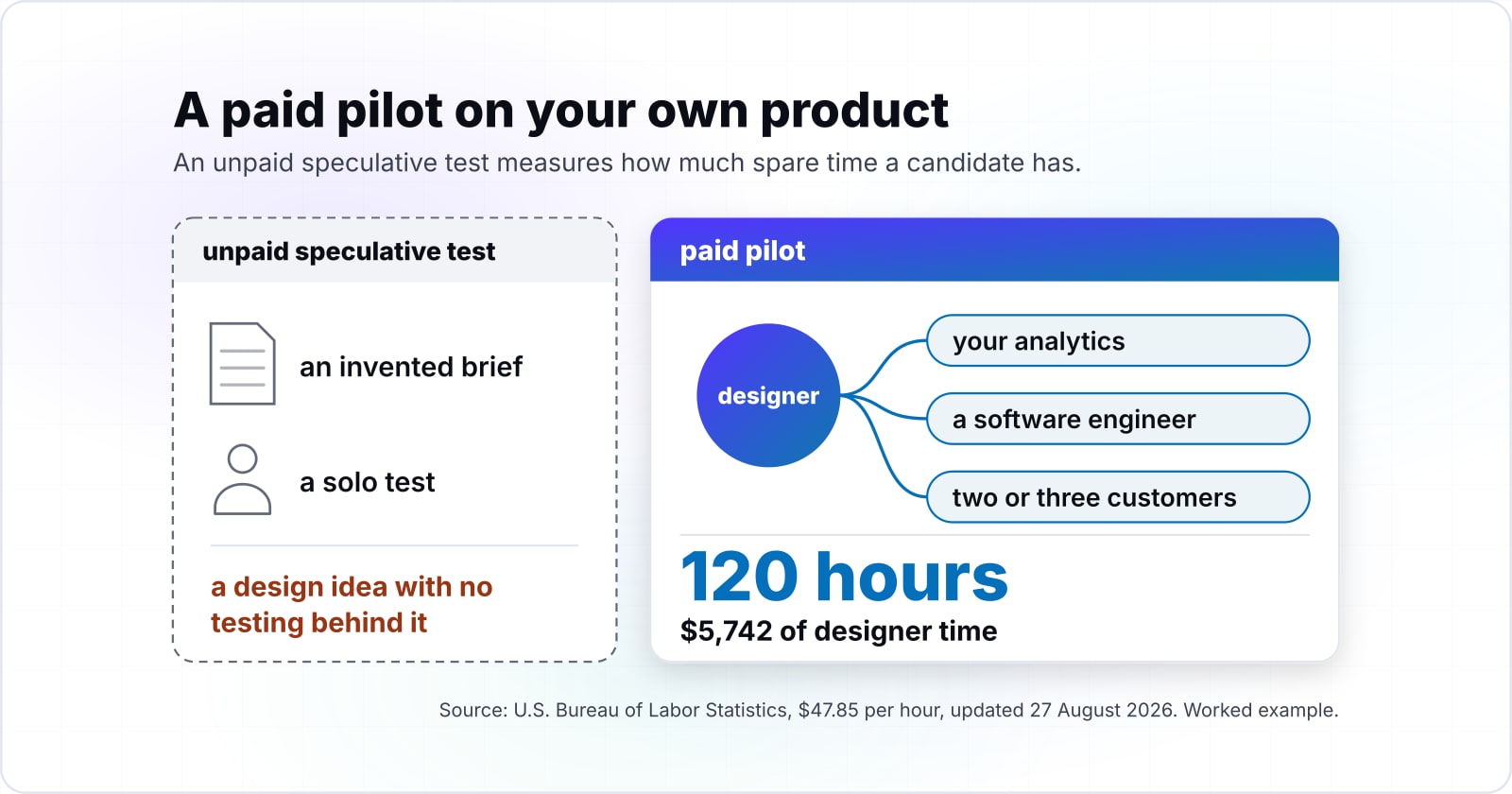
An unpaid speculative test asks for free work on an invented brief, so it measures how much spare time a candidate has rather than how they work on your product. iCreatives is a staffing firm. It puts the designer's view bluntly: "a graphic test is just unpaid work." It adds that such a test "won’t give any information about a potential job candidate’s ability to work on a team".
That second point matters most, because design is done with other people. A designer works with developers, product owners and customers. But a solo test on an invented brief removes all of them, and so does any product designer test task set as homework. As a result, you see a design idea with no testing behind it.
The test also filters the wrong way. Artisan Talent, a creative staffing firm, warns that unpaid multi-day tasks quietly filter for people who can afford to work for free. Its rule of thumb is simple: "A skills assessment might be unpaid, whereas a working interview is a job." Still, Artisan Talent allows one exception. A short, generic task of twenty to thirty minutes that tests thinking, not output, can stay unpaid.
Yet the cost of fixing this is small. At the BLS 2025 median of $47.85 per hour for web developers and digital designers, one hour of a designer's time is worth about $48. For that sum, you get work on your product instead of a guess about someone else's.
$48
One hour of designer time
$5,742
A three-week paid pilot of 120 hours
For that sum, you get work on your product instead of a guess about someone else's.
| Option | designer time, US dollars |
|---|---|
| One hour of designer time | $48 |
| A three-week paid pilot of 120 hours | $5,742 |
What should a paid pilot on your own product look like?#
A paid pilot puts the designer on one real problem in your own product for a fixed number of hours, judged against the pass lines written before the search. First, pick a problem you already know matters, such as a sign-up step people abandon. Then give the designer real access: your analytics, a software engineer, and two or three customers to talk to.
Here is a worked example. Say the pilot runs three weeks at 40 hours a week, so 120 hours in total. At the BLS 2025 median of $47.85 per hour, those 120 hours come to $5,742 of designer time. Likewise, at the same BLS rate, a one-week pilot of 40 hours is $1,914, and two weeks is $3,828.
Designer time a paid pilot buys
Set the pilot length in hours; it multiplies them by the BLS 2025 median hourly pay for web developers and digital designers.
Designer time for the pilot
$5,742
- One hour of an unpaid test, for comparison
- $48
Designer time at the 2025 median hourly pay, U.S. Bureau of Labor Statistics Occupational Outlook Handbook, updated 27 August 2026.
The figure is designer time at the median wage, not a quote, since a contractor or a partner will price differently. Still, it tells you the scale of what you are buying.
In return, you get evidence no free test can give. For example, you see how the designer asks questions, works with your software engineers, and handles a customer who says something surprising. Then you walk the pass lines, one by one.
Should the designer be an employee, a freelancer or a dedicated hire?#
Choose the engagement by how long the design work lasts and who on your side can judge it, because the pilot and the pass lines work in all three. A freelancer suits a defined piece of work with an end date. In contrast, an employee suits years of work on one product. A dedicated designer through a partner sits between the two, and the partner handles replacement.
The comparison of these three models for software roles is covered in dedicated developer vs freelancer, and the same logic applies to a designer. But one factor is specific to employees. In BLS data for May 2025, the median web and digital interface designer earned $87,640 in wholesale trade and $133,260 in finance and insurance. So your industry moves the budget too, not only seniority.
Show data table
| Item | Value |
|---|---|
| Wholesale trade | 87,640 |
| Computer systems design and related services | 109,990 |
| Information | 130,140 |
| Finance and insurance | 133,260 |
Your industry moves the budget too, not only seniority.
Then ask who will judge the work. If no one on your side can walk the pass lines each week, a freelancer working alone will drift. In that case, pick a model where someone else reviews the work too.
What should the first month produce?#
The first month should end with every pass line walked one by one, met or not met, and with design files and findings already in your own accounts. Do the walk in a meeting, with the sheet on screen, and give no partial credit. "Mostly met" is not met.
Then decide what a miss means. A miss on a line you wrote well is a reason to change the designer. In contrast, a line that turned out to be wrong gets rewritten for the next cycle. But you never soften a good line so a weak result can pass it.
Atyantik's model for designers works the same way. At the end of the pilot, the sheet is walked line by line, met or not met. Then a wrong line is rewritten for the next cycle, not quietly softened. On a miss, Atyantik replaces the designer and re-runs the pilot.
If the designer joins a team you already have, the first month is also about fit. So they should sit in your planning, review work with your software engineers, and ship at least one change into the product. The trade-offs of adding one person to an existing team are covered in dedicated team vs staff augmentation.
When is a paid pilot the wrong fit?#
A paid pilot is the wrong fit when there is no product yet to work on, when the need is a single visual asset, or when nobody on your side will judge the result. Yet each case has a better tool.
First, with no product yet, a pilot has nothing real to test against. Instead, start with a prototype: a clickable model you can put in front of customers before any code exists. A product prototyping engagement fits that stage.
Second, a logo, a deck or an ad set does not need a UI/UX designer at all. A graphic designer is the better fit. In BLS data for May 2025, the median graphic designer earned $62,960 a year, against $104,000 for a web and digital interface designer.
Third, if no one on your side has the time to walk the pass lines, the pilot has no judge. In that case, hire a design team that owns the outcome and reviews its own work, such as a UI/UX design service. Then hold that team to the same sheet.
| Case | The better tool |
|---|---|
| No product yet | A prototype: a clickable model you can put in front of customers |
| A logo, a deck or an ad set | A graphic designer: $62,960 median a year, against $104,000 for a web and digital interface designer |
| No one on your side has the time to walk the pass lines | A design team that owns the outcome, held to the same sheet |
Where do you go from here?#
Start with the pass lines this week, then use the related guides and the design pages below for the step that comes next on your side. Write three to five lines, each one met or not met. Once written, that sheet alone will change how you read every portfolio.
For the engagement model, dedicated developer vs freelancer sets out the trade-offs. And for a designer joining an existing team, see dedicated team vs staff augmentation. Then, for the same first-month test applied to a whole software partner, read how to choose a custom software development company.
If you want this model run for you, you can hire dedicated UI/UX designers on a pilot judged against written criteria. The UI/UX design and product prototyping pages describe the design work itself.