Hiring the right React developer: skills, evaluation, and common mistakes
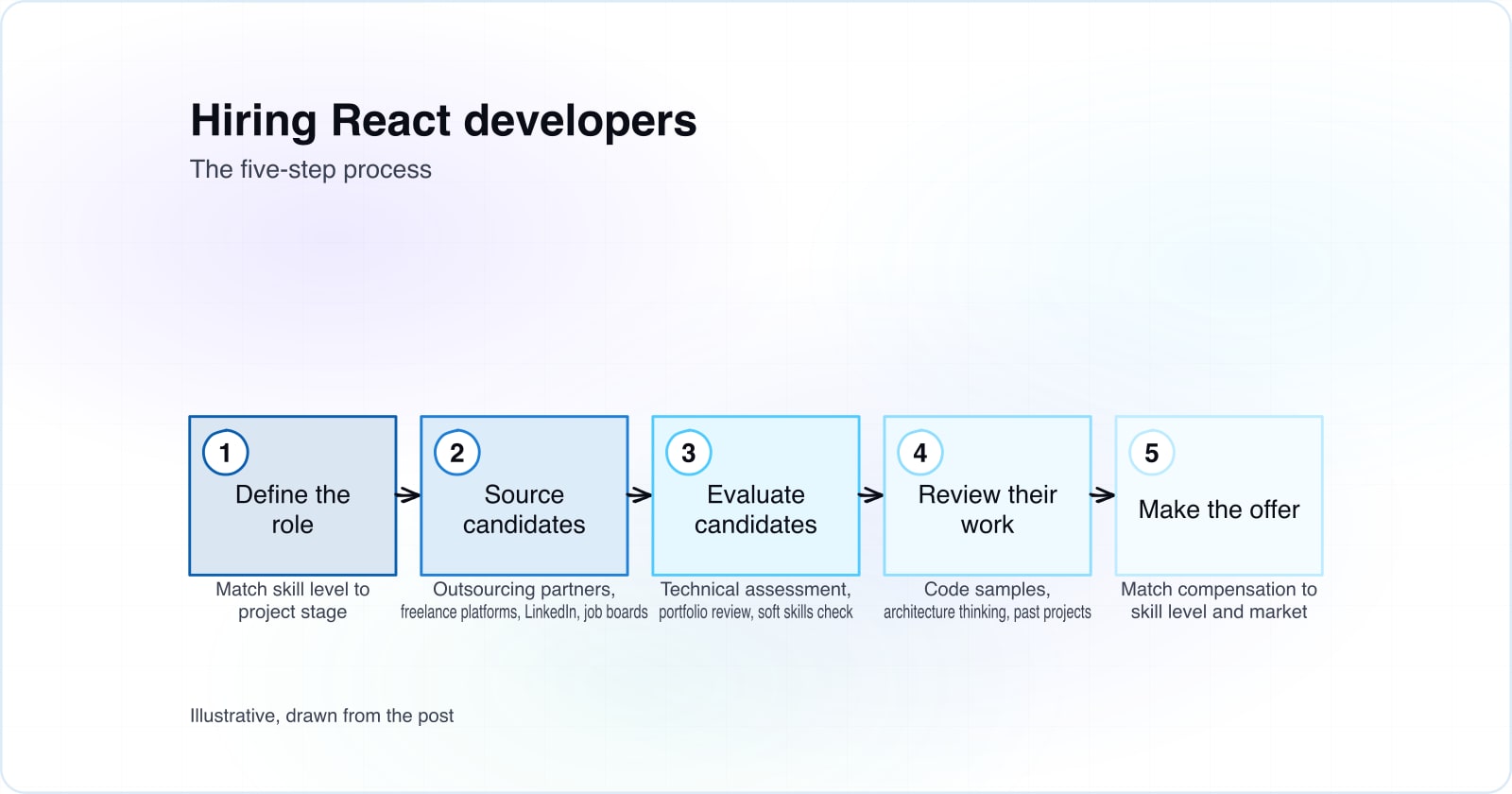
Hiring the right React developer can make or break your project timeline. Post a vague job listing, and you will get a flood of applicants. Many list React on their resume but cannot tell you why a component re-renders. Hire too senior for a small feature, and you will overpay. Hire too junior for a complex build, and you will spend more time fixing code than shipping it. This guide covers what to look for, where to find developers worth interviewing, and the mistakes that slow hiring down.
Why React still matters in 2026#
React has been around since 2013, and it has not been dethroned. Going into 2026, it remains the most used front-end framework among developers, according to the Stack Overflow Developer Survey data. Well over three-quarters of JavaScript developers work with it in some form.
That staying power comes down to a few things that have not changed: reusable components, a huge ecosystem, and a virtual DOM. These qualities keep apps fast even as they grow complex. What has changed is React itself. Modern React, paired with frameworks like Next.js, now supports server components by default. This means less JavaScript gets shipped to the browser and pages load faster.
Meta, Netflix, Airbnb, and Uber all run on React in some part of their stack. That is not a reason to pick it by default, but it does mean the talent pool, tooling, and long-term support are about as solid as you will find in front-end development.
What a React developer actually does#
A React developer builds, tests, and maintains the interactive parts of your web or mobile app, the parts users actually click, scroll, and type into. That includes turning designs into working components, connecting the front end to your APIs, and making sure the app performs well even with a lot of data or traffic moving through it.
Good React developers also think about things users never see: component structure, state management, load times, and accessibility. A developer who only writes code that "works" is different from one who writes code your team can maintain a year from now.
When you should hire a React developer#
Startups: Speed and cost matter most early on. React's component reusability means less code written from scratch, and its large community means most problems already have a documented solution. This is usually where you want a versatile mid-level developer who can move fast without much hand-holding.
Growing businesses: As traffic and complexity increase, you need someone who can keep the app stable while adding features. React's backing, maintained by Meta and a large open-source community, means regular updates and long-term support. You are not betting on a framework that disappears in two years.
Enterprises: At scale, you are dealing with high traffic, complex workflows, and integrations across multiple systems. This is where senior React talent earns its value, through performance optimization, code splitting, and architecture decisions that hold up under load.
React developer skill levels: what to look for#
Junior developers (1 to 2 years): Solid with components, props, state, hooks, JavaScript ES6+, and basic CSS. They own small features, bug fixes, and guided tasks. They need oversight but work well when paired with mid-level mentorship.
Mid-level developers (2 to 4 years): Comfortable with custom hooks, Context API, TypeScript, Redux or Recoil, and build tools like Webpack or Vite. They own full features, can tune performance, and need minimal oversight on architecture.
Senior developers (5+ years): Expert in system design, advanced state patterns, code splitting, server-side rendering, and mentoring others. They own technical direction and lead architecture decisions. They are what you reach for when scale or complexity demands hard choices.
If you are building your own hiring pipeline for junior talent, our guide on contributing to open source as a frontend developer is a useful reference for what a strong entry-level candidate should already know.
Where to find React developers#
Outsourcing to a development partner: This gets you access to vetted, senior-level developers without carrying the full cost of an in-house hire. A good partner handles recruitment, HR, and backups if someone leaves your project. When evaluating outsourcing partners, look at their actual delivered work, not just their pitch. We have shipped React projects for clients in the US, UK, and beyond, including work for teams in New York, San Francisco, and other major markets. See our custom software development services for more on how we structure engagements.
Freelance platforms: Sites like Upwork and Toptal work well for short-term projects or a specific, narrow task. Ratings and reviews help you screen quickly, but you are managing coordination yourself.
LinkedIn and GitHub: LinkedIn is useful for sourcing and checking work history. GitHub lets you see actual code, which tells you more about a developer's real ability than a resume ever will.
Job boards: Indeed, Hubstaff Talent, and similar sites work for candidates actively job hunting, with filters for location, experience, and skill set.
How to evaluate React developer candidates#
A resume tells you what someone claims. A technical interview and a portfolio review tell you what they can actually do.
Technical assessment: Ask about component optimization, state management choices, and how they would debug a slow-rendering app. A short, paid coding task beats a whiteboard exercise almost every time. You are looking for thoughtfulness, not speed.
Portfolio review: Look for projects with complexity similar to yours, not just polished demos. Ask what they would do differently on a past project. That answer tells you more than the project itself.
Soft skills: React developers work closely with designers, backend engineers, and product managers. Someone who can explain a technical tradeoff in plain language will save you time later. This matters even more with distributed teams, where collaboration happens asynchronously in writing.
Common mistakes when hiring React developers#
Writing a vague job description: "Looking for a React developer" attracts the wrong applicants. List the actual stack, project type, and seniority you need.
Skipping the code review: A polished interview does not guarantee clean, maintainable code. Always look at real work before making an offer.
Hiring on price alone: The cheapest developer often costs more later in rework and delays. Compare skill level to rate, not rate alone.
Ignoring communication skills: This matters even more with distributed teams, where a lot of collaboration happens asynchronously in writing.
Not planning for AI-assisted workflows: Most developers now use AI coding tools daily, and that is fine. What matters is whether they can review, test, and own that code, not just generate it. See our guide to scaling software teams for more on how to evaluate technical depth in a world of AI-assisted coding.
Final thoughts#
Hiring the right React developer comes down to matching skill level to project stage, checking real work instead of just resumes, and being honest with yourself about what you need and what you can reasonably support. The same principles apply whether you are looking to hire a Node.js developer or any other specialist role: focus on work samples, ask about architecture, and align seniority with your project stage.
Whether you hire in-house, freelance, or outsource, the evaluation steps stay the same. Look at code. Ask hard questions about architecture and tradeoffs. Talk to someone who has worked with them before if you can. And do not let price be the only factor.
If you would rather skip the sourcing and vetting process, our teams come pre-vetted for React and modern frontend work. Get in touch to talk through your project.