Hire the right Node.js developer for your project
As we step into 2026, the demand for skilled Node.js developers continues to surge. Giants like PayPal, Netflix, and Uber have long trusted Node.js for its ability to power scalable, real-time applications. With businesses increasingly prioritizing agility and performance, Node.js has become a cornerstone of modern backend development. This guide equips you with the knowledge to hire the best Node.js talent, whether you're a startup scaling rapidly or an enterprise modernizing legacy systems.
Why hire Node.js developers?#
Node.js powers 40.8% of web development projects globally (Statista, 2024). Its event-driven architecture and non-blocking I/O model make it ideal for:
- Real-time applications (chat, live streaming)
- Microservices architectures
- API-driven platforms
- IoT applications
Key benefits include:
- Scalability: Handle thousands of concurrent connections.
- Speed: Powered by Google's V8 engine for fast execution.
- Cost Efficiency: Reusable code and a vast NPM ecosystem reduce development time.
What Node.js developers do#
Node.js developers specialize in building scalable backend systems. Their responsibilities span:
- Building scalable server-side logic
- Creating RESTful and GraphQL APIs
- Integrating databases (SQL and NoSQL)
- Optimizing application performance
- Collaborating on full-stack projects
A core responsibility is building and configuring HTTP servers that handle concurrent connections efficiently, manage connection lifecycle, and implement proper timeout and resource management.
Key skills to look for in Node.js developers#
Technical skills#
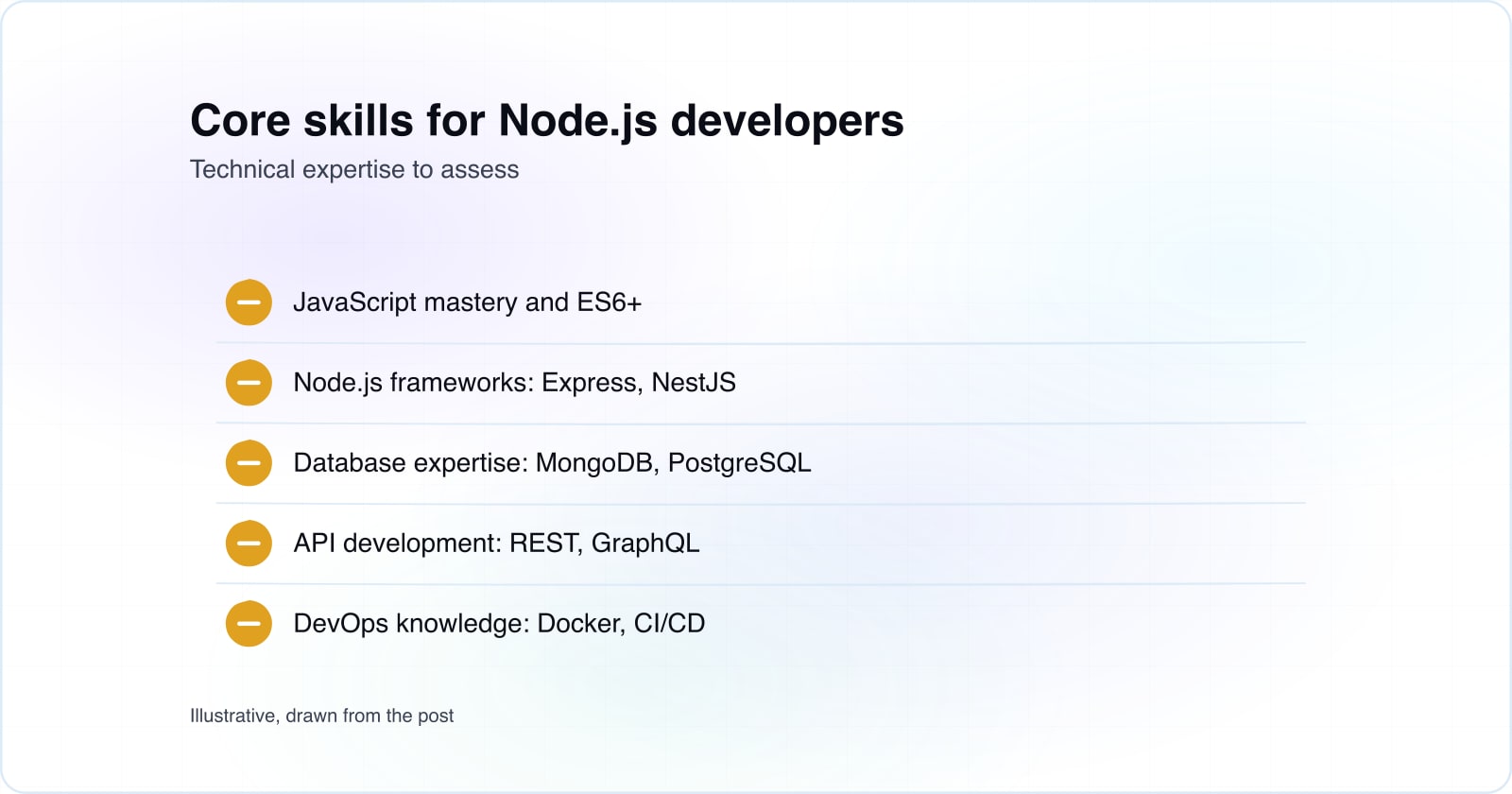
- JavaScript Mastery: ES6+, asynchronous programming, and functional patterns.
- Node.js Frameworks: Express.js, NestJS, or Hapi.
- Database Expertise: MongoDB, PostgreSQL, or Redis.
- API Development: REST, GraphQL, and WebSockets.
- DevOps Knowledge: Docker, Kubernetes, and CI/CD pipelines.
Soft skills#
- Strong communication for cross-team collaboration.
- Problem-solving under pressure.
- Adaptability to evolving technologies.
Where to find Node.js developers#
Freelance platforms#
- Upwork: Ideal for short-term projects. Filter by reviews and portfolio.
- Toptal: Pre-vetted senior developers for complex projects.
Outsourcing companies#
- Atyantik: A trusted partner offering vetted Node.js experts with comprehensive technical evaluation and design services.
- Turing: Curated pool of vetted Node.js developers.
Developer communities#
- GitHub: Search for contributors to open-source Node.js projects.
- LinkedIn: Engage with professionals in the Node.js space.
Job boards#
- We Work Remotely: Targets remote Node.js talent.
- Stack Overflow Jobs: Attracts developers active in technical forums.
When to hire Node.js developers: use cases#
Real-time applications#
Node.js excels in building chatbots, live tracking systems, and collaborative tools where immediate user feedback matters.
Microservices architecture#
Break monolithic systems into scalable, manageable services that teams can develop and deploy independently.
API development#
Create high-performance APIs for integrating third-party services such as payment gateways, analytics platforms, or messaging systems.
Legacy system migration#
Modernize outdated applications with Node.js for improved performance and maintainability.
Types of Node.js developers#
By experience#
- Junior: 1-2 years of experience. Focus on basic API development and debugging.
- Mid-Level: 3-5 years. Proficient in Express.js and database optimization.
- Senior: 5+ years. Architectural expertise, team leadership, and DevOps skills.
By role#
- Backend Developer: Specializes in server-side logic and databases.
- Full-Stack Developer: Handles both frontend (React, Vue) and backend.
- API Specialist: Focuses on building high-performance APIs.
If your project requires both frontend and backend expertise, you might consider hiring React developers to pair with Node.js specialists across the whole stack.
How to hire Node.js developers in four steps#
1. Define requirements#
Clarify project scope, technical needs, and timeline. Example: "Hire a senior Node.js developer with NestJS and microservices experience for a 6-month project."
2. Source candidates#
Use platforms like Upwork or LinkedIn. Partner with outsourcing firms that maintain pre-vetted talent pools and handle initial screening.
3. Evaluate skills#
- Technical Tests: Assign coding tasks such as building a CRUD API.
- Interview Questions:
- Explain the event loop and non-blocking I/O.
- How would you optimize a slow API endpoint?
- Describe your experience with database optimization.
4. Onboard without friction#
Use tools like Notion for documentation and Slack for communication. Clarify project expectations, code standards, and communication cadence.
Hire Node.js developers with Atyantik#
Skip the hassle of recruitment with Atyantik's streamlined hiring process. We partner with you through every stage:
- Define Roles: Align developer skills with project goals.
- Candidate Shortlisting: Access a pool of pre-vetted Node.js experts.
- Interview & Assess: Conduct thorough technical evaluations with our team.
- Onboard: Legal paperwork and tool setup handled by Atyantik.
Our approach to scaling development teams includes ongoing support and performance management so your team ships confidently.