Cross-functional team communication on a software product team, decided pair by pair
Most teams answer a communication problem with one more meeting. The better fix is smaller: count who has to talk to whom, decide how each pair talks, and write the decisions where the next person will look.
What does cross-functional team communication need on a software product team?#
Cross-functional team communication works when a product team decides which role pairs talk live, which hand over in writing, and where every decision is recorded. That is three design choices, and none is a new tool.
The Scrum Guide, revised by Ken Schwaber and Jeff Sutherland in November 2020, defines the team this way. Scrum Teams "are cross-functional, meaning the members have all the skills necessary to create value each Sprint". The same paragraph gives the reason for keeping them small: "smaller teams communicate better and are more productive."
Still, having every role on one roster is the start, not the finish. A product manager, a designer, software engineers and QA can sit in one team and still lose context. The context leaks at the joins, where one role's output becomes another role's input.
Team Topologies gives those joins names. Its interaction guide says "only three Team Interaction Modes are needed": collaboration, X-as-a-Service and facilitating. In practice, each pair of roles or teams sits in one of these modes at a time. So the work is to pick the mode on purpose. Then the team writes down what it decided, in one place.
Why does communication get harder every time the team grows?#
A team of 10 people has 45 possible pairwise conversations, and a team of 15 has 105, because the paths grow with roughly the square of headcount. Because each new person can talk to everyone already there, the count climbs fast.
Melvin Conway made this point in his April 1968 paper, How Do Committees Invent?, published in Datamation. He put the number of possible communication paths at "approximately half the square of the number of people in the organization". The exact count is the number of pairs: n times n minus one, divided by two.
So the curve bends fast. Going from 5 people to 10 doubles the headcount, but by that 1968 arithmetic it more than quadruples the pairs.
Show data table
| Item | Value |
|---|---|
| 3 people | 3 |
| 5 people | 10 |
| 7 people | 21 |
| 10 people | 45 |
| 15 people | 105 |
| 20 people | 190 |
Possible paths grow with roughly the square of headcount: 10 at 5 people, 45 at 10 and 190 at 20.
Of course, not every path is used every day. However, each one is a place where some people hear a decision and others miss it. Conway saw the same pressure in 1968: "it becomes necessary to restrict communication in order that people can get some 'work' done."
This is also why the Scrum Guide sets its ceiling where it does. When a team grows too large, the guide's advice is to reorganize "into multiple cohesive Scrum Teams, each focused on the same product". In short, the 2020 guide treats size as a communication problem first.
What happens to the paths when one team of 10 becomes two teams of 5?#
Splitting a team of 10 into two teams of 5 that meet through one named interface cuts the possible paths from 45 to 21. But the saving only holds if the two teams really do talk through that one interface.
Take a common product team as a worked example. It has one product manager, one designer, six software engineers and two QA specialists, so 10 people and 45 pairs. Now split it into two teams of 5, each owning one part of the product. Each team has 10 pairs inside it, so the two teams carry 20 between them. Then add one named path between the teams, such as a shared backlog owner or an agreed contract between services. The total is 10 plus 10 plus 1, which is 21.
Paths before and after a split
Set the number of teams and the people in each. It counts every pair as one team, then every pair inside each team plus one named interface between each pair of teams.
Paths after the split, one interface per pair of teams
21
- Paths as one team
- 45
- Paths saved
- 24
Defaults are the worked example: two teams of 5, 45 paths before and 21 after. The saving holds only while cross-team requests go through the named interface.
The split fails in a way you can predict. If every person on one team still reaches across to every person on the other, the 25 cross-team pairs come back. Then the total climbs to 45 again, and only the org chart changed.
That is why the interface has to be designed, not hoped for. Team Topologies calls the designed version X-as-a-Service. One team offers a clear service, and the other team uses it without needing to know how it works inside.
Which conversations between product, design, software engineering and QA need a live channel?#
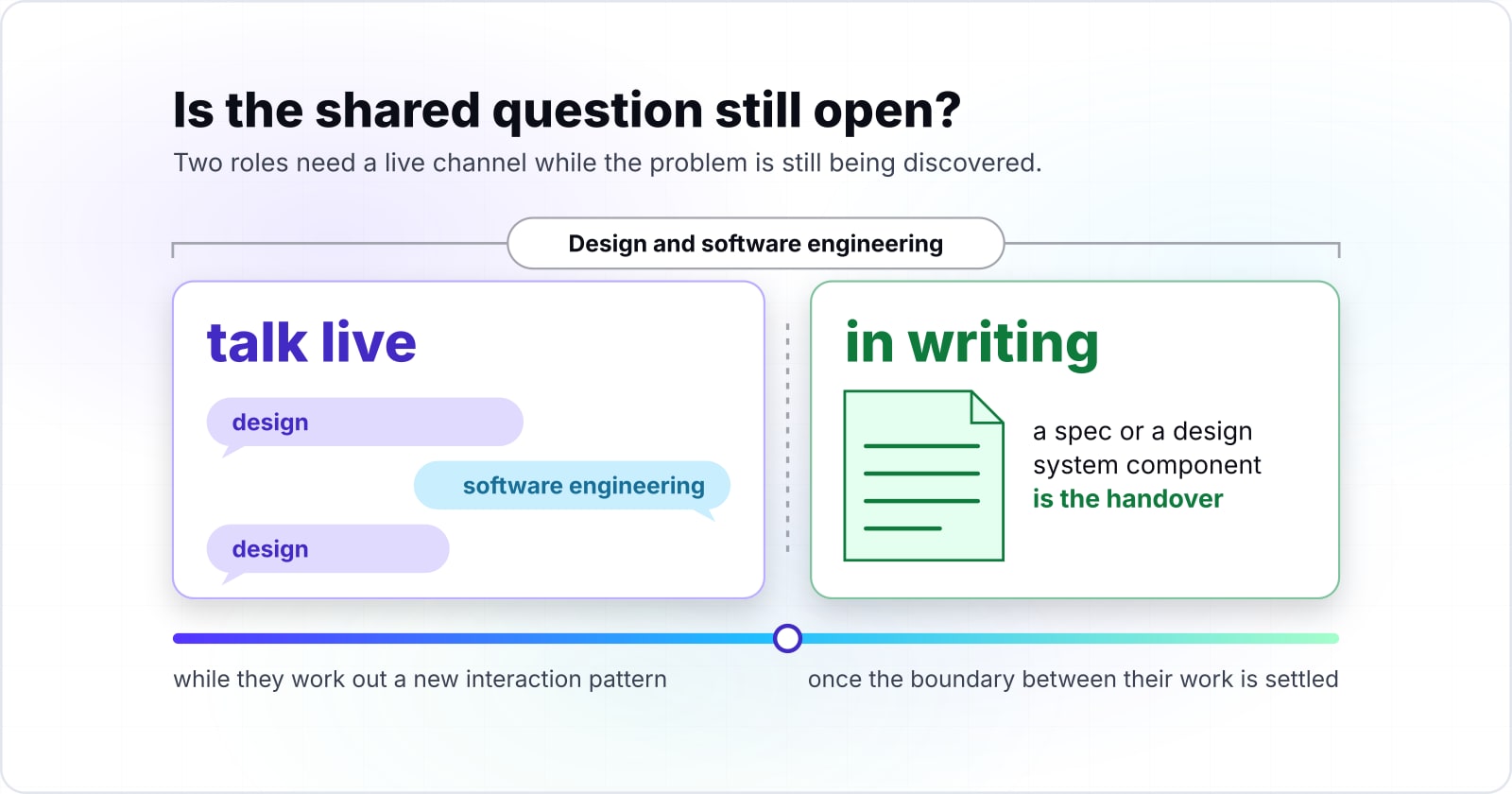
Two roles need a live channel while the problem is still being discovered, and a written interface once the boundary between their work is settled. So the test is simple: is the shared question still open?
Team Topologies frames it the same way. In collaboration mode, "Teams work closely with other teams that have different skill sets". That mode fits work where "a high degree of adaptability or discovery is needed". By contrast, X-as-a-Service is "a natural interaction model after collaboration has discovered suitable boundaries."
That sorts the four roles on a product team:
- Product and design talk live while they are still framing the problem. Once both agree the scope, the written brief becomes the interface.
- Design and software engineering talk live while they work out a new interaction pattern. After that, a spec or a design system component is the handover.
- QA and software engineering talk live on new risk areas and on a bug the team cannot reproduce. For routine work, acceptance criteria and test results in writing carry the load. The next section, on how developers and testers collaborate, goes deeper on this pair.
- Product and QA mostly meet through writing: acceptance criteria going in, release notes and known issues coming out.
A written handover is not a lesser channel. For example, an October 2025 arXiv case study by Devang Dhanuka followed a team of developers, QA and project managers that shared a written summary after each meeting. Team members "reported that having a written summary improved clarity of tasks". Also, its project manager found that weekly meetings could be "shortened by about 15 minutes on average."
A pair that keeps every talk live long after the boundary is clear spends its time repeating context. Meanwhile, the rest of the team cannot see what the pair agreed. When a team sits several time zones away, the shared working hours of a nearshore or offshore team limit how much of that talk can be live.
How do developers and testers collaborate effectively?#
Collaboration between developers and testers works when the tester joins before the code exists, both agree in writing what done means, and they talk live only where the risk is new.
The 2020 Scrum Guide removes the line between the two roles on paper. "Developers are the people in the Scrum Team that are committed to creating any aspect of a usable Increment each Sprint." So a tester on a Scrum team is one of the Developers, not a reviewer standing outside the work.
In practice, the written agreement they share is the Definition of Done. Also, the same guide calls it "a formal description of the state of the Increment when it meets the quality measures required for the product", and adds: "The Developers are required to conform to the Definition of Done." So when a tester and a developer disagree about whether a story is finished, the Definition of Done settles it, not whoever argues longer.
So in cross-functional team communication, that turns into three habits for the pair:
Finally, to see whether it works, measure what the pair ships rather than each side's count of bugs. DORA's change fail rate, accessed 7 October 2026, is "The ratio of deployments that require immediate intervention following a deployment." So that number belongs to both roles. In short, a bug count per tester measures one side of the pair; a change fail rate measures what the pair released.
How do the three Team Topologies interaction modes apply to a product team?#
Team Topologies names three ways teams interact: collaboration for discovery, X-as-a-Service once a boundary is clear, and facilitating when one team coaches another. Each mode fits a stage of a relationship, and collaboration is meant to end.
The interaction modelling guide describes each mode in a sentence or two:
| Mode | What Team Topologies says it is | When it fits |
|---|---|---|
| Collaboration | Teams work closely with teams that have different skill sets, "for a defined period of time (usually a few weeks)" | A high degree of adaptability or discovery is needed |
| X-as-a-Service | "clear ownership of a service with a smaller cognitive load for teams consuming the service" | After collaboration has found suitable boundaries |
| Facilitating | "One team helps another" | To clear impediments and find gaps in what other teams use |
Source: Team Topologies, Team Interaction Modeling with Team Topologies, accessed 1 October 2026.
On a product team, collaboration is the right mode for a new feature where product, design and software engineering are still finding the shape of the problem. Then, once the shape is settled, the feature team should be able to use the platform or design system as a service. Finally, facilitating fits when one group lifts another's skill. For instance, a QA specialist might help a feature team set up its own test automation.
The guide is direct about how long collaboration should last. It says Team Topologies has "a much stricter definition of Collaboration". In that definition, collaboration "should be short-lived and purposeful". It also warns that "although collaboration is good for discovery, it can also be expensive". So when a collaboration has run for months with no planned end, the mode was never chosen on purpose.
Which meetings carry the communication load, and what is each one for?#
The Scrum Guide gives every event one communication job, so a meeting with no job on that list is the first one to question. And ownership written down once keeps meetings from becoming the place where it is argued.
Here is what the 2020 guide says each event is for. First, Sprint Planning "initiates the Sprint by laying out the work to be performed". Its timebox is up to eight hours for a one-month Sprint. Second, the Daily Scrum is "a 15-minute event for the Developers". The guide says "Daily Scrums improve communications, identify impediments, promote quick decision-making". Then the Sprint Review is where the team and stakeholders "collaborate on what to do next," and the guide asks that it not be a presentation. Finally, the Retrospective is for plans "to increase quality and effectiveness."
Sprint Planning
Initiates the Sprint by laying out the work to be performed. Up to eight hours for a one-month Sprint.
Daily Scrum
A 15-minute event for the Developers to improve communications, identify impediments and promote quick decision-making.
Sprint Review
The team and stakeholders collaborate on what to do next. It is not a presentation.
Sprint Retrospective
The team plans ways to increase quality and effectiveness.
In practice, a calendar often holds more than these four. However, an extra meeting usually exists because the team does not know who owns a decision. That is a roles problem, and a meeting does not fix it.
Atlassian's Roles and Responsibilities play is a short exercise for that. Its page lists 15 minutes to prepare and 60 minutes to run. Each person writes the top 3 to 5 duties of their own role, then what they think the other roles own. After that, each role holder accepts or rejects what others wrote about them. In Atlassian's words, the play is about "defining who is responsible for what."
The most useful output is the list of unassigned duties. Those are the gaps that would otherwise surface as a surprise at a review. If your team picks a different process, the events change, but each one still needs a named job. Our guide to software development methodologies covers how that choice is made.
Where should a decision live so the next person can find it?#
DORA found continuous delivery lifted organizational performance by 656% in teams with above-average documentation quality, against 63% in teams below it. A decision written in one findable log outlives the meeting and the people who made it.
The figures come from DORA's documentation quality capability page, which reports its 2022 research. DORA measured quality with eight metrics, covering attributes "like clarity, findability, and reliability". It also found "documentation quality driving the implementation of every single technical practice we studied". In other words, good writing did not replace the practices. Instead, it made each one pay off more.
Show data table
| Dimension | Below-average documentation quality | Above-average documentation quality |
|---|---|---|
| Continuous delivery | 63% | 656% |
| Continuous integration | 34% | 750% |
| Loosely coupled teams | 46% | 313% |
| Site reliability practice | 79% | 343% |
Every capability lifted performance far more where documentation quality was above average: 656% against 63% for continuous delivery.
Microsoft's design decision log guide, updated 26 August 2024, gives a simple form. Each record has a number and title, a date, a status, the context, the decision and its consequences. The status is one of "Proposed/Accepted/Deprecated/Superseded."
The same guide says why a log beats one long document. With a log, people "can see the decision log and track the changes". That holds "even as the team composition changes over time". It adds that "it is easier to find the design decision in a log than having to read a large document."
In practice, one log per product, linked from the backlog, works for product, design and software engineering decisions alike. Until someone copies a chat decision into that log, it is not a decision the team can find.
How can a team tell its communication is working this month?#
A team can check its communication with four observable signals, starting with whether last month's decisions can be found by someone who was not in the room. Each one is a count, not a survey.
Run these once a month at the Retrospective. Because the Retrospective is already where the team plans how to improve, the checks need no new meeting.
When a check fails, the fix is usually one of the three choices again. A pair moves from live to written, or a decision goes into the log. Sometimes a long collaboration gets an end date. Our post on why bug triage discussions matter shows the same habit in one recurring meeting.
When is a single cross-functional team the wrong fit?#
A single cross-functional team is the wrong fit once it grows well past 10 people or when one specialist is shared across several teams. In both cases a different structure helps more than extra meetings.
First, size. A team of 20 has 190 possible paths, by the same pair count Conway described in 1968. Past the Scrum Guide's ceiling of "typically 10 or fewer people," the better tool is several smaller teams joined by X-as-a-Service. The guide says such teams "should share the same Product Goal, Product Backlog, and Product Owner."
Second, the shared specialist. One security expert or one accessibility specialist cannot sit inside five teams at once. Instead, Team Topologies describes an enabling team that works in facilitating mode: "One team helps another". That team teaches each feature team to do the work, then steps back.
Third, a fixed, well-understood handover. If one team only uses a stable service from another, a joint team adds paths for no gain. In that case the honest answer is a clear X-as-a-Service contract and a named owner on each side.
45
10 people, the Scrum Guide ceiling
190
20 people
A team of 20 has 190 possible paths, by the same pair count Conway described in 1968, against 45 at the Scrum Guide's ceiling of 10.
| Option | possible pairwise paths, n(n-1)/2 |
|---|---|
| 10 people, the Scrum Guide ceiling | 45 |
| 20 people | 190 |
Source: Melvin E. Conway, How Do Committees Invent?, Datamation, 1968
Where to go next#
The pairs and rituals above each have a deeper treatment, from how testers and developers work together to how bug triage reaches a decision. Start with the pair or the meeting that hurts most this month.
For the QA and software engineering pair, what a software quality analyst does shows the tester's side of the work, and the psychology of bugs explains why a second person catches what the author misses. If delivery keeps slipping at the joins between roles, managing project timelines shows which project delivery challenges move a date and how to hold it. And the methodologies guide covers how the process you pick decides which events exist.
If you are still agreeing on the problem itself, our product discovery page describes how we frame it with product, design and software engineering together. And if you want a team that already works this way to build the product, see custom software development.
Still, you need none of that to start better cross-functional team communication. The Scrum Guide, the Team Topologies interaction guide and one decision log are enough on their own.