AI agent development cost and how long it takes
Thinking about an agent for your own systems? A price range by tier tells you nothing about your plan. Here is the part you can work out today, and what sets the rest.
What does AI agent development cost, to build and to run?#
An AI agent has two costs: the monthly cost to run it, worked out from model calls per task, and the cost to build it, set by its tools, systems, tests and approvals. However, they behave very differently. You can look up what goes into the monthly cost today. The cost to build it depends on your systems. As a result, any single figure printed without them is a guess.
| Running it | Building it | |
|---|---|---|
| What it is | what you pay the model provider each month while the agent works | the work to connect, test and ship the agent once |
| What sets the cost | model calls per task, tokens per call, the token price and tasks a month | tools that can change data, the systems it connects to, the test cases it must pass, and where a person must approve |
| When you can know it | today, from a test run and the provider's pricing page | only once those four factors are known for your agent |
The monthly cost to run it has four inputs: model calls per task, tokens per call, the token price, and tasks a month. A token is the unit a provider's API (application programming interface) charges by, a short piece of a word. Since calls and tokens per call are design choices, much of that cost is yours to shape.
The cost to build it follows the four factors instead. Which tools can change data? How many systems does the agent connect to? How many test cases must it pass? And where must a person approve an action before it happens? Those four set the work, the testing and the calendar.
For scale, take our case study of a business-to-business pricing assistant, published 11 October 2026. It says "a reply inside a narrowing conversation can take up to six model calls". So the running cost sums below use that one figure. If you would rather have an agent scoped against your own systems, see how our AI agent development work runs.
How do you work out what an AI agent costs to run each month?#
The monthly cost to run an agent is model calls per task times tokens per call times the token price times tasks a month, so the call count matters first. It is easy to price the model and forget the count. Yet a task that takes six calls costs six times a task that takes one. And that holds at any price.
Take the pricing assistant's worst case of six calls per reply, from our case study published 11 October 2026. Then say each call writes 1,000 output tokens, an illustrative figure. At Anthropic's list prices, accessed 28 November 2026, 1,000 such replies cost $120 in output on Claude Opus 5.5. The same replies cost $60 on Claude Sonnet 5.5 and $3 on Claude Haiku 5.5. But those figures leave out input tokens, which come next.
Show data table
| Item | Value |
|---|---|
| Claude Opus 5.5 | 120 USD |
| Claude Sonnet 5.5 | 60 USD |
| Claude Haiku 5.5 | 3 USD |
At six calls per reply, 1,000 replies cost $120 in output on Claude Opus 5.5 and $3 on Claude Haiku 5.5.
Next, scale it to a month. Say the agent sends 10,000 replies a month, an illustrative volume. On those dated list prices, that is ten times the figures above. In practice your own numbers come from logs, not guesses. So log the calls per task and the tokens per call on a test run, then multiply.
Monthly cost to run your agent
Put in your agent's model calls per task, tokens per call and tasks a month. It multiplies them by the token price to give the monthly cost to run it, split into input and output.
Monthly running cost
$144
- Input tokens part
- $24
- Output tokens part
- $120
- Cost per task
- $0.14
Arithmetic from Anthropic's Claude API pricing page, accessed 28 November 2026. Modelled, not measured.
This calculator is an estimate, not financial advice. Also, it differs from the single-call token calculator in our approval workflow guide, because here the call count is the dial you turn.
Which model tier changes the monthly running cost most?#
On Anthropic's API pricing page, accessed 28 November 2026, Opus 5.5 output costs $20 per million tokens and Haiku 5.5 output costs $0.50. That same pricing page lists Sonnet 5.5 between them at $10 for output. For input, it lists $4 for Opus 5.5, $2 for Sonnet 5.5 and $0.10 for Haiku 5.5. And the Haiku input figure holds for prompts up to 100,000 tokens.
Within one provider, the gap between the top and bottom tier is larger than any other single input. So the tier you pick moves the monthly cost more than any cut to tokens per call. Try the cheapest tier that passes your test cases first.
Show data table
| Dimension | input | output |
|---|---|---|
| Claude Opus 5.5 | 4 USD | 20 USD |
| Claude Sonnet 5.5 | 2 USD | 10 USD |
| Claude Haiku 5.5 | 0.1 USD | 0.5 USD |
Claude Haiku 5.5 output costs $0.50 per million tokens against $20 on Claude Opus 5.5, a fortyfold gap.
Anthropic's own page describes Haiku 5.5 as built "for high-volume, latency-sensitive tasks such as classification, extraction, and routing". Many agent steps are exactly that. For example, the pricing assistant case study, published 11 October 2026, notes that most messages are "a classification or a short extraction". Therefore a mix often wins. Use a small model for the routine steps and a larger one only where a step needs it.
The trade-off is quality. If a cheaper tier fails one case in ten, it can cost more in fixes than it saves. So the tier choice waits on your test cases.
What do caching and batch discounts do to the cost of running an agent?#
On OpenAI's API pricing page, accessed 28 November 2026, cached input for gpt-6.2-sol costs $0.10 per million tokens against $2.00 for fresh input. Cached input is a prompt the provider has already stored, so a repeat costs far less.
An agent resends the same instructions and tool definitions on every call. So cached input pricing and batch discounts cut the part of the monthly cost that repeats. Anthropic's pricing page, accessed 28 November 2026, says tool requests are priced on input tokens "including in the tools parameter". Also, that page adds 286 tokens of built-in tool instructions on Opus 5.5, Sonnet 5.5 and Haiku 5.5 when a tool is present.
$2.00
Fresh input
$0.10
Cached input
On OpenAI's API pricing page, accessed 28 November 2026, cached input for gpt-6.2-sol costs $0.10 per million tokens against $2.00 for fresh input.
| Option | US dollars per million tokens |
|---|---|
| Fresh input | $2.00 |
| Cached input | $0.10 |
Source: OpenAI, API pricing, 2026
Each provider handles the repeat in its own way. On Anthropic's page, accessed 28 November 2026, a cache hit on Claude Opus 5.5 costs $0.20 per million tokens. But a five-minute cache write there costs 1.25 times the base input price, per the prompt caching guide. On the same date, Google's Gemini pricing page lists context caching for Gemini 4 Argon at $0.10 per million tokens. Meanwhile OpenAI's page lists cached input for gpt-6.2-astra at $0.40.
Batch work is the other discount. Anthropic's Batch API is a way to send many requests to run later. Its pricing page, accessed 28 November 2026, gives "a 50 percent discount on both input and output tokens". On the same date, OpenAI's batch table halves gpt-6.2-astra input from $8.00 to $4.00. However, a batch suits overnight jobs, not a person waiting on a chat reply.
Still, these three providers are not ranked here, and many others publish prices too.
Why does the cost of running an AI agent grow after launch?#
Google's Gemini API pricing page, accessed 28 November 2026, lists Gemini 4 Argon input rising from $2.00 to $4.00 per million tokens on 1 December 2026. A monthly cost worked out at launch goes stale. In practice, calls per reply creep up, prompts get longer, and providers change list prices on a date you do not choose.
Show data table
| Dimension | Through 30 November 2026 | From 1 December 2026 |
|---|---|---|
| Input | 2 USD | 4 USD |
| Output | 10 USD | 20 USD |
| Context caching | 0.1 USD | 0.2 USD |
Every Gemini 4 Argon price line doubles on 1 December 2026: input $2.00 to $4.00, output $10.00 to $20.00 and context caching $0.10 to $0.20.
The first cause is creep. As a team adds checks and steps, calls per reply grow. Our case study of the pricing assistant, published 11 October 2026, puts it plainly: "The calls add up." On the client's test system, that study records, the median time per message rose from 3.2 to 6.6 seconds over three months.
The second cause is longer prompts. Each new tool adds its definition to every call. Google's page, accessed 28 November 2026, also says that for Gemini 4 Argon "every token the model processes is counted and billed, including thinking tokens". And Anthropic's page on the same date lists a higher Haiku 5.5 input price once a prompt passes 100,000 tokens.
The third cause is the price itself. Google's change doubles every line in the table above, on a date set by Google. As a result, a figure from launch day is an estimate with a date on it. So redo the sums each quarter, and watch calls per reply as closely as the price.
What drives the cost of building an AI agent?#
Four factors set the cost to build an agent: tools that can change data, the systems it connects to, the test cases it must pass, and where a person approves. A tier label such as "simple" or "advanced" says none of this. Those four factors say all of it.
| Factor | What it adds to the work | Where it shows in shipped work |
|---|---|---|
| Tools that can change data | permission checks, a safe default, an audit trail | writes stay off until an operator switches them on |
| Systems it connects to | one connection, sign-in check and failure path per system | a price only from the client's pricing system, after a sign-in check |
| Test cases it must pass | checked cases to collect, run and keep current | each step returns output the next step can check |
| Where a person must approve | a review screen and a hand-off for each | a person checks flagged fields, then sends the draft order |
First, tools that can change data. An agent that only reads is far simpler than one that writes. Take our case study of an MCP server for a commerce platform, published 12 October 2026. It records 24 typed tools, and "writes stay off until an operator switches them on". MCP, the Model Context Protocol, is a standard way to hand an agent a set of tools.
Second, the systems it connects to. In the pricing assistant study, published 11 October 2026, the price comes only from the client's pricing system. And it comes only after the backend checks who is signed in. So each system adds a connection, a sign-in rule and a way to fail.
Third, the test cases, the checked examples that prove the agent works. Fourth, where a person must approve. In our purchase order case study, published 12 October 2026, "a person checks the flagged fields before one click sends a draft order to the store". So each approval point is a screen to build. Once you know these four factors for your agent, you know the shape of the build.
How do test cases and human approval add to the cost of building an agent?#
In the Measuring Agents in Production study on arXiv, run from April to November 2025, 74% of deployed agents rely primarily on human evaluation. arXiv is an open archive of research papers. Agents in production lean on people to judge their output, and they stop for a person within a few steps. So the test cases and the approval points are build work, not extras.
Show data table
| Item | Value |
|---|---|
| Execute at most 10 steps before human intervention | 68% |
| Prompt off-the-shelf models instead of weight tuning | 70% |
| Depend primarily on human evaluation | 74% |
| Construct prompts manually | 79% |
In the survey, 68% of deployed agents execute at most 10 steps before human intervention and 74% depend primarily on human evaluation.
The same paper, with its survey run April to November 2025, finds that "68% execute at most 10 steps before human intervention". It adds that 47% stop in fewer than five. In other words, a person stays in the loop. So that person needs a screen, a clear view of what the agent proposes, and a way to say no.
Testing takes work too. In that 2025 survey, human review (74%) and a model grading another model's answers (52%) both beat rule-based checks (42%). Each method needs checked examples, and someone has to write them. Meanwhile 70% of those teams prompt models they did not train, per the same paper. So the work sits in prompts, tests and screens, not in training a model.
Treat the test cases as part of the build from week one. If they wait for the last week, the tier choice and the call count both wait with them.
How long does it take to build an AI agent?#
The calendar for building an AI agent is set by three waits: access to the systems it connects to, a set of checked test cases, and sign-off on actions that change data. How long an agent takes depends less on writing the code than on those three waits.
The first wait is access. You cannot test an agent against a system it cannot reach, and access often needs another team's sign-off. Our case study of the pricing assistant, published 11 October 2026, notes that our software engineer joined after the first workflow existed. That order is common, because the systems and their owners are there before the agent is.
The second wait is the test cases. Checked cases come from the people who know the work, and they have day jobs. So start collecting them on day one, while the first version is still being written.
The third wait is sign-off on writes. In the MCP server study, published 12 October 2026, writes stay off until an operator allows them. Then someone with authority has to agree what the agent may change, and that meeting is rarely quick.
The same pricing study lists one lesson for next time: "run the catalogue's own vocabulary through the provider's filter in the first week". In short, the risks that cost weeks show up early when you test real data early. But no week count appears here, because a credible one depends on your three waits.
Which three choices set your AI agent pricing?#
Choose the cheapest model tier that passes your test cases, then the fewest model calls a task needs, then the approval points your riskiest action demands. What it costs to run each month follows from those three choices, in that order.
First, the tier. On Anthropic's pricing page, accessed 28 November 2026, Haiku 5.5 output is one fortieth of the Opus 5.5 price. So run your test cases on the smallest tier first, and move up only on the steps that fail.
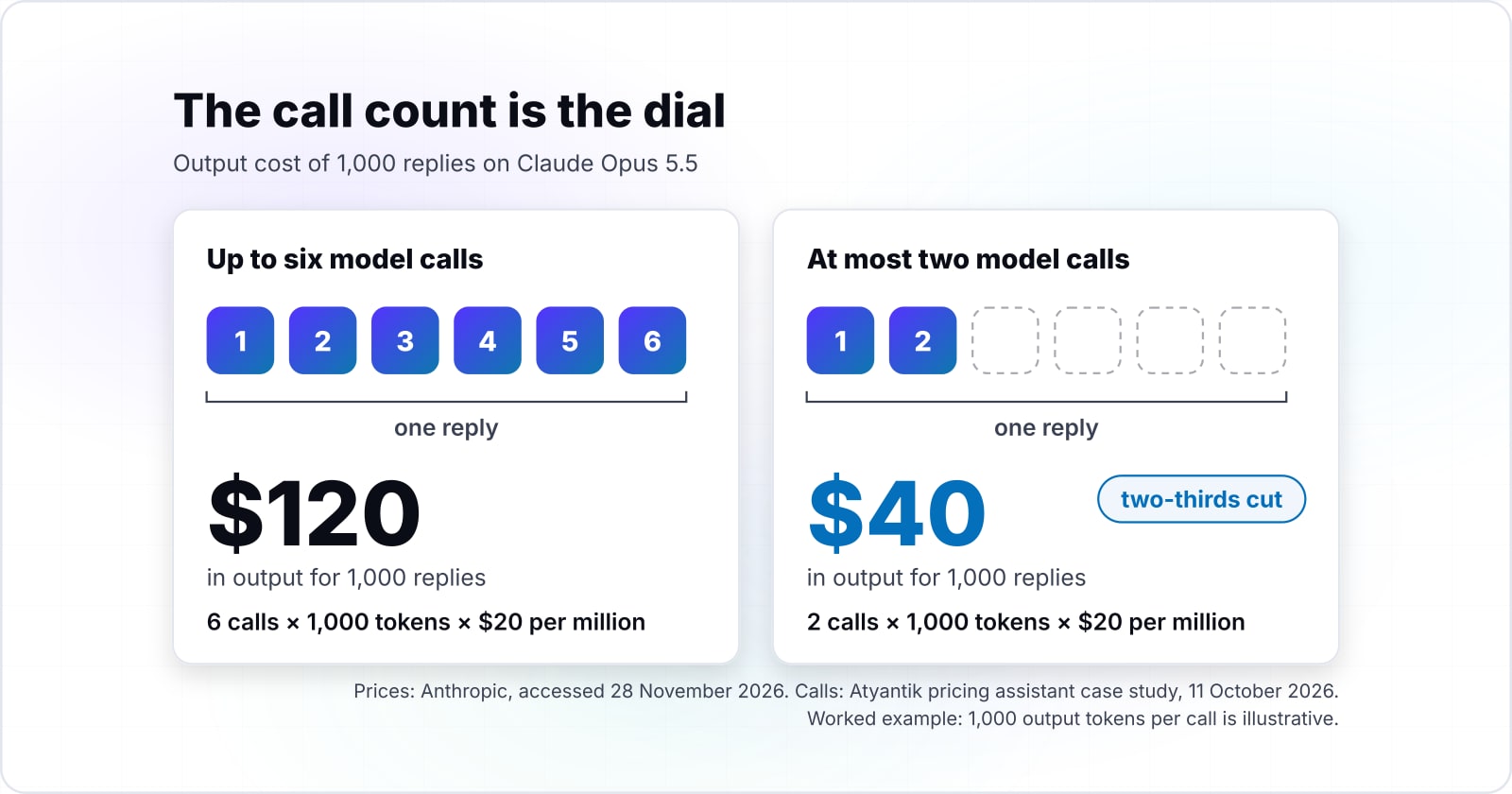
Second, the call count. Our case study of the pricing assistant, published 11 October 2026, describes a design "with at most two model calls per message", down from up to six. Take the illustrative 1,000 output tokens per call and Anthropic's list prices from 28 November 2026. Then 1,000 replies on Opus 5.5 would fall from $120 to $40 in output. That is a two-thirds cut, if the two-call design holds on your cases. The study also notes that an off-topic message "stops after one model call". So routing in code saves calls before any model runs.
Third, the approval points. Put a person before every action that changes data, as the purchase order and MCP studies do. Then remove a checkpoint only when your test cases show it is safe to.
$120
Up to six model calls per reply
$40
At most two model calls per reply
Take the illustrative 1,000 output tokens per call and Anthropic's list prices from 28 November 2026: 1,000 replies on Opus 5.5 would fall from $120 to $40 in output.
| Option | US dollars in output, at an illustrative 1,000 output tokens per call |
|---|---|
| Up to six model calls per reply | $120 |
| At most two model calls per reply | $40 |
When is an AI agent the wrong fit for the job?#
An agent is the wrong fit when the steps never change, because a fixed workflow or plain code does the same job with no model cost at all. In a press release of 25 June 2025, Gartner forecasts that over 40% of agentic AI projects will be canceled by the end of 2027. It says they will be canceled "due to escalating costs, unclear business value or inadequate risk controls". So three cases call for something else.
First, fixed steps. If every run follows the same path, a workflow tool is the better choice. Our comparison of n8n and custom AI agents shows where a workflow tool, such as n8n, is enough.
Second, a single judgment. If the task is one classification or one extraction, one model call inside ordinary code does it. Then you have one call to price and one answer to test, not a loop.
Third, low volume. If a person handles the task in a few minutes a few times a week, a good form and a checklist beat any agent. The monthly cost to run it would be small, but the cost to build it would never pay back.
| Case | Better choice | What is left to price |
|---|---|---|
| Fixed steps | a workflow tool, or plain code | no model cost at all |
| A single judgment | one model call inside ordinary code | one call to price and one answer to test |
| Low volume | a good form and a checklist | a cost to build that would never pay back |
Where do the neighbouring cost questions get answered?#
Each neighbouring question has its own page: building versus assembling an agent, the token cost of one approval workflow, and what AI does to the cost of building software. First, whether to assemble an agent in a workflow tool or build one is in our n8n versus custom agents comparison. Then the token cost of one approval step, with its own calculator, is in the approval workflow guide.
Next, what AI does to the cost of building software is in does AI make custom software cheaper. And the drivers behind any first release are in MVP development cost drivers, where MVP means minimum viable product.
If you want an agent scoped against your systems, read about our AI agent development work. If you would rather add people to your own team, see how to hire AI software engineers. Still, the provider pricing pages linked above are enough on their own to work out what your agent will cost to run today.