What testers notice that others miss, and why it matters
Delivering a feature that works is no longer enough. True success lies in delivering software that is reliable, intuitive, resilient, and aligned with real-world usage. This is where software testers play a uniquely critical role.
While developers, designers, and business stakeholders each view the product through their own lenses, testers observe the product as a whole. They notice details, risks, and patterns that often remain invisible to others, until they become costly issues. These insights are not accidental; they stem from a distinct mindset shaped by curiosity, experience, and a deep sense of responsibility toward quality.
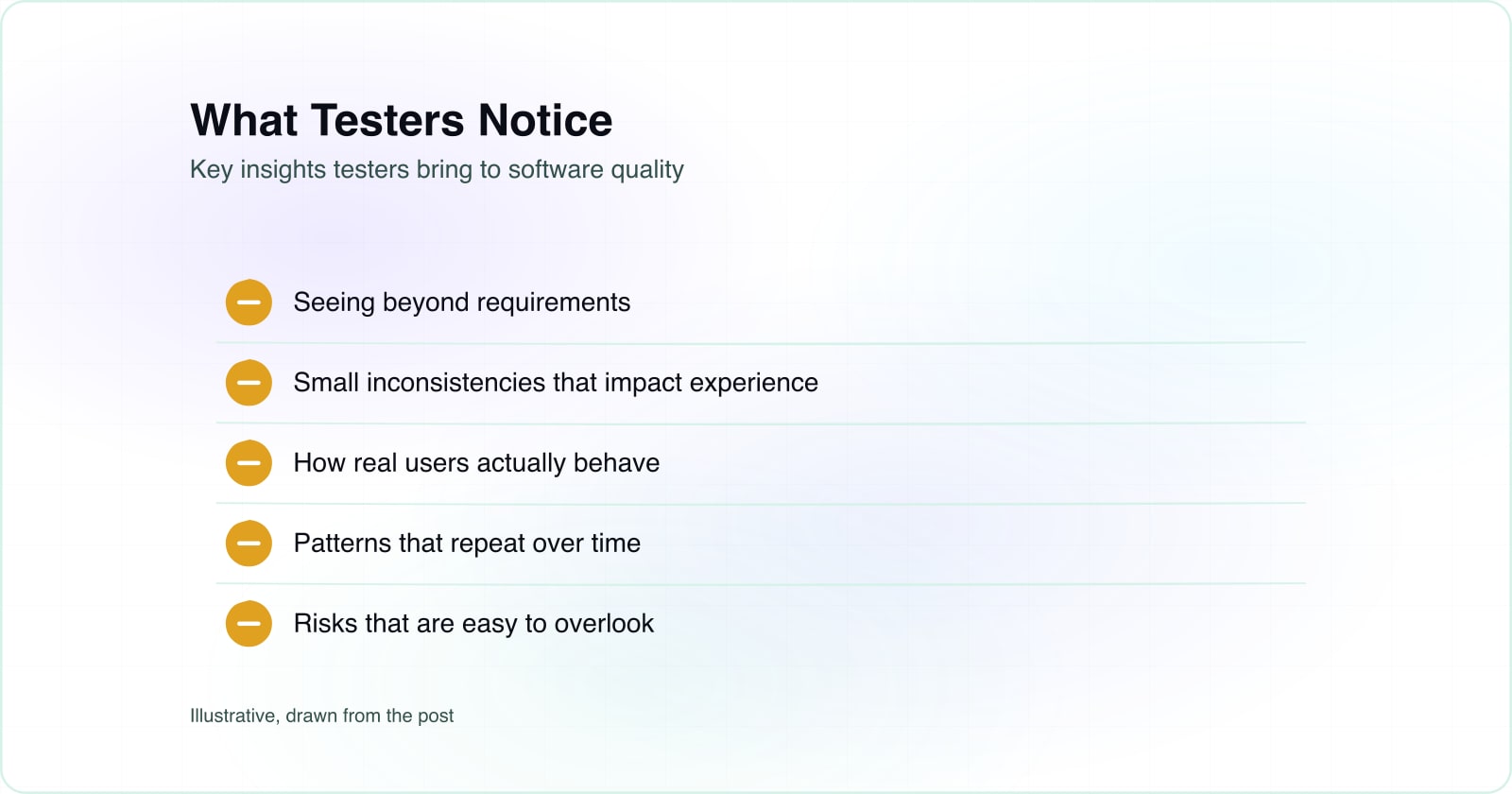
Seeing Beyond Written Requirements#
Most software begins with requirements, documents, tickets, or user stories that define what needs to be built. Developers focus on implementing these requirements accurately. Testers, however, focus on what happens outside what is written.
They notice:
- Assumptions hidden between acceptance criteria
- Scenarios that are logically possible but not explicitly mentioned
- Conditions where a requirement is technically met, yet practically incomplete
For example, a requirement may state that a user can submit a form successfully. A tester will naturally explore what happens if the user submits incomplete data, refreshes the page, navigates backward, or submits the form multiple times. These questions uncover gaps early, long before they surface as production defects.
The Small Inconsistencies That Impact User Experience#
What may seem like a minor inconsistency to one role can significantly affect user trust and usability. Testers are trained to spot these subtle but impactful issues.
They notice:
- Inconsistent validation messages across screens
- Buttons that work but provide no feedback
- Features that behave differently in similar workflows
- Text, spacing, or alignment issues that degrade accessibility and clarity
While such issues may not block functionality, testers understand that quality is cumulative. Small inconsistencies, when left unchecked, lead to poor user experience and reduced confidence in the product.
How Real Users Actually Behave#
Users rarely interact with software in the ideal way it was designed. They skip steps, misunderstand labels, multitask, and change their minds midway through a flow. Testers are acutely aware of this reality.
Unlike others, testers deliberately:
- Break expected workflows
- Perform actions in unexpected sequences
- Interrupt processes midway
- Use the system with incomplete or incorrect inputs
This perspective allows testers to simulate real-world usage more accurately, ensuring the product remains stable and usable under less-than-perfect conditions. That is why continuous testing in the CI/CD pipeline has become essential to modern delivery.
Patterns That Repeat Over Time#
One of the most valuable insights testers bring is historical awareness. Over multiple releases, they recognise patterns that are not immediately visible in a single sprint.
They notice:
- Modules that frequently regress
- Changes that repeatedly impact shared components
- Defects that resurface in different forms
- Areas where fixes tend to introduce side effects
This long-term perspective enables testers to proactively focus on high-risk areas, improving test coverage and reducing recurring issues across releases.
Risks That Are Easy to Overlook#
Not all defects carry the same weight. Testers are trained to evaluate risk by considering impact, likelihood, and scope rather than just correctness.
They identify:
- Changes that affect legacy workflows
- Scenarios that could compromise data integrity
- Issues that may affect a large user base
- Failures that could damage business credibility
This risk-based thinking helps teams prioritise effectively, ensuring that critical issues are addressed before release. For CTOs weighing testing strategy and investment, understanding where quality fits into technical strategy shapes better decisions.
When "It Works" Isn't Enough#
Perhaps the most important thing testers notice is when a feature technically works but still falls short of quality expectations.
Examples include:
- Processes that require unnecessary steps
- Error messages that are correct but unclear
- Features that meet requirements but confuse users
Testers advocate for usability, clarity, and reliability, even when no explicit requirement is violated. In doing so, they act as the voice of the end user and the guardian of overall product quality.
Why Tester Insights Matter#
The observations a tester brings to a project help organisations:
- Prevent costly production issues
- Improve customer satisfaction
- Reduce rework and support overhead
- Build confidence in releases
At Atyantik, quality is not treated as a final checkpoint. It is a shared responsibility embedded throughout the development lifecycle. Testers play a pivotal role in enabling this culture by identifying blind spots early and fostering collaboration across teams.
Conclusion#
Testers notice what others don't because they are trained to question assumptions, explore beyond the obvious, and see software behaviour across its whole lifespan. Their insights go far beyond defect detection. When teams collaborate on quality, they influence design decisions, reduce risk, and raise overall product quality.
Understanding why bugs happen in the first place also shapes how testers approach their work. When organisations recognise and value this perspective, quality becomes proactive rather than reactive. And that is where truly successful software is built.