Six Testing Trends Shaping Software Quality in 2025
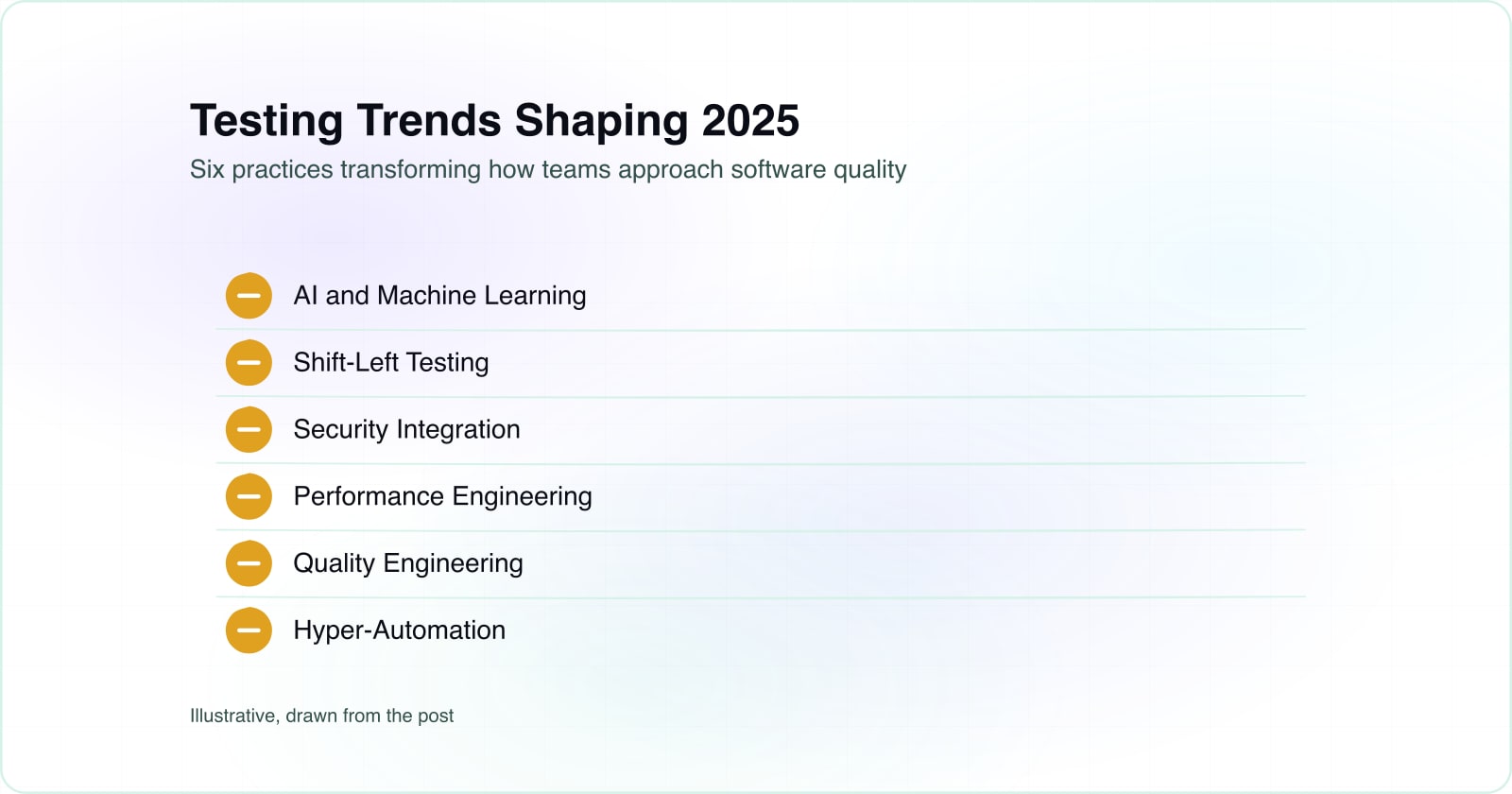
The future of software testing is shifting toward automation, changing user expectations, and rising complexity across software systems. Organizations that keep pace with these trends will improve their testing processes, ship higher-quality software, and maintain competitive advantage. Six key directions are reshaping how your team tests.
AI and Machine Learning Transform Test Automation#
Artificial intelligence and machine learning are revolutionizing how you approach testing. These technologies analyze massive datasets from your test runs, predict where defects are likely to occur, and enhance the efficiency and effectiveness of your entire testing program.
Three capabilities stand out. Self-healing testing uses AI to automatically update your test scripts when your application changes, eliminating the manual script maintenance that consumes your team's time. Predictive analytics interprets your historical test data to spot possible defects before they reach production, reducing the testing burden on your team. Machine learning ensures you expand test coverage to the high-risk areas that manual testing cannot reach efficiently.
Shift-Left Testing Moves Quality Upstream#
Shift-left testing means starting quality assurance early in the development process rather than treating testing as a final gate. This paradigm shift emphasizes quality throughout development, making it much more popular with organizations that need faster releases without sacrificing reliability.
The benefits are immediate. Detecting faults early in development costs far less to fix than addressing them after release. Integrating testing into your entire development process enables real-time feedback, letting your team respond quickly to issues. Closer collaboration from the beginning fosters shared accountability for quality across developers and testers. Agile workflows with continuous feedback loops let your team preempt problems rather than react to them.
Security Testing Becomes Essential#
As cyber threats grow more advanced, incorporating security testing into your development lifecycle becomes non-negotiable. Identifying vulnerabilities before they can be exploited is what organizations must prioritize as they shape their approach to testing.
Three security practices matter most. Automated security testing uses tools to identify system deficiencies through attack scenarios, establishing security parameters during development rather than after. Compliance testing ensures your software meets regulatory requirements like GDPR and CCPA, building trust and reducing legal risk. Zero-trust principles validate authentication and authorization at every development stage, systematically mitigating security risks before release.
Software Performance Engineering: From Reactive to Proactive#
Performance testing has become a proactive and dynamic discipline. Instead of measuring performance after deployment, you design applications to meet customer needs from the start, making software performance engineering a vital part of modern testing.
Three approaches define the practice. Performance architecture means your team factors performance into architectural and design decisions from the start, ensuring your application can scale on any tier. Real-user monitoring captures user experience data from your live application, giving you insights into actual performance and guiding optimizations. AI-driven load testing simulates real user behavior under varying loads, ensuring your application scales flexibly under stress.
Software Quality Engineering Replaces Quality Assurance#
Quality Assurance historically sat in isolation, testing software after development finished. Software quality engineering owns quality across the entire software lifecycle, embedding quality into every phase. This transition shapes how the future of software testing unfolds.
Three shifts define the change. Integration of DevOps means testers work closely with developers, embedding testing directly into CI/CD pipelines so quality never slips during any phase. Unified metrics consolidate statistical measures across your team, helping everyone understand quality's value to the organization. User-driven testing grounds tests in real user scenarios, ensuring your application meets actual user requirements rather than theoretical specifications.
Hyper-Automation Eliminates Manual Testing Bottlenecks#
With hyper-automation, artificial intelligence, robotic process automation, and orchestration tools work together to automate even the most complex testing workflows. This combination delivers efficiency improvements that eliminate most manual testing effort, making hyper-automation key to the future of testing.
Three practices drive the shift. Continuous testing moves away from manual regression testing toward automated performance and security testing that runs through your whole development cycle, assuring that every activity maintains consistent quality. Codeless automation frameworks let non-technical testers create automated scripts through graphical interfaces rather than code, democratizing automation across your organization. Cross-tool orchestration integrates multiple tools full, breaking down silos and enabling better collaboration across your testing practice.
Testing for IoT and Edge Computing#
Companies deploying Internet of Things and edge computing need new testing approaches. These technologies are reshaping testing practices by introducing new devices, new architectures, and new failure modes that traditional testing cannot handle.
Three testing needs emerge. Interoperability testing ensures clear communication across diverse IoT devices, creating smooth user experience across your device ecosystem. Testing edge devices requires ensuring performance and data integrity when applications run at the edge, away from central systems. Security compliance testing for IoT means implementing strong security measures to protect IoT device systems from attackers who target connected hardware.
Staying Ahead of Testing Trends#
In 2025, AI, shift-left approaches, integrated security, and hyper-automation are adding new dimensions to software testing. Organizations that embrace these trends will improve their testing processes, ship higher-quality software, and remain competitive in their markets.
Awareness and flexibility are essential. Adopt these innovative testing methods incrementally, strengthen the ties between your development and testing teams, and invest in training your people on new tools and approaches. The future of software testing is not just about hardware efficiency. It is about building security, usability, and reliability standards that your customers depend on, and these standards are what define success as testing evolves.
Your testing strategy must evolve with these trends. Manual testing improves automation quality by catching edge cases automation misses, especially as your systems grow more complex. Choosing the right tools matters. compare Selenium, Cypress, and Playwright based on your architecture before committing to a framework. As you adopt these six trends, your testing discipline becomes a competitive advantage, not a cost center.