Digital Transformation Manufacturing Guide: Benefits, Named Examples and Where to Start
Most talk about factory software promises everything at once. A plant gets its money back one loss at a time, starting with a number it already writes down every week.
What is digital transformation in manufacturing, in one paragraph?#
Digital transformation in manufacturing means connecting machines, production records and business systems so that daily decisions run on live data instead of paper, memory and month-end reports. The International Society of Automation describes the systems involved in its ISA-95 standard. That standard "organizes technology and business processes into layers" and sets out how an enterprise can connect them. In plain terms, the machines produce data, the shop floor software records what happened, and the business system plans what happens next.
Most plants already own pieces of all three. However, the pieces rarely talk to each other. For example, a supervisor copies counts from a machine screen into a spreadsheet, and the planner re-types them into the business system a day later. As a result, every decision runs a day behind the floor.
Transformation is the work of closing those gaps, one connection at a time. Also, it is not one product, and it is not a single project with a finish date. Instead, it is a habit: find the place where data is re-typed or guessed, connect it, and measure what changes.
What are the benefits of digital transformation in manufacturing?#
The benefits of digital transformation in manufacturing land in six areas, and the best measured is maintenance, where NIST found 52.7% less unplanned downtime among respondents using preventive and predictive maintenance. The six areas are efficiency, downtime, quality and compliance, supply chain visibility, decision speed and scalability. Each one below is tied to a source from 2021 or later that you can open and check.
Efficiency. The World Economic Forum's Global Lighthouse Network recognizes production sites that have "achieved exceptional impact on productivity and sustainability, enabled by digital transformation." Its January 2026 Global Lighthouse Network report describes Siemens Numerical Control in Nanjing, China. There, the site paired digital twins with lean methods. The Forum defines a digital twin as a virtual model of a physical system, used to simulate, analyse and optimize its performance from real-time data. The site reported 50% more units per hour and 12% shorter cycle time.
Downtime and predictive maintenance. This is the area with a public survey behind it. NIST researchers Douglas Thomas and Brian Weiss analysed survey responses from US manufacturers in a 2021 paper. They split respondents by how much they relied on reactive maintenance. That means fixing a machine only after it fails. Before the survey, NIST had said the effect of advanced maintenance was "not well documented at the national level", in a news post dated 24 June 2021 and updated 3 February 2025.
Show data table
| Item | Value |
|---|---|
| Unplanned downtime: preventive and predictive group vs reactive group | 52.7% |
| Defects: preventive and predictive group vs reactive group | 78.5% |
| Unplanned downtime: predictive-led vs preventive-led | 18.5% |
| Defects: predictive-led vs preventive-led | 87.3% |
Moving off reactive maintenance carried the larger downtime gap, while predictive work carried the larger defect gap.
In the 2021 paper, the half that relied more on preventive and predictive maintenance had 52.7% less unplanned downtime. Then, among the planned groups, those who leaned on predictive work had 18.5% less unplanned downtime than those who leaned on schedules. Therefore, for downtime, the bigger step is moving from reactive to planned work at all. For defects, however, predictive work showed the larger gain, with 87.3% fewer defects than the schedule-led group.
Quality and compliance. The same NIST respondents in the planned group reported 78.5% fewer defects. Meanwhile, the January 2026 Lighthouse report describes Eaton in Changzhou, China, where robots with machine vision check wiring in control boxes. There, the World Economic Forum reports, Eaton reached 99.8% inspection accuracy. Also, a plant that records each inspection digitally holds a batch history an auditor can read without a paper chase.
Supply chain visibility. Tüpraş in İzmit, Türkiye, replaced manual forecasting and siloed planning with an AI-driven system for crude buying, scheduling and logistics. As a result, the World Economic Forum's 2026 report lists a 5% cut in inventory levels and six more weeks of planning visibility.
Decision speed. At Qatar Shell's gas plant in Ras Laffan, an AI system now sets valve positions for each offshore well every 30 minutes. The same 2026 report lists a 98% cut in response time to a system upset. That is because the system no longer waits for a manual adjustment.
Scalability. The World Economic Forum's 2026 report says Lighthouse sites connect, on average, 85% of their production and logistics endpoints. In practice, that shared data layer lets a second line or a second site join without a new project from scratch.
What are real examples of digital transformation in manufacturing?#
Siemens Numerical Control in Nanjing reported 50% more units per hour and 83% shorter delivery lead time after pairing digital twins with lean methods, in the World Economic Forum's January 2026 report. That report, Global Lighthouse Network: Rewiring Operations for Resilience and Impact at Scale, names each site, the problem it faced and the figure it reported. In particular, four of its cases cover the benefit areas above.
| Site | Problem | What it built | Reported change |
|---|---|---|---|
| Siemens Numerical Control, Nanjing, China | Volatile demand and more custom orders | More than ten digital twin tools, paired with lean methods | 50% more units per hour; 83% shorter delivery lead time |
| Eaton, Changzhou, China | Wiring errors caused over half of yield loss | Humanoid robots with machine vision to find wiring errors | 90% less troubleshooting time |
| Tüpraş, İzmit, Türkiye | Manual forecasting and siloed planning | Digital twins, demand forecasting and analytics | 5% lower inventory levels; a planning horizon six weeks longer |
| Qatar Shell, Ras Laffan, Qatar | Siloed systems, fragmented data and scarce local skills | Real-time structural health monitoring and corrosion prediction | 64% cut in annualized capital spending; six more years of life for critical equipment |
Show data table
| Item | Value |
|---|---|
| Siemens Numerical Control, Nanjing: units per hour, 50% more | 50% |
| Siemens Numerical Control, Nanjing: cycle time, 12% shorter | 12% |
| Siemens Numerical Control, Nanjing: delivery lead time, 83% shorter | 83% |
| Eaton, Changzhou: troubleshooting time, 90% less | 90% |
| Tüpraş, İzmit: inventory levels, 5% lower | 5% |
| Qatar Shell, Ras Laffan: annualized CapEx, 64% lower | 64% |
Each site reported its change in the unit it already counted, from 5% lower inventory to 90% less troubleshooting time.
Siemens Numerical Control, Nanjing, China. Demand was volatile and customers wanted more custom orders. So the site built more than ten digital twin tools to plan layouts and balance lines before moving any machine. Linking twins to live lines brings cybersecurity and latency risks. The World Economic Forum adds that the site "mitigated these risks through an interconnected" operations management system that tested changes before they reached production.
Eaton, Changzhou, China. Wires in its control boxes grew by 300%, and wiring errors caused over half of yield loss. As a result, troubleshooting took 50 hours a month. Eaton piloted humanoid robots with machine vision to find wiring errors, and reported 90% less troubleshooting time, according to the same January 2026 report.
Tüpraş, İzmit, Türkiye. After an upgraded plant came online, manual forecasting and siloed planning caused delays and excess inventory. Then the refiner deployed digital twins, demand forecasting and analytics across crude selection, scheduling and logistics. The 2026 report lists 5% lower inventory levels and a planning horizon six weeks longer.
Qatar Shell, Ras Laffan, Qatar. The gas-to-liquids site faced siloed systems, fragmented data and scarce local skills. So it added real-time structural health monitoring and corrosion prediction, and repairs now wait for planned downtime. In the 2026 report, the site lists a 64% cut in annualized capital spending and six more years of life for critical equipment.
None of these is a small plant, and none of their budgets transfers. However, the method transfers, and that is the subject of the next section.
What do the factories that got results have in common?#
The World Economic Forum's Lighthouse network grew from 16 sites in 2018 to 223 in 2025, and each site it describes tied a technology to one operating number it already measured. For instance, Siemens Nanjing tracked units per hour. Eaton Changzhou tracked troubleshooting hours. Tüpraş tracked inventory, and Qatar Shell tracked equipment life.
Show data table
| Stage | Value |
|---|---|
| 2018 | 16 |
| 2019 | 26 |
| 2020 | 54 |
| 2021 | 93 |
| 2022 | 124 |
| 2023 | 170 |
| 2024 | 201 |
| 2025 | 223 |
The network grew from 16 sites in 2018 to 223 in 2025.
The pattern is the same in every case. First, a loss the site already counted. Then, a technology chosen to move that loss. Finally, a reported change in the same unit the site counted before.
That order matters more than the technology. Because a plant that buys a platform first has no target, it has to go looking for a problem it can solve. By contrast, a plant that starts from a counted loss already knows what success looks like, and it can stop or change course when the number does not move.
The other common thread is reuse. For example, the World Economic Forum notes that Lighthouses build shared data links between office systems and plant systems. As a result, the second project starts with data the first one already connected.
Why do so many manufacturing digital projects stall?#
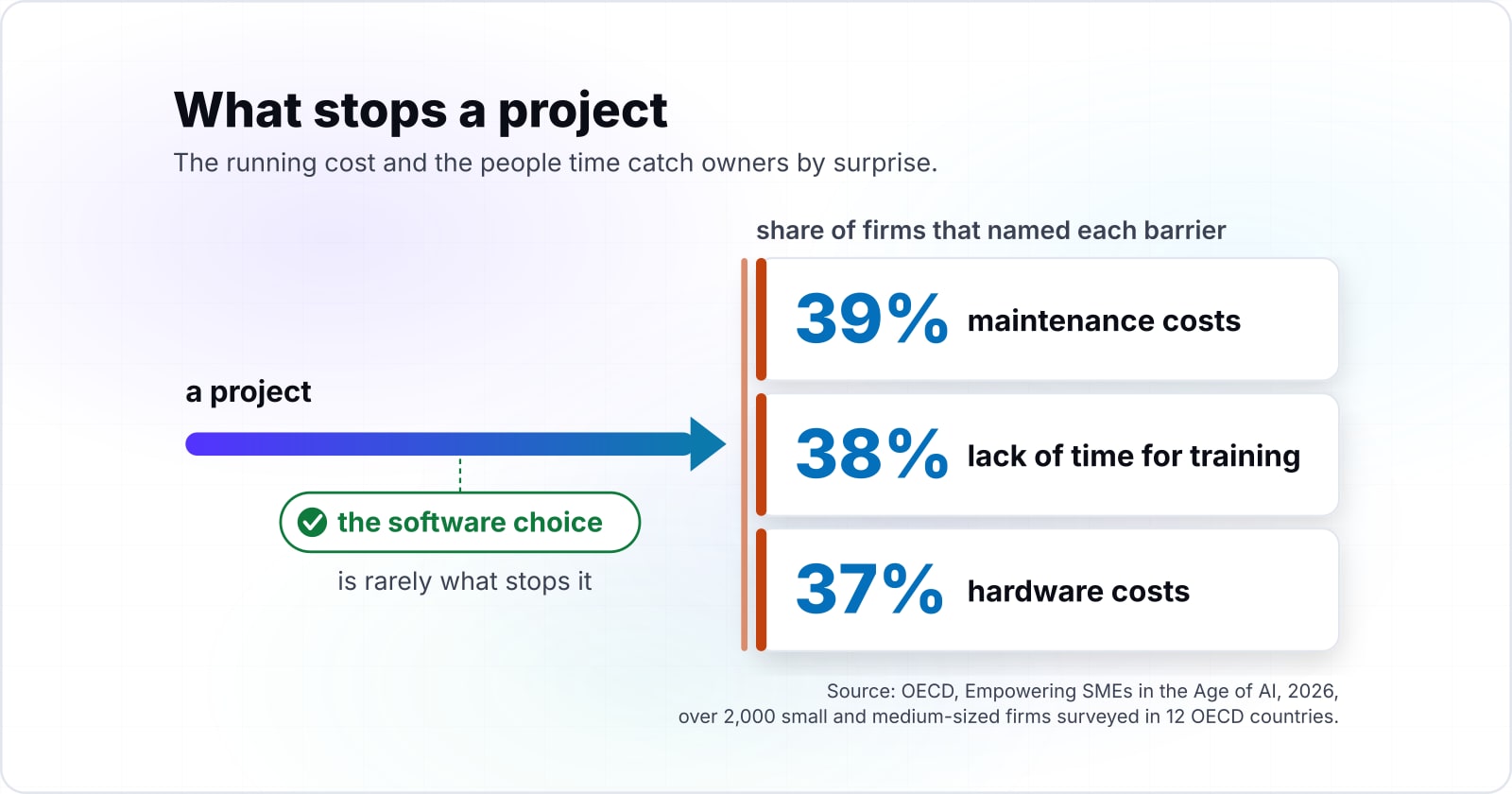
The OECD's 2026 survey of small firms names time constraints, maintenance costs and skills gaps as the barriers that most often hold digital adoption back. The survey is published in Empowering SMEs in the Age of AI. It drew answers from over 2,000 small and medium-sized firms in 12 OECD countries.
In the OECD's 2026 results, 39% named maintenance costs, such as software fees or technical service fees. Also, 38% named lack of time for training, and 37% named hardware costs. In short, the software choice is rarely what stops a project. Instead, the running cost and the people time catch owners by surprise.
The OECD's earlier report makes the same point from another side. That is The Digital Transformation of SMEs, from February 2021. It traces the small-firm digital lag to skills gaps, short capital and "missing complementary assets such as technology itself or organisational practices".
For a plant, that list turns into three checks before any purchase. Who will run the new tool every week, and when do they get the hours to learn it? What will it cost to keep running in year two, not just to install? Also, which working habit has to change for the data to be trusted?
| Barrier named | Share of firms | The check for a plant |
|---|---|---|
| Maintenance costs, such as software fees or technical service fees | 39% | What will it cost to keep running in year two, not just to install? |
| Lack of time for training | 38% | Who will run the new tool every week, and when do they get the hours to learn it? |
| Hardware costs | 37% | What will it cost to install, and to keep running in year two? |
| Missing organisational practices (OECD, 2021) | Not given as a share | Which working habit has to change for the data to be trusted? |
How do machines, MES and ERP fit together without a big-bang project?#
ISA-95 splits a plant's systems into levels, with ERP planning the business, manufacturing operations software running the floor and control systems running machines, so a first project can connect two adjacent levels. In particular, the ISA-95 standard page describes the interface "between level 3 manufacturing systems and level 4 business systems". Below level 3 sit the control functions that run the machines themselves.
In most plants, enterprise resource planning (ERP) software is the level 4 business system. Below it, a manufacturing execution system (MES), or any tool that records production on the floor, works at level 3. Meanwhile, machine controllers and sensors sit below that.
A first project does not need to replace any of these. Instead, it connects two levels that are next to each other. For example, machine run and stop signals can flow into a floor-level record, so downtime is logged by the machine rather than by memory. Alternatively, finished counts from the floor can flow into the business system, so the planner sees today's output today.
The ISA-95 standard exists to reduce "the risk, cost and errors associated with implementing the interface" between those levels. Because the interface is standard, a plant can keep its current business system and add the missing link around it. That is the smallest useful step.
Where should a small or mid-sized manufacturer start?#
Start with one loss the plant already counts, such as unplanned downtime hours, and size the first project against that number before choosing any software. Any digital transformation manufacturing guide that skips this step leaves you with a platform and no target. Downtime is a good first pick. That is because NIST has published a measured gap for it, and most plants log stoppages in some form already.
Here is a worked example. Say a plant logs 40 hours a month of unplanned downtime and runs mostly on reactive maintenance. NIST's survey paper found that the half which relies more heavily on predictive and preventive maintenance had 52.7% less unplanned downtime. So the gap in that comparison is 40 times 0.527, or about 21 hours a month.
Size a first project from your downtime
Put in your plant's monthly unplanned downtime and your lost margin per hour; the gap starts at NIST's 2021 comparison of survey groups.
Hours a month inside the NIST gap
21 h
- Those hours times your margin per hour, a rough upper bound
- Enter your margin per hour
Arithmetic from NIST, Thomas and Weiss, 2021. Modelled, not measured.
Next, multiply those 21 hours by your own lost margin per hour. That gives a rough upper bound to weigh a first maintenance project's yearly running cost against. Be careful with it, though. NIST's 2021 paper compared groups of manufacturers, and a group average promises nothing to any single plant.
If you run a US plant, the NIST Manufacturing Extension Partnership is a sensible first call. Its MEP Centers exist to help small and medium-sized manufacturers make operational improvements. They work in all fifty states and Puerto Rico.
When is a digital transformation programme not a fit for your plant yet?#
A digital programme is not a fit yet when the process is unstable or unmeasured, because software then records the variation faster without removing it. In that case, the better first step is standard work and a manual measure, with software after. Three signs say a plant is in that position.
None of this rules out software for good. It only changes the order. Once the process is stable and the loss is counted, the first project has a number to move and a baseline to prove it against.
What should you ask a software partner before signing?#
Ask any partner which ISA-95 level their work touches, which of your existing systems it keeps, and which number from your own plant it will move. In short, a partner worth hiring names the level, the systems and the number before any product.
The first question tells you whether the work is a connection or a replacement. For example, a connection between level 3 and level 4 is a contained project. By contrast, a replacement of the business system is a much larger one, and it needs its own case.
The second question protects what already works. So a good proposal lists the systems it leaves alone and says how it will read from them. A weak one asks you to move everything into its platform first.
The third question ties the project back to your counted loss. If the answer is "visibility" or "insight", ask for the unit. A partner who cannot name downtime hours, scrap rate or lead time has not yet understood the problem.
Next steps from this digital transformation manufacturing guide#
The next reads go deeper on the AI uses, the supply chain systems and the partner choice that this guide only touches. Each one picks up a thread from above. For the AI uses that sit on top of connected plant data, such as vision inspection and forecasting, read how to pick the first AI build for a plant. For how ERP, warehouse and transport systems fit together, see supply chain management software, and for the EDI, carrier and truck links built around them, see what custom logistics software connects beyond a WMS and TMS. And if your plant runs on older systems, choosing a legacy modernization partner covers the questions above in more depth.
If you want the work done, two service pages describe it. ERP development covers planning and inventory that have outgrown spreadsheets. API integrations covers connecting machines, floor systems and ERP without replacing them. Equally, the NIST survey and the World Economic Forum report linked above are enough to plan a first project on your own.