Why manual testing matters in an era of automation
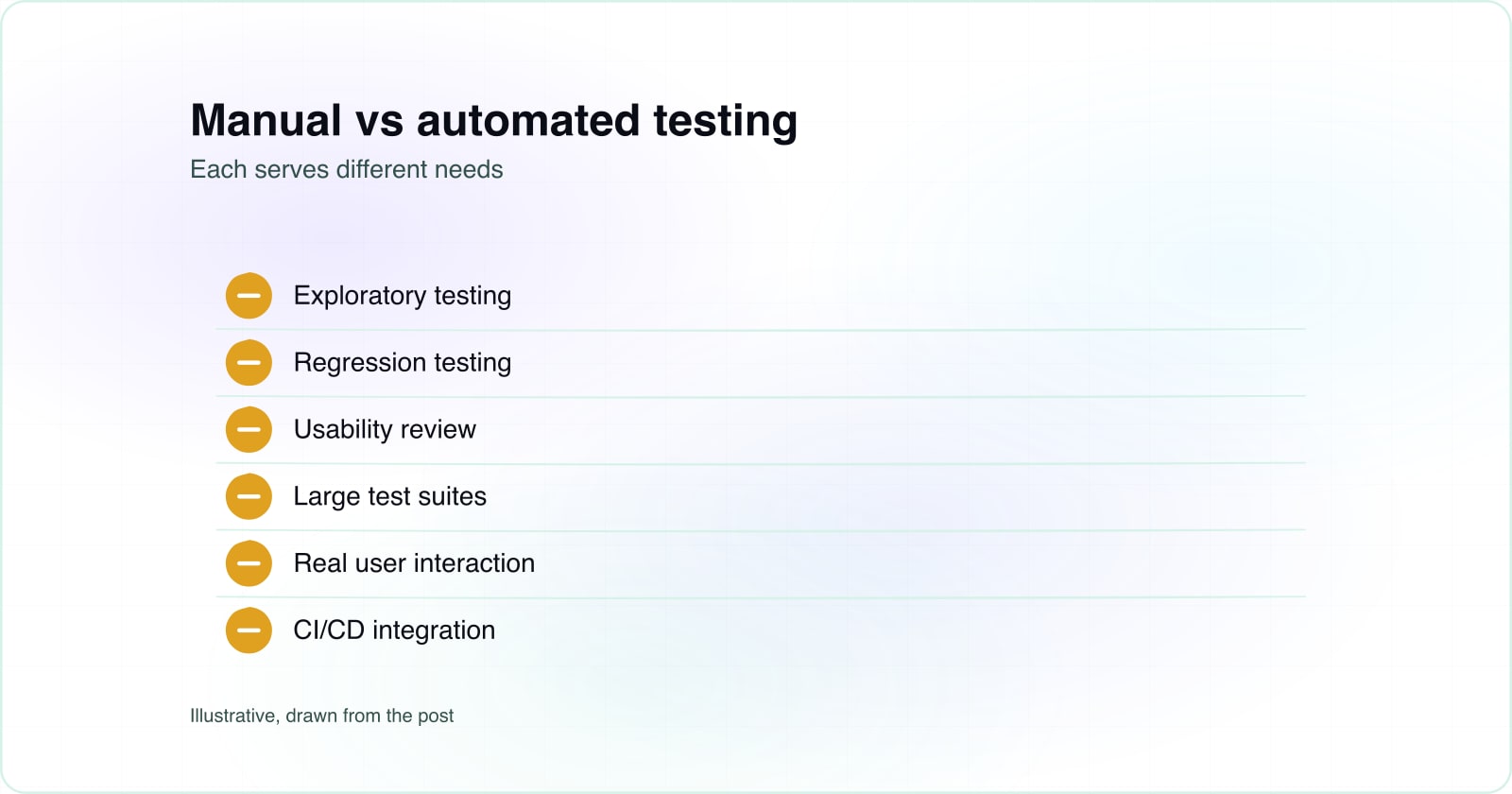
Speed and automation dominate testing conversations today. The question you hear is rarely "should we test" but "how much should we automate." Yet the choice between manual and automated testing is not binary. The real question is which tool solves which problem, and when.
Automation shines at scale#
Automated tests run fast. They execute the same steps consistently. They integrate into continuous integration pipelines so every code change triggers a full test suite in seconds. For regression testing, checking that old functionality still works, automation is irreplaceable. You write once and run thousands of times.
Automation also handles volume. When your application grows to thousands of test scenarios, manual effort becomes impossible. A regression suite of five hundred tests takes weeks to run by hand and minutes automated.
Manual testing requires human judgment#
Automated tests follow rules you defined before you ran them. They pass or fail against those rules. They never deviate. That is their strength and their limit.
A human tester sees a button that looks wrong even though the markup is valid. They notice a flow that technically works but confuses real users. They think like an end-user instead of following a script. That intuition catches gaps automation cannot see.
Exploratory testing needs creative thinking#
You cannot automate what you have not anticipated. When you explore a feature for the first time, you uncover edge cases and interactions no script predicted. A tester clicks something unexpected, tries an unusual input sequence, or combines features in ways the original design did not account for.
This is where defects hide. A user finds a state your test suite never enters because nobody wrote that path. Manual exploratory testing finds those gaps before real users do.
Usability matters more than correctness alone#
A feature can be technically correct and still fail users. An automated test confirms that a form submits. It does not tell you whether users understand what the form asks. It does not catch confusing error messages, broken navigation, or buttons placed where users do not expect them.
Manual testing by someone unfamiliar with the code reveals how real people interact with your software. That difference between "it works" and "users can use it" is where quality lives.
Test design comes before automation#
Before you automate a test, you must design it. A poorly designed test is one that is too brittle, too specific, or checks the wrong thing. It becomes technical debt. Automation amplifies bad test design across your whole suite.
Manual test design lets you explore whether a test makes sense before you invest in automation. You discover the right approach, then automate it. That order prevents wasted effort and makes automated tests actually useful.
The right mix depends on your project#
Small, frequently-changing projects benefit from manual testing. Automation costs time to build and maintain. If your application changes weekly, rewriting test automation becomes expensive relative to its value.
Large, stable applications need extensive automation. Their core features change rarely, so automation ROI is high. Run regression suites constantly. Keep manual testing for new features, exploratory work, and usability review.
Start new features with manual exploratory testing. Design tests manually first. Automate regression tests for what ships. A structured approach to continuous integration keeps both manual and automated tests running efficiently. This sequence catches issues early while keeping maintenance cost reasonable.
The actual goal is user value#
Software quality is not a test metric. It is software that solves real problems for real people. Automation helps you scale that work. Manual testing keeps you honest about what actually matters to those people.
Every strong QA discipline uses both. Automated tests catch regressions constantly. Manual testing ensures that what you are regressing toward is actually what users need. Neither replaces the other. Both together create software worth using.