Robotic process automation (RPA) in healthcare: where it works and where it fails
Bots earn their keep on manual, high-volume, rule-based work behind stable systems. Here is how to tell that work from the processes that change every quarter or sit on fragile old software, before the pilot starts.
RPA in healthcare: where it works and where it fails#
Robotic process automation succeeds in healthcare for manual, high-volume, rule-based tasks with stable system integrations, but fails when compliance requirements, legacy system brittleness, or organizational resistance exceed what RPA's thin orchestration layer can address. Think of a hospital that verifies claims by hand. Claims move across two systems: the EHR and payer system. This creates a bottleneck. So RPA can automate entry and route claims fast. But not all work fits this pattern. When rules change, RPA needs updates each time. When old systems cannot handle bot traffic, automation fails. So choose the right work, or it fails.
What does RPA automation buy in healthcare?#
RPA on the right workflows delivers documented labor savings and accuracy gains measured in case studies and peer-reviewed research. Most RPA initiatives in healthcare fail to meet expectations, according to research from arXiv in 2026 (Castillo et al., arXiv 2026). Because organizations pick processes without a standard selection method, they focus on volume alone and miss compliance and system-stability risks. However, when organizations apply clear selection criteria to assess process stability and risk, payback periods shrink dramatically. Claims scrubbing pays back in 1.8 months, eligibility verification in 2.1 months, and appointment scheduling in 2.5 months. So the right choice cuts payback time sharply.
A 2026 narrative review from PubMed Central found that RPA with smart oversight cuts errors and raises accuracy in billing, claims work, and administrative tasks (PubMed Central 2026). Therefore, success or failure depends entirely on choosing the right workflow, keeping systems stable, and following compliance rules. Organizations that win pick high-volume, rule-based work with stable systems and then check each task for compliance risk and system fragility before they build. In contrast, organizations that fail pick by volume alone. Because they miss compliance and system risks, automation becomes costly and hard to maintain over time.
What eligibility checks cost you by hand
Put in your own daily claims, the minutes each check takes by hand and with RPA, and the hourly cost of the person doing it. Add what automating it would cost you to see the payback.
Staff cost saved a year
$175,000
- Staff hours saved a day
- 25 h
- Staff cost saved a day
- $700
- Checking time cut by
- 83%
- Payback on your cost
- Enter your cost
The defaults are an illustrative example, not a measured rate. Change them to your own.
How does RPA work, and why is healthcare different?#
RPA automates screens and forms through stable, rule-based logic. Healthcare regulation and legacy system brittleness make RPA risky. The software copies what users do: it clicks, types, and moves data based on rules. When workflows stay stable and rules stay clear, RPA works well. For example, a simple rule like "if member is active, route claim to billing" runs predictably. However, healthcare compliance adds work that other industries don't face. HIPAA rules, HL7 standards, and FDA rules all matter. When a new rule comes out, old RPA rules may break. Additionally, old hospital systems were not built for bots, so a fast bot can crash them. Because HL7 rules govern healthcare data, when RPA breaks those rules, audit risk grows and compliance fails.
A 2026 narrative review published in PubMed Central studied RPA in healthcare and found that the work requires good technical skills, continuous learning, compliance expertise, and strong data security (PubMed Central 2026). Therefore, these compliance demands set healthcare apart from other industries where RPA adoption is simpler.
Which healthcare workflows fit RPA best?#
RPA excels on high-volume, rule-based tasks: eligibility verification, claims entry, appointment scheduling, patient record sync. These workflows are manual, high-volume, use stable tools, follow clear rules, and need no human judgment. Therefore, when you look for your first RPA project, seek workflows with these traits. Eligibility checks are the top fit because the work is simple: confirm coverage, verify member ID, and route the claim. Claims entry works the same way because RPA cuts processing time per claim quickly and consistently. Appointment booking follows the same pattern: check availability, confirm limits, and book the slot. In summary, all three workflows are automatable because they are rule-based, high-volume, and require no human judgment.
Why do healthcare RPA implementations fail?#
RPA breaks when regulations change, legacy systems are brittle, or organizations do not monitor automation drift. Regulatory change is the top cause because HIPAA guidance updates may change how organizations handle audit logs, identity checks, or data access, so RPA systems built under older rules may break with new requirements. Because a bot might work for years, it may suddenly stop when the insurer changes their portal. Additionally, legacy system brittleness makes it worse because many hospitals run old systems that were not built for external automation bots. When a fast bot runs, it can overflow database pools, crash servers, or break transactions under high load. The third failure mode is drift, where the robot runs old rules and nobody monitors it. Since rule changes happen in the business, the RPA rule stays old and the bot uses the wrong rule. This compliance risk grows quietly and invisibly until an audit finds the problem.
What compliance and integration issues make RPA risky?#
Regulatory constraint and system coupling matter more than task volume. High constraint or tight coupling makes RPA expensive. Compliance affects feasibility significantly, because high-constraint workflows fall under HIPAA, FDA, state, or payer rules that need updates often as guidance changes. Tight integration is the second issue, so when a workflow depends on three old systems talking through an old API, RPA becomes fragile. The API wasn't made for robots, so a small change in one system breaks the chain. A low-volume task with no compliance risk and stable APIs fits RPA, but a high-volume task under strict compliance and fragile links does not. Unfortunately, most healthcare organizations choose the opposite: they choose by volume alone and ignore compliance and integration risk.
RPA versus API integration versus hiring: which to choose?#
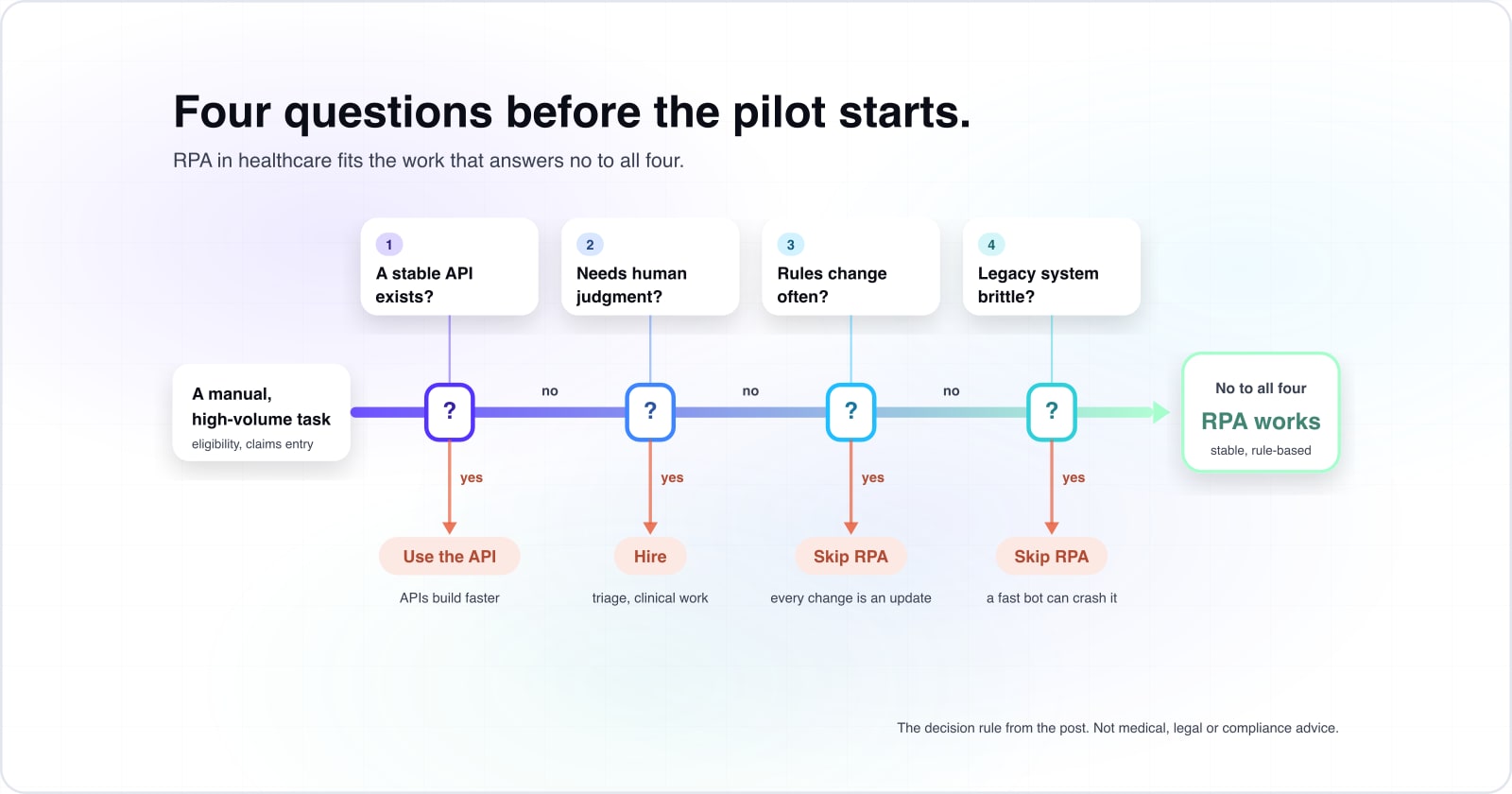
Choose RPA for high-volume, stable tasks without API access. Choose APIs when available. Choose hiring when judgment matters. Therefore, RPA is one option among many, and the choice depends on system coupling, rule stability, and error cost. When the system has a stable API, use it, because APIs build faster, are more reliable, and are easier to maintain than RPA. When no API exists, RPA is next. But when the task needs human judgment, hire instead, because triage, peer review, and clinical work all require judgment. So don't automate these tasks. When the process itself is slow, fix the process first, because automation is secondary. The decision is simple: Is the interface stable? Use APIs. Does the task need judgment? Hire. Do rules change often? Skip RPA. Are legacy systems brittle? Skip RPA. If you answered no to all four, then RPA works.
When not to use RPA in healthcare?#
Do not use RPA when rules change frequently, judgment is required, or error cost is patient safety or compliance. Workflows that change weekly don't fit RPA because RPA rules need updates each time and the benefit fades fast. Tasks that need clinical judgment should never be automated because choosing which patient gets treatment, sorting urgent cases, and approving exceptions all require human judgment. Serious errors harm patients and break compliance rules in ways that outweigh RPA gains: a bot that denies a claim wrongly breaks rules, miscoding a diagnosis harms patients, and losing a record costs penalties. So skip rule-heavy tasks and wait until rules stay stable for at least 18 months. The honest exit is this: if you need a system that learns from feedback, adapts to change, or makes judgment calls, build custom software or hire people instead. RPA is not a replacement for those needs. Therefore, it works only for stable, rule-based, high-volume tasks.
Next steps: audit your workflows now.#
Assess your high-volume tasks for compliance constraint and system coupling. Use the framework above to decide RPA, API, or hiring. Start with a workflow audit where you find high-volume manual tasks in your operation and assess each for stability. Ask: does the rule change? Check compliance next: does the task fall under HIPAA or state rules? Check system links too: are the systems stable, and are they coupled? Stable, low-constraint, loosely coupled workflows fit RPA best. Measure ROI now by asking what one manual run costs in time and errors, how often it happens, and what RPA costs in licenses, development, testing, and support. Then put that cost into the calculator above to see the payback on your own volume. The paper cited earlier reports 2.1 months for eligibility verification on well-chosen processes, so if your payback runs far longer than that, the workflow is probably a poor fit. To learn more about healthcare process optimization, see Atyantik's scale and optimize services for custom work. For automation in regulated settings, explore security and compliance services, how automation improves business, and more on process efficiency.
What questions can you answer about RPA in healthcare?#
Here are direct answers to the key questions about RPA adoption in healthcare.