How sustainable regression strategies prevent burnout
In modern software delivery, speed is no longer optional. Neither is quality. As release cycles shorten and changes stack up, regression testing becomes one of the most critical safeguards in the development lifecycle. Yet it is also one of the most underestimated and exhausting activities in quality assurance.
Why regression testing looks repetitive but feels overwhelming#
While regression testing may look repetitive on the surface, testers experience it very differently. They notice risks, patterns, and hidden dependencies that others often overlook. More importantly, they understand that sustainable quality cannot come at the cost of tester burnout.
Regression testing exists to answer a deceptively simple question: did something that used to work break because of this change?
Developers focus on newly implemented functionality. Business stakeholders look at feature readiness. Testers, however, must think across existing workflows, shared components, legacy functionality, and integrations and dependencies.
Testers quickly learn that even a small change can have far-reaching consequences. A minor validation update, configuration tweak, or backend fix can quietly disrupt stable functionality elsewhere. This broader responsibility is what makes regression testing essential. It is also what makes it mentally demanding.
What testers notice during regression that others often miss#
Testers develop a keen eye for the gaps between what developers intend and what actually travels through the system. This insight is where sustainable regression strategies begin.
Hidden dependencies between features#
Changes are rarely isolated. Testers notice that multiple features rely on shared services or APIs. Legacy workflows are still actively used by customers. Small UI or logic changes can affect accessibility, performance, or data flow.
These dependencies may not be documented. Testers uncover them through experience and observation. This is why testers often recommend expanding regression scope when others feel confident limiting it.
The risk of last-minute changes#
Late-stage fixes are common in fast-moving projects. They come with risk. Testers recognise that last-minute changes often skip full validation. Quick fixes can introduce regressions in unrelated areas. Minor changes may bypass established test coverage.
This awareness allows testers to raise timely concerns. Not to delay releases, but to prevent avoidable production issues.
When regression becomes draining#
Regression testing becomes exhausting not because of repetition, but because of inefficiency. Testers notice burnout when the same low-risk tests repeat every release without prioritization, when manual effort is used where smarter strategies could help, and when no framework exists to make decisions about scope.
Experienced testers understand that running more tests does not always result in better quality. Running the right tests does.
How testers prevent regression burnout#
Risk-based regression testing#
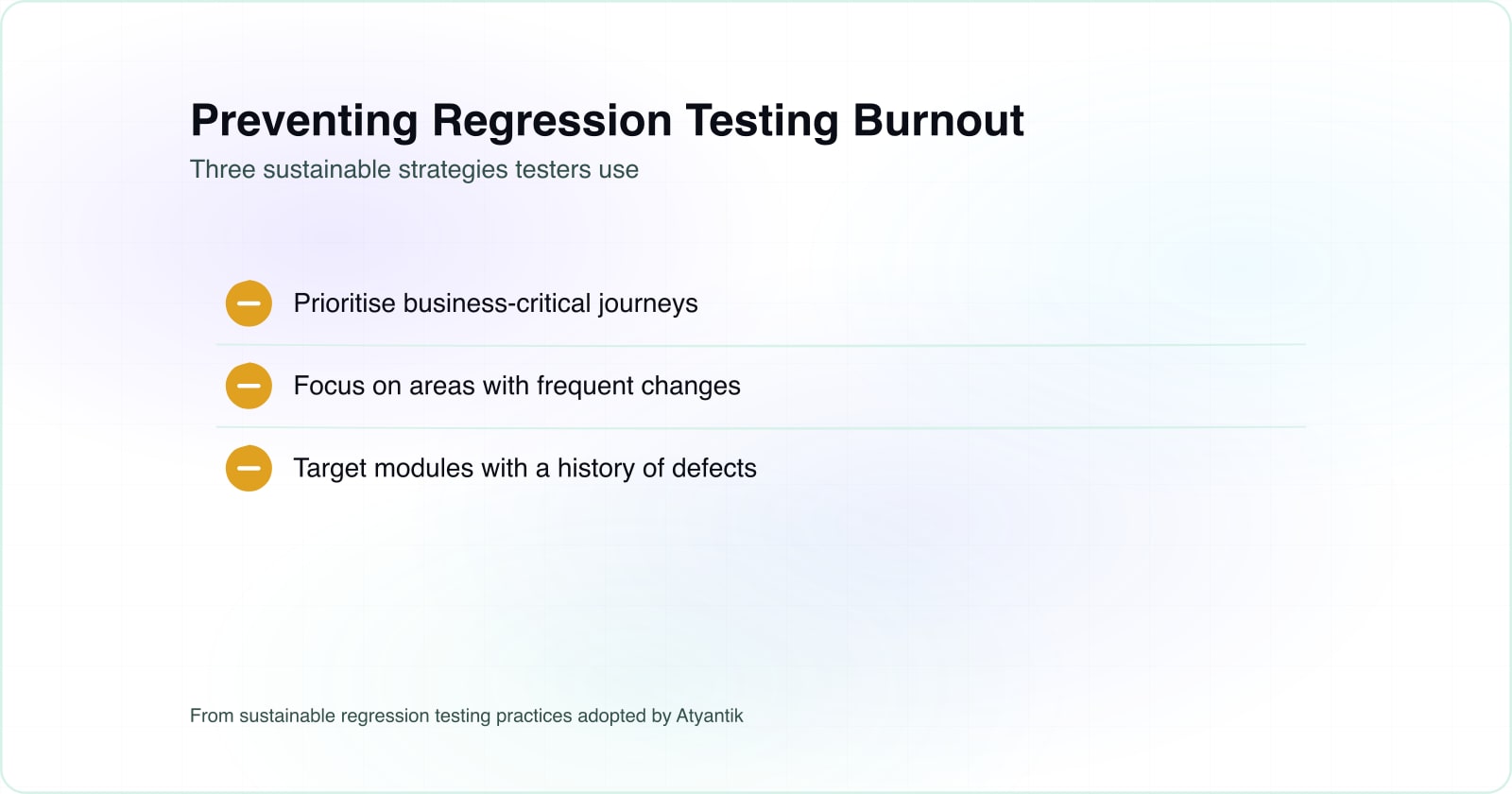
Rather than testing everything equally, testers prioritise business-critical user journeys, areas with frequent changes, and modules with a history of defects. This approach reduces effort while maintaining confidence in the release. Effective DevOps and CI/CD practices embed regression testing early, catching issues before they reach production.
Using experience to optimise coverage#
Over time, testers recognise patterns. Certain modules are more fragile than others. Some test cases rarely detect issues. Specific changes consistently cause regressions. By refining regression scope based on real data and experience, testers transform regression testing into a focused, high-value activity.
- Prioritise business-critical journeys
- Focus on areas with frequent changes
- Target modules with a history of defects
- Refine scope based on real data
Automation as an enabler, not a shortcut#
Automation plays a key role. Testers understand its limits. They use automation to reduce repetitive execution, validate stable and predictable flows, and free time for exploratory and risk-focused testing. Automation supports regression testing. It does not replace human judgement.
Why sustainable regression testing matters#
When regression testing is approached thoughtfully, releases become more predictable, production defects reduce significantly, and QA teams remain motivated and effective.
At Atyantik, quality is not treated as a final gate. It is embedded throughout the delivery lifecycle. Testers play a central role by balancing speed, coverage, and sustainability. Sustainable regression strategies pair with ongoing maintenance and support to keep systems stable.
This balance is not achieved by testing more. It is achieved by testing smarter. It is achieved by testing with purpose. By trusting tester insights and adopting smarter regression strategies, organisations protect software quality without exhausting the people responsible for it.