European Accessibility Act compliance: am I in scope, and what must I prove?
The EAA applies from 28 June 2025. Treat it as one node of a single global accessibility obligation, and two questions decide everything: are you in scope, and what does fixing it once actually satisfy?
What the European Accessibility Act actually is#
The European Accessibility Act is Directive (EU) 2019/882. It is in force, and its requirements apply from 28 June 2025. That date is a fixed calendar fact, not a countdown you have to beat.
The Directive sets common accessibility rules across the EU for a defined set of products and services. Because it is a directive, each member state writes it into national law, so the letter varies a little by country. However, the technical core does not vary. Conformance is measured against EN 301 549, the harmonized European standard, which incorporates WCAG 2.1 Level AA for web content. In short, European Accessibility Act compliance for a website or app means meeting WCAG 2.1 AA, then proving it.
Am I actually in scope?#
This is the first question, and scope is where European Accessibility Act compliance either starts or stops for you. Most guides answer it in vague prose. Instead, this section turns scope into a decision you can run in under a minute. The wedge is one distinction the cohort blurs: the product track behaves differently from the service track.
Two tracks: covered product vs covered service#
First, scope runs on two separate tracks. The product track covers physical hardware such as payment terminals, e-readers, ticketing and check-in machines, smartphones, and computers. The service track covers digital services such as e-commerce, consumer banking, e-books, transport, telecom, and media. Because the exemption logic differs by track, you must decide which track you are on first.
The micro-enterprise exemption covers services only, never products#
Here is the single most-missed fact. The micro-enterprise exemption applies to service providers, and it never applies to the makers of covered products.
The non-EU seller rule#
Still, many teams outside the EU assume the Act cannot reach them. That assumption is wrong. The rule is flat and decidable: if you place a covered product or service on the EU market, you are in scope, regardless of where your company is incorporated.
So a US-based or India-based company selling to EU consumers is treated like any EU seller. Being established abroad is not an exemption. Because the trigger is the market you sell into, not your address, the decision is simple. Do you place it on the EU market? If yes, you are on one of the two tracks above.
Run the scope decision yourself#
In practice, the scope logic above exists in most articles only as prose. Here it becomes a structure you can run. First, read the two-lane flowchart, which is the static decision path. Then use the checker below it to walk your own case to a verdict.
Now make it yours. Pick your track, set whether you place it on the EU market, and answer the covered-category and micro-enterprise questions. The checker computes a verdict live, with the reason and the resulting obligation.
Pick your track
Try the worked example:
Your verdict
In scope
A covered service placed on the EU market, above the micro-enterprise threshold. Being established outside the EU is no exemption, because the service reaches EU consumers.
Then what. Conform to EN 301 549 (WCAG 2.1 Level AA for web content), publish an accessibility statement, and keep the supporting technical documentation. Then maintain it.
| Track | On the EU market | Covered category | Micro-enterprise | Verdict |
|---|---|---|---|---|
| Service | Yes | Yes | Yes (under 10 AND not over EUR 2M) | Exempt, Art. 4(5) |
| Service | Yes | Yes | No | In scope |
| Product | Yes | Yes | Not applicable to products | In scope |
| Either | No | Any | Any | Out of scope |
Service track. Verdict: In scope. A covered service placed on the EU market, above the micro-enterprise threshold. Being established outside the EU is no exemption, because the service reaches EU consumers.
A scope-triage aid built on the Directive's own definitions, not legal advice. It resolves the common case: covered category, EU market, and the micro-enterprise test. Sector carve-outs, disproportionate-burden pleas, and national transposition detail need a licensed attorney.
Worked example: two contrasting companies#
In particular, two illustrative companies show how the single threshold decides the outcome. Load them as presets in the checker above, or follow along here.
Scenario A is in scope. A US-headquartered online retailer has 40 employees and EUR 8,000,000 in annual turnover. It sells physical goods to consumers in Germany, France, and Spain through its website and app. Run the test. 40 persons is not fewer than 10, and EUR 8M is well over the EUR 2M ceiling, so it is not a micro-enterprise. Moreover, e-commerce is a covered service, and being US-based is no exemption. Therefore, from 28 June 2025 its storefront must conform to EN 301 549, publish an accessibility statement, and retain technical documentation.
Scenario B is exempt, until one variable moves. A 6-person EU web consultancy with EUR 1,200,000 turnover offers an online booking service. Because 6 is fewer than 10 and EUR 1.2M is under EUR 2M, it is a micro-enterprise, and a service micro-enterprise is exempt under Art. 4(5). Now change one thing. If that same 6-person firm instead manufactured a payment terminal, the exemption would vanish, because products are never exempt. In practice, scope for a small team hinges on that one product-versus-service line.
If I fix it once, what have I actually satisfied?#
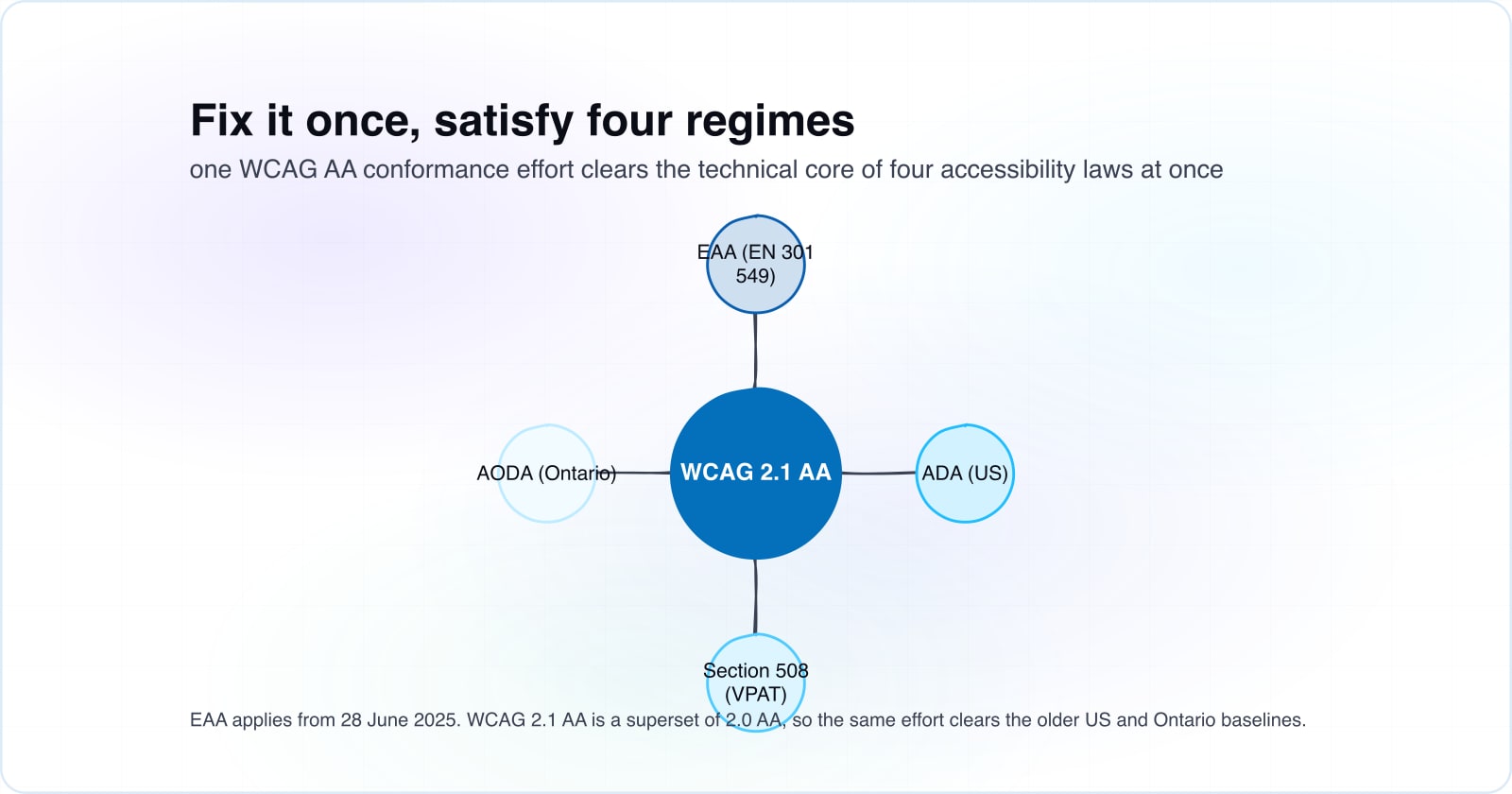
This is the second question, and it is the payoff that makes European Accessibility Act compliance worth doing once. The common fear is four separate compliance projects for four regions. In reality, one conformance effort covers the technical core of all of them, because they share a standard.
The one-obligation crosswalk#
In short, the crosswalk below is the proof. Read across each row. Whatever your region, the technical target is a WCAG AA baseline, so one effort satisfies the technical core of four regimes at the same time.
| Framework | Technical standard | Who enforces it | Required artifact |
|---|---|---|---|
| EAA (via EN 301 549) | Technical standardWCAG 2.1 Level AA | Who enforces itMember-state market-surveillance authorities | Required artifactAccessibility statement plus technical documentation |
| ADA (United States) | Technical standardWCAG 2.1 AA in practice | Who enforces itDOJ and private litigation | Required artifactNo filed artifact; evidence on demand |
| Section 508 (US federal) | Technical standardWCAG 2.0 AA (Revised 508) | Who enforces itFederal agencies and procurement | Required artifactAccessibility Conformance Report (VPAT) |
| AODA (Ontario, Canada) | Technical standardWCAG 2.0 AA | Who enforces itOntario provincial government | Required artifactFiled accessibility compliance report |
Meanwhile, the columns differ in enforcer and paperwork, yet the technical standard converges. Because WCAG 2.1 AA is a superset of 2.0 AA, meeting the EAA target also clears the older US and Ontario baselines. As a result, the work compounds instead of repeating.
What conformance actually requires: three artifacts#
Still, conformance is not just a passing scan. It is three first-class obligations, and the cohort usually names only the first.
First, conform to EN 301 549, which sets WCAG 2.1 AA as the web baseline. Second, publish an accessibility statement that users can find and read. Third, keep the supporting technical documentation that shows how you meet the standard. Miss the statement or the records, and you have done the hard part without the proof.
The accessibility statement, specified#
Most pages mention the accessibility statement, then leave it undefined. Treat it instead as a maintained artifact with a real spec.
The leg everyone drops: maintain#
Meanwhile, most guides treat conformance as a one-time audit. That is the leg they drop. A shipping product changes every sprint, and each change can reintroduce a barrier a previous audit had cleared.
Therefore maintenance is part of the obligation, not an optional extra. In practice, that means a regression gate in CI plus a periodic manual pass, so conformance holds as the product moves. For the mechanics of that gate and the manual layers around it, see accessibility testing practices that satisfy EAA conformance checks.
How European Accessibility Act compliance is enforced#
In practice, enforcement is real, and it is also less dramatic than the scare headlines imply. There is no single EU-wide fine schedule. Instead, each member state enforces its own transposed law through market-surveillance authorities, and the process is largely complaint-driven. The escalation runs in stages.
- Trigger
A complaint or a market check
Enforcement is largely complaint-driven. A user, a competitor, or an authority flags a barrier.
- Assessment
The authority reviews conformance
It checks the product or service against the national law that transposes the Directive.
- Correction
A request to fix, with a deadline
The usual first step is a corrective-action order, not a fine. Many cases end here once the fix ships.
- Penalty
Fines that vary by country
There is no single EU-wide schedule. Each member state sets its own penalties and ranges.
- Withdrawal
Removal from the EU market
The final escalation for a non-compliant product is withdrawal from sale in that market.
So the honest picture is a corrective ladder, not an instant penalty. Still, the ladder ends somewhere serious, and remediation under deadline pressure costs far more than building it in. Because of that, treating conformance as a design property beats treating it as a legal fire drill.
When this framing does not apply#
This is the honest limit of the approach. The one-obligation framing is a strong default, yet it is not a universal key, so here is when NOT to lean on it.
First, do not treat the crosswalk as legal coverage. It maps the technical standard, not every procedural duty in every jurisdiction. Second, do not assume a green automated scan equals European Accessibility Act compliance. A scanner settles only part of WCAG, so the manual layers still carry most of the judgment. Third, and most important, be honest about overlays.
A practical European Accessibility Act compliance path#
Here is a plain path that avoids both panic and overlays. It has four steps, in order.
First, audit against WCAG 2.1 and 2.2 AA, using automated checks plus manual keyboard and screen-reader passes. Second, prioritize the findings by user impact and legal risk, not by scanner severity alone. Third, document the result as a published accessibility statement plus the technical records behind it. Fourth, maintain conformance with a CI regression gate and a periodic manual review.
Finally, the foundations sit underneath this path. For the semantic-HTML and POUR basics that make a page conformant in the first place, read why accessibility matters and how to get started. For one concrete criterion done right, see how to build the keyboard-focus indicators required under WCAG 2.1 AA. Together they cover the build; this guide covers the law.
Want a second read on where you land on the two questions, scope and equivalence, before you commit build time? This connects to Atyantik's WCAG compliance service and to broader accessibility support from audit through maintenance. No pressure, and no lock-in.
See Atyantik's approach to WCAG compliance