How to Hire a Laravel Developer in 2025: Expert Tips and Strategies
As we step into 2025, the demand for skilled Laravel developers continues to soar. Businesses across industries are turning to Laravel, a leading PHP framework, to build reliable and scalable web applications. With its elegant syntax, rich features, and ecosystem, Laravel has become a favored choice for developers worldwide. However, finding the right Laravel developer for your project can be a challenge. This guide walks you through the steps to hire a qualified Laravel developer who delivers exceptional results.
The Importance of Hiring the Right Laravel Developer#
A skilled Laravel developer can be the cornerstone of your web application's success. They can harness Laravel's powerful tools and features to create applications that are functional, scalable, and maintainable.
Laravel's built-in support for authentication, routing, and database management accelerates the development process. A qualified developer ensures projects are delivered on time and within scope. They know how to use the framework to avoid common pitfalls. Quality development reduces technical debt and long-term maintenance costs.
The wrong hire creates the opposite outcome. Inexperienced developers may overcomplicate solutions. They may miss security best practices. They may build applications that are hard to maintain or extend later. The cost of hiring the wrong person extends far beyond the initial engagement.
Defining a Qualified Laravel Developer#
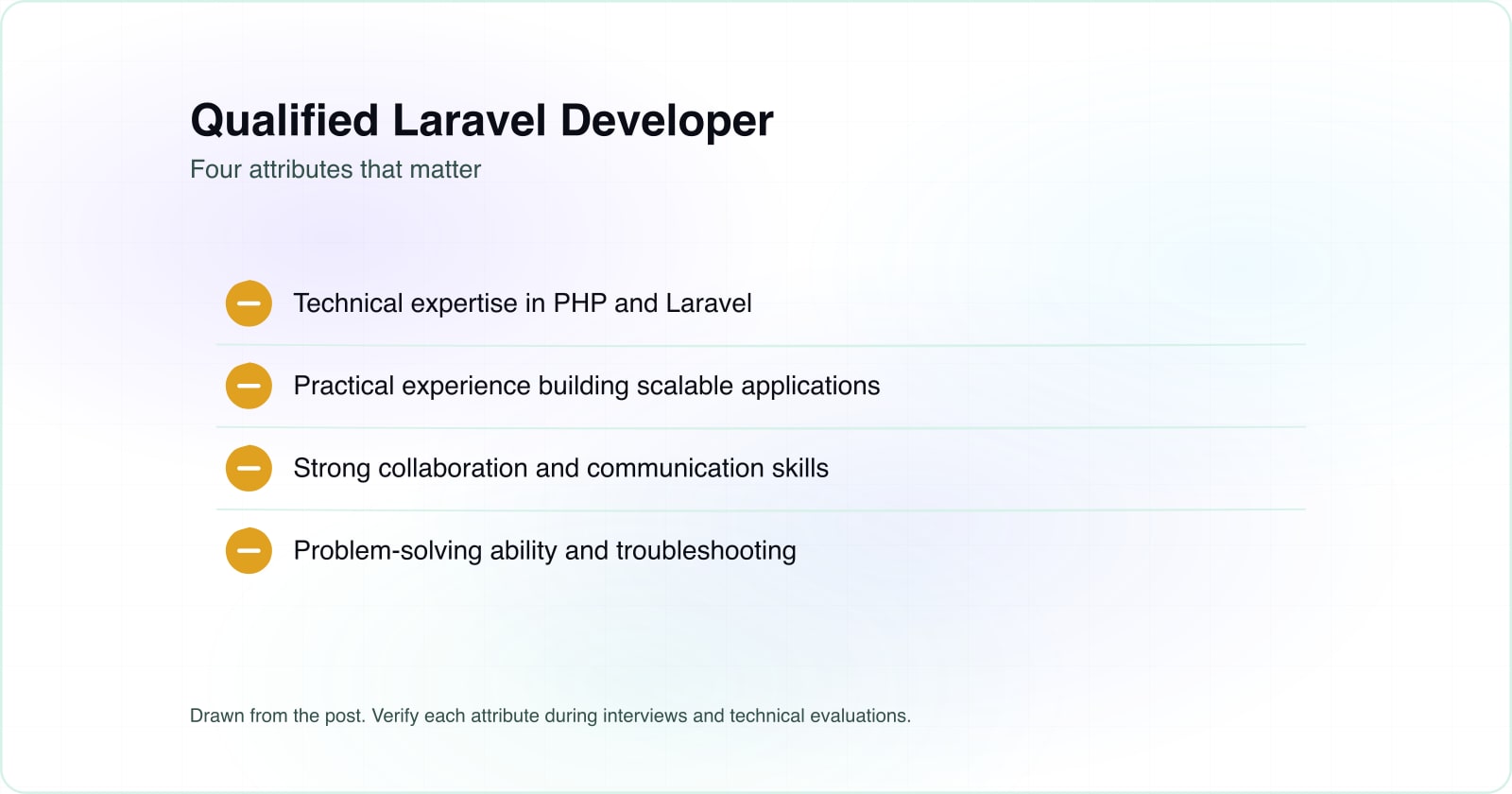
A qualified Laravel developer has several key attributes. Technical expertise matters. So do practical experience, collaboration skills, and problem-solving ability.
Technical Expertise#
Proficiency in PHP and object-oriented programming is foundational. Look for deep knowledge of Laravel-specific features. This includes Eloquent ORM for database interactions. Blade templating for views matters. Artisan commands for scaffolding and maintenance are essential.
A developer should understand the MVC pattern and why it matters. They should know how to write clean, testable code. Familiarity with Laravel's middleware system is important. Understanding service providers and dependency injection shows architectural depth.
Practical Experience#
Look for a proven track record building scalable applications. Ask for examples where they've used Laravel to solve real business problems. Practical experience means they've faced and solved production issues.
Experience with different project types strengthens their background. Building APIs is different from traditional web applications. E-commerce projects have different concerns than content management systems. A developer with diverse experience brings perspective to your unique requirements. For SaaS applications, particular expertise in multi-tenancy and billing systems matters.
Collaboration Skills#
The ability to work within a team is crucial. Check their Git proficiency and code review practices. Effective communication with stakeholders prevents misunderstandings later.
How they handle feedback matters. Do they take constructive criticism well? Can they explain technical decisions to non-technical team members? These soft skills often make the difference between smooth and painful projects.
Problem-Solving Ability#
Experience troubleshooting and optimizing Laravel applications shows depth. Can they diagnose why code is slow? Do they know how to profile applications? Problem solvers don't just fix immediate issues. They think about prevention and scalability.
How to Hire a Laravel Developer for Your Project#
Follow these steps to find the right developer for your needs.
Step 1: Define Your Project Requirements#
Before searching for a Laravel developer, define your project's scope carefully. What is the timeline? What is your resource allocation? What Laravel features are essential for your project?
Do you need authentication systems? Will you build an API? Do you need real-time components? Having clear understanding of requirements helps you communicate effectively with candidates. It ensures you find someone aligned with your goals.
Step 2: Identify Developers with Proven Laravel Experience#
Look for developers who demonstrate Laravel skills through strong portfolios. Use platforms like LinkedIn, Upwork, and specialized job boards. Prioritize developers with relevant project experience.
Check their familiarity with Laravel's latest features and best practices. Ask about their preferred development tools and workflows. Do they follow PSR coding standards? Have they contributed to the Laravel ecosystem? These details reveal their engagement with the community.
Step 3: Verify Reputation and Client Feedback#
Check reviews on platforms like Clutch and Google Reviews. Reach out to past clients directly. Ask about their work quality, professionalism, and reliability.
This step filters out unreliable candidates. It ensures you're hiring someone whose track record matches their claims. Ask specific questions about communication, deadline adherence, and problem resolution.
Step 4: Assess Communication and Collaboration Skills#
During interviews, evaluate how well the developer explains technical concepts. Ask how they approach project discussions. Explore their experience working in teams and handling feedback. Like the assessment process used by hiring managers evaluating Node.js developers, evaluate the same communication patterns and team dynamics.
Strong communication ensures smoother project execution. It reduces misunderstandings. Pay attention to how they listen, not just how they talk. Do they ask clarifying questions? Can they adapt explanations to different audiences?
Step 5: Conduct Technical Evaluations#
Assign a practical test relevant to your project. For example, ask them to build a small Laravel application with authentication and CRUD operations. This assesses technical ability and problem-solving approach.
Provide clear instructions and feedback. Give them time to complete the task properly. Pay attention to code quality, not just functionality. Do they follow Laravel conventions? Is their code readable and maintainable?
Why Choose Atyantik Technologies for Laravel Development?#
Finding a single developer takes time. Building a team adds complexity. Sometimes partnering with an established agency makes sense for your project.
Atyantik Technologies offers comprehensive solutions:
- Custom Laravel applications for websites, CMS platforms, and e-commerce solutions
- Mobile app integration for Android and iOS to complement web applications
- Ongoing support and maintenance to keep applications secure and up-to-date
Working with an agency brings additional benefits. You get access to multiple developers with different specializations. You have backup if a primary developer becomes unavailable. Quality assurance processes are typically built in. You can scale resources up or down as project needs change. Atyantik offers SaaS development expertise and long-term application maintenance support as part of their service offerings.
Atyantik's commitment to client satisfaction, on-time delivery, and budget adherence makes them a reliable choice for businesses seeking Laravel development expertise. When compared to hiring individual contractors, agencies provide continuity that supports your project long-term.
Conclusion#
Hiring a Laravel developer requires a thoughtful approach. Define your requirements clearly. Vet candidates thoroughly. Assess both technical and soft skills.
Whether you hire independently or partner with an agency, prioritizing quality and compatibility leads to successful outcomes. A good hire pays dividends throughout your project. A bad hire costs far more than you saved. Take time to make the right choice.