Real examples of digital transformation in manufacturing
Manufacturers today want to see how digital transformation actually works in real factory environments. You need practical examples that show you what changed, how operations improved, and what business impact materialized. Generic definitions don't answer the questions manufacturing leaders typically ask before investing in technology.
Why manufacturers look for real digital transformation examples#
Before you invest in technology, you ask yourself practical questions. What problems did this solve? What changed in daily operations? What measurable business impact did it create?
These questions are answered best through real examples rather than high-level strategy talks. Understanding what digital transformation means at a strategic level is important. But examples show you how that strategy translates into daily work on the shop floor.
Example 1: Real-time production monitoring on the shop floor#
Challenge. A mid-size manufacturer relied on manual production reporting and end-of-day updates. Supervisors lacked real-time visibility into machine performance and couldn't identify bottlenecks until hours or days had passed.
Approach. Custom production monitoring software captured live machine data and displayed real-time dashboards across all production lines. The system gave supervisors immediate visibility into what was running, what had stopped, and where delays were building.
Results.
- Live visibility into production performance
- Faster identification of bottlenecks
- 15 to 20 percent improvement in overall equipment effectiveness (OEE)
These outcomes reflect the broader benefits of digital transformation in manufacturing, where data replaces assumptions and production loss gets caught in minutes instead of days.
Example 2: Predictive maintenance to reduce unplanned downtime#
Challenge. Unexpected machine failures were causing frequent production delays and driving maintenance costs higher every quarter.
Approach. IoT sensors and analytics software tracked machine behavior including temperature, vibration, and usage patterns. The system generated predictive alerts that warned maintenance teams before failures occurred, not after equipment stopped.
Results.
- 30 to 40 percent reduction in unplanned downtime
- Lower emergency repair costs
- Improved equipment lifespan through earlier interventions
Predictive maintenance moves you from reactive firefighting to proactive planning, letting your team schedule repairs when it's convenient rather than when equipment fails. Many manufacturers achieve these results by applying AI applications in manufacturing, especially in environments where equipment breakdowns are expensive.
Example 3: Inventory and supply chain digitalization#
Challenge. Despite carrying high inventory levels, manufacturers still faced raw material shortages and delayed production schedules. Data lived in separate systems with no way to see the full picture.
Approach. Integrated inventory and supply chain software connected procurement, production planning, and supplier data into one system. For the first time, planners could see demand forecasts, current stock, supplier lead times, and production schedules all together.
Results.
- Accurate demand forecasting based on real data
- 20 to 30 percent reduction in inventory carrying costs
- Better supplier coordination and shorter lead times
Digital transformation in supply chain improves operational efficiency from raw materials through shipment, not just production decisions alone.
Example 4: Digital quality control and compliance tracking#
Challenge. Manual quality checks led to inconsistent inspections and delayed defect detection. Regulatory audits required tracing documentation across paper records and spreadsheets.
Approach. Automated inspection systems and centralized quality dashboards tracked defects in real time and maintained digital audit trails. Every inspection, every defect, and every corrective action was captured automatically.
Results.
- Faster defect identification during production
- Reduced scrap and rework rates
- Improved regulatory compliance and audit-ready traceability
In regulated industries, this form of digital transformation in manufacturing reduces audit risk and creates a permanent record that proves your quality practices.
Example 5: Data-driven decision making for leadership teams#
Challenge. Leadership decisions were based on outdated reports and fragmented data from multiple departments. Each area had its own numbers, and nobody agreed on what was actually happening across the business.
Approach. Custom analytics dashboards consolidated data from production, quality, maintenance, and supply chain systems into one source of truth. Executives could now see the full operational picture and trace any decision back to real data.
Results.
- Faster and more confident decision-making at every level
- Improved alignment between departments
- Better accuracy in long-term planning and forecasting
When every department reports from the same data, strategy sessions become focused on what to do next rather than what the numbers actually say.
What these digital transformation examples have in common#
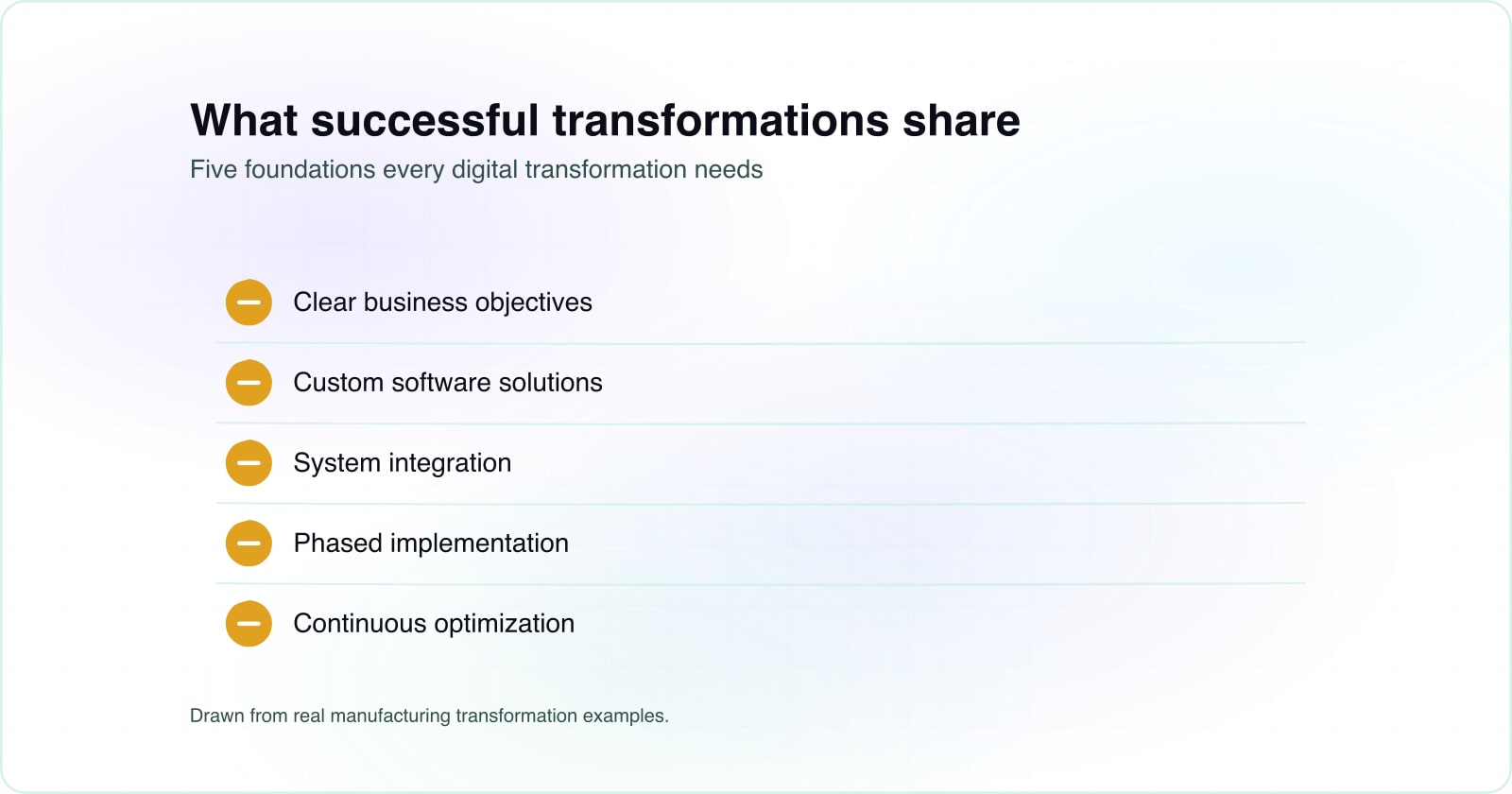
Across different industries and factory sizes, successful digital transformations consistently share the same foundations. These success factors appear in every example above:
| Success Factor | Why It Matters |
|---|---|
| Clear business objectives | Why It MattersKeeps technology ROI-driven |
| Custom software solutions | Why It MattersFits your actual manufacturing workflows |
| System integration | Why It MattersEliminates data silos |
| Phased implementation | Why It MattersMinimizes operational risk |
| Continuous optimization | Why It MattersSustains long-term value |
These patterns show why generic, off-the-shelf tools rarely deliver the same impact. When you pick solutions that fit your actual workflows, you get results. When you try to force your operations into a generic tool, you get frustration.
Role of custom software in manufacturing digital transformation#
In nearly every successful example, custom software plays a central role. Manufacturing operations are too complex and too varied for rigid, one-size-fits-all tools.
Working with a specialized software development company ensures your digital solutions align with your existing ERP and MES systems, reflect shop-floor realities, meet your compliance requirements, and scale as your business grows. This approach lets you build a connected transformation roadmap rather than isolated digital projects that don't talk to each other.
How these examples fit into your bigger digital transformation journey#
Manufacturers often start by understanding what digital transformation in manufacturing means at a strategic level before evaluating how it applies to your own operations. As you review real-world use cases, these examples help you quantify ROI and predict what operational impact you can realistically expect.
From there, attention naturally shifts toward advanced capabilities such as predictive insights and automation powered by artificial intelligence. When you're ready to execute at scale, you evaluate custom AI software for manufacturing that converts strategy into measurable production efficiency.
Together, these topics guide manufacturers from inspiration to execution without overwhelming your teams or disrupting operations.
Final thoughts for manufacturing decision-makers#
Real-world digital transformation examples in manufacturing prove that transformation is practical, measurable, and scalable when done correctly. You're not guessing at outcomes. You're following a proven path that other manufacturers have already walked.
Manufacturers that learn from proven examples, align technology with clear business goals, and invest in partners who understand shop-floor realities gain a lasting competitive advantage in efficiency, quality, and decision-making.
Digital transformation is not about copying another factory. It's about applying proven strategies and patterns to your own manufacturing reality.