How AI applications in manufacturing improve operations
Artificial intelligence is no longer a future concept for manufacturers. It is already transforming how factories operate, compete, and scale. From predictive maintenance to intelligent quality control, AI is helping manufacturers reduce inefficiencies and make faster, data-driven decisions. For manufacturers in the USA and India, artificial intelligence applications in manufacturing are most effective when built around real operational workflows. This is why many companies invest in reliable custom software development services that tailor AI solutions to their specific production environments rather than forcing generic tools onto complex processes. Learn how custom AI software delivers measurable results in production environments.
What Artificial Intelligence Means for Modern Manufacturing#
Artificial intelligence in manufacturing refers to systems that analyze large volumes of production data and identify patterns. These systems make predictions or recommendations with minimal human intervention. Unlike traditional automation, AI systems continuously learn from data generated by machines, sensors, operators, and enterprise systems.
When aligned with a clear digital strategy, AI becomes a core pillar of manufacturing transformation. It enables smarter operations and larger strategic gains. Many manufacturers first explore AI after understanding what digital transformation in manufacturing involves. They learn how data acts as the foundation for intelligent decision-making.
Why Manufacturers Are Adopting AI Today#
Manufacturers adopt AI not for innovation alone, but to solve persistent operational challenges. Common drivers include rising production and labor costs, increasing equipment downtime, inconsistent product quality, supply chain volatility, and pressure to improve margins. AI enables manufacturers to move from reactive decision-making to predictive and preventive operations. This shift is one of the most valuable benefits of manufacturing transformation.
Key AI Applications in Manufacturing#
AI is applied across multiple manufacturing functions, delivering value at every stage of production.
Predictive Maintenance#
Unexpected equipment failures can halt production and cause significant losses. AI models analyze machine data such as vibration, temperature, and usage patterns to predict failures before they occur. Business impact includes thirty to forty percent reduction in unplanned downtime, lower maintenance costs, and extended machine lifespan. Predictive maintenance is one of the most widely adopted artificial intelligence applications in manufacturing industry environments today.
Quality Control and Defect Detection#
Manual inspections are slow, inconsistent, and error-prone. Computer vision systems powered by AI inspect products in real time, detecting defects invisible to the human eye. AI-driven quality control reduces scrap and rework, accelerates defect identification, and improves compliance and traceability. This approach is frequently seen across automotive, electronics, and consumer goods sectors.
Demand Forecasting and Production Planning#
Traditional forecasting methods struggle with market volatility. AI analyzes historical sales, seasonal trends, and external data to predict demand more accurately. Manufacturers using AI for planning often achieve twenty to thirty percent improvement in inventory efficiency. This translates to optimized production schedules, reduced inventory costs, and better alignment between sales and operations.
Supply Chain Optimization#
Supply chain disruptions can derail production schedules and inflate costs. AI models identify supplier risks, predict delays, and recommend alternative sourcing strategies. These capabilities improve supplier reliability, reduce lead times, and strengthen production planning across procurement and logistics functions. Organizations gain visibility into risks weeks or months before they would impact production.
Energy Management and Cost Optimization#
Energy costs are a major expense in manufacturing operations. AI systems analyze energy consumption patterns and recommend optimal usage strategies. Business impact includes lower energy costs, reduced carbon footprint, and improved sustainability compliance. For facilities with high energy intensity, AI-driven optimization often pays for itself within the first year.
Real-World Examples of AI in Manufacturing#
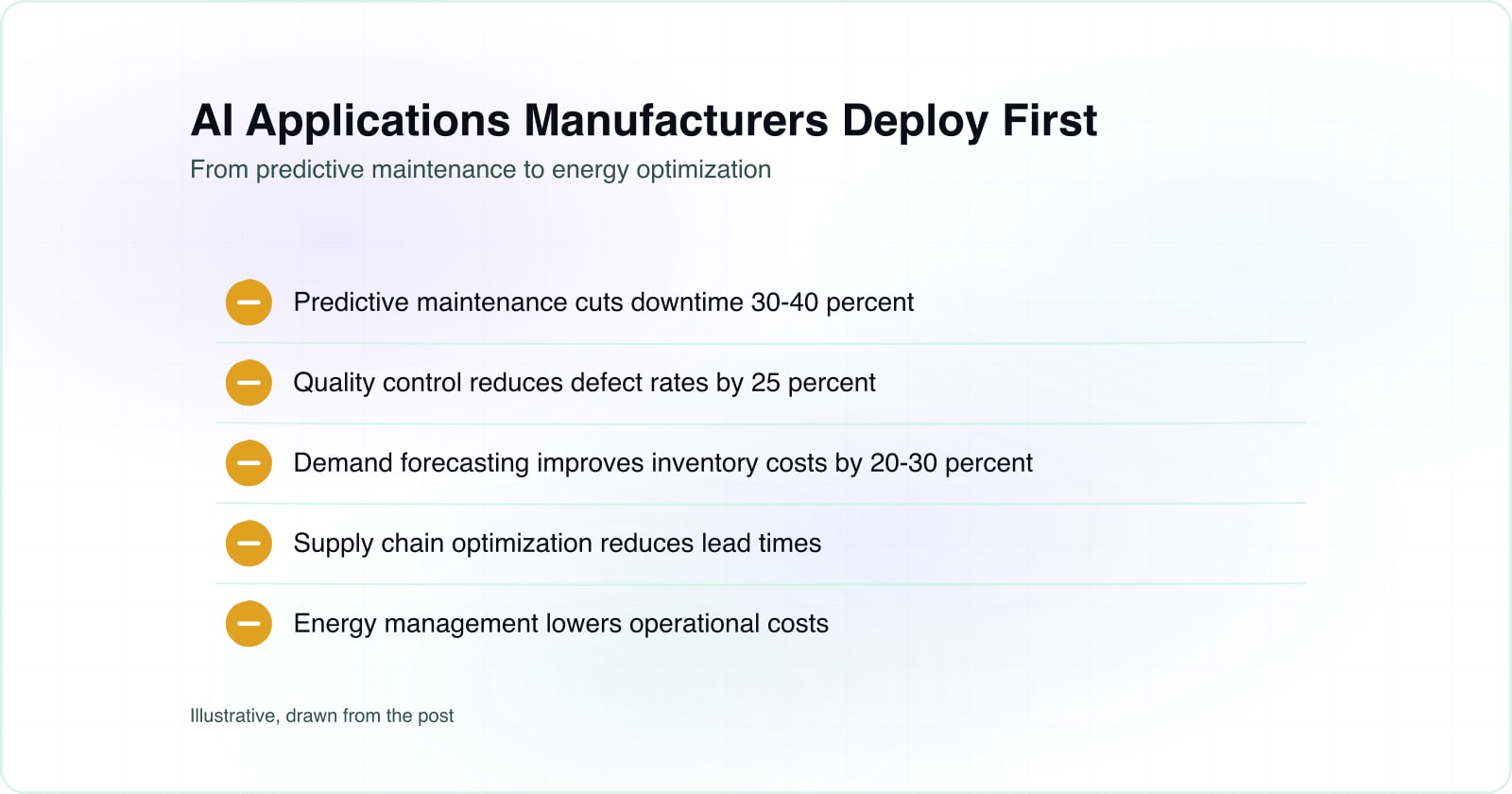
Manufacturers across the USA and India are already seeing tangible results from AI adoption. Predictive maintenance systems have cut downtime by thirty to forty percent. AI quality inspection reduces defect rates by twenty-five percent. Demand forecasting improves inventory costs by twenty to thirty percent. Smart scheduling increases efficiency by fifteen to twenty-five percent. Energy optimization lowers operational costs across facilities.
These outcomes demonstrate why AI is becoming central to manufacturing transformation strategies. Manufacturers that move early gain competitive advantage through lower costs, faster time to market, and improved product consistency.
How AI Fits into the Broader Transformation Journey#
AI does not operate in isolation. Its success depends on how well it integrates with existing systems, data sources, and workflows. Manufacturers often start by reviewing digital transformation examples in manufacturing, then move toward AI-driven use cases once foundational systems are in place.
At this stage, many organizations rely on software development consulting to identify high-ROI AI use cases, assess data readiness, design scalable AI architectures, and avoid over-engineering solutions. This ensures AI investments deliver measurable business value rather than experimental outcomes. You can read more about this process in our guide to designing software systems that scale with your business.
Why Custom AI Solutions Work Better Than Generic Tools#
Off-the-shelf AI tools often fail in manufacturing environments due to limited flexibility and poor system integration. Custom AI solutions are designed around existing machines and data sources, real production workflows, industry-specific compliance needs, and long-term scalability. Partnering with an experienced manufacturing software development company ensures AI systems integrate with ERP, MES, and legacy infrastructure, maximizing ROI.
Custom approaches also adapt to unique production environments. No two factories operate identically. A custom AI solution learns from your specific machines, your data patterns, and your operational rules, delivering insights that generic software cannot.
How AI Applications Connect with Other Manufacturing Topics#
Manufacturers exploring AI typically evaluate it alongside other transformation initiatives. Many begin by understanding what manufacturing transformation means at a strategic level, then assess the benefits before moving into execution. Real-world examples provide confidence, while purpose-built AI software helps translate AI strategy into production-ready systems.
These related topics guide manufacturers from awareness to implementation without operational disruption. For a comprehensive overview, explore our article on building production software systems that align with manufacturing workflows.
Final Thoughts for Manufacturing Leaders#
Artificial intelligence applications in manufacturing are no longer optional. They are becoming a competitive requirement. Manufacturers that adopt AI strategically gain better operational visibility, reduced downtime and waste, smarter decision-making, and scalable growth. When combined with the right digital foundation and custom software approach, AI becomes a powerful driver of long-term manufacturing success, not just a technological upgrade.