Why large organizations choose custom enterprise software
Most "benefits of custom software" content reads the same whether you\'re a five-person startup or a 5,000-employee organization. That\'s a problem, because what actually matters changes with scale.
A startup cares about getting to market fast. A large organization is usually dealing with a dozen departments running different systems, compliance requirements across multiple business units, and a technology budget that gets scrutinized at the board level.
Why Large Organizations Are Rethinking Off-the-Shelf Software#
The shift toward custom software isn\'t a niche trend. The global custom software development market is projected to grow from $50.94 billion in 2026 to $115.95 billion by 2031, according to Mordor Intelligence, and large enterprises already account for roughly 57% of that spend. That\'s not startups experimenting. That\'s established organizations concluding that packaged software has stopped scaling with them.
The reason usually isn\'t dramatic. It\'s cumulative. A department adopts a CRM. Another picks a project management tool. Finance runs its own system. None of these decisions are wrong in isolation, but a few years in, the organization is running dozens of disconnected platforms, each with its own login, its own data format, and its own limitations.
At that point, the conversation shifts from "which off-the-shelf tool is best" to "can any off-the-shelf tool actually fit what we\'ve become."
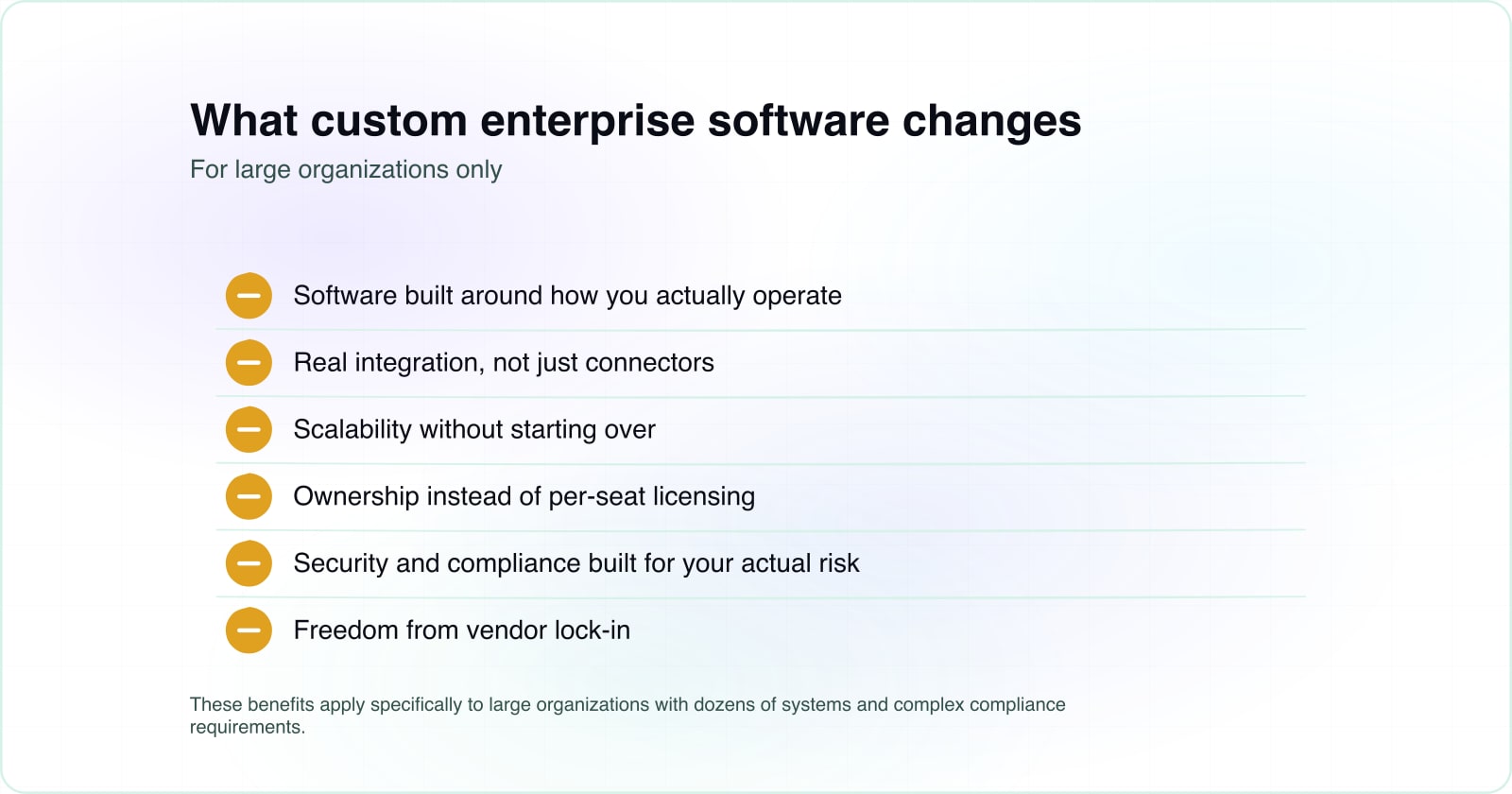
Software Built Around How You Actually Operate#
Large organizations rarely run textbook processes. Approval chains have exceptions. Reporting structures vary by region or business unit. Off-the-shelf platforms are built for the average customer, which means your organization either simplifies its process to match the software, or pays for expensive customization modules to bridge the gap.
Custom enterprise software starts from the process you actually have, not the one a vendor assumed you\'d have. That matters more at scale, because the cost of a workaround multiplied across hundreds of employees adds up fast.
Real Integration, Not Just Connectors#
This is usually where the pain is most visible in large organizations. Off-the-shelf tools offer standard integrations with popular platforms, but connecting to a legacy internal system or an older database usually still requires custom development. At that point you\'re paying for both the license and the integration work.
Custom software can be built API-first from the start, so your ERP, CRM, and internal systems share data as part of the architecture, not as an afterthought. This is where large organizations lose the most operational time when they\'re forced to wrangle multiple disconnected platforms.
Real integration saves operational time that would otherwise get lost in manual reconciliation, data sync errors, and workaround processes.
Scalability Without Starting Over#
Off-the-shelf platforms scale in steps defined by the vendor. You upgrade to the next pricing tier and get the next batch of features, whether you need all of them or not. Custom software scales based on what your organization actually needs next, since it\'s built with your growth path in mind rather than a vendor\'s product roadmap.
Most enterprise custom builds today ship as cloud-based platforms for exactly this reason. Cloud-based custom platforms let you scale compute and storage independently from your feature investment, which is how organizations avoid the "tier lock-in" problem where one extra feature forces you to pay for capacity you don\'t need.
Ownership Instead of Per-Seat Licensing#
At enterprise headcount, licensing costs stop being a rounding error. Off-the-shelf platforms typically charge per user or per transaction volume, so your software cost grows in direct proportion to headcount, regardless of whether each additional employee needs the full feature set.
Custom software carries a higher upfront cost, but no recurring per-seat fees. Over a multi-year horizon, especially at large headcount, the total cost of ownership frequently favors custom software once licensing costs are actually added up.
The payback horizon depends on your headcount and growth rate, but the math shifts decisively at organizations that cross a few thousand employees.
Security and Compliance Built for Your Actual Risk#
Large organizations are bigger targets, and they usually carry more regulatory exposure across more jurisdictions than a smaller company. Off-the-shelf software applies the same security model to every customer, which means your specific compliance requirements have to fit inside a generic framework that wasn\'t built with them in mind.
Custom software lets you build access control, encryption, and audit logging around your actual risk profile rather than configuring around someone else\'s default settings.
This matters for organizations handling regulated data, operating across multiple countries, or managing sensitive trade secrets that need compartmentalized access controls.
Freedom From Vendor Lock-In#
This is a risk that grows with organizational size, not one that shrinks. The more of your operation that depends on a single vendor\'s platform, the less negotiating power you have when that vendor raises prices at renewal, gets acquired by a competitor, or quietly sunsets a feature your workflow depends on.
Large organizations feel this acutely, because switching an enterprise-wide system isn\'t a weekend project. It\'s a multi-month migration with real business disruption.
Custom software puts your organization\'s roadmap in your own hands. You\'re not negotiating from a position of dependency every time a contract comes up for renewal, and a vendor\'s business decisions don\'t become your operational emergency.
A Foundation Your AI Initiatives Can Actually Use#
Most enterprise AI efforts stall for a reason that has nothing to do with the AI model. The underlying data is scattered across disconnected systems, inconsistently formatted, and hard to access reliably. Off-the-shelf platforms often make this worse, since your data lives inside a vendor\'s schema, accessible only through whatever export or API access they choose to offer.
Custom software can be built with clean, centralized, well-structured data from the start, which is the actual prerequisite for any AI initiative to produce reliable results. This applies whether you\'re building forecasting models, automation rules, or decision support systems.
This is less about chasing an AI trend and more about not having to redo your data architecture later to make one work.
Built for Mergers, Acquisitions, and Multi-Entity Consolidation#
This is a distinctly large-organization problem. Growth through acquisition means inheriting whatever systems the acquired company was running. That\'s often a completely different CRM, a different ERP, and different reporting standards than your own.
Off-the-shelf tools aren\'t built to reconcile five different systems into one coherent operational view. Usually, the acquired entity just keeps running its own stack indefinitely, and the integration debt never actually gets paid down.
Custom software can be designed specifically to unify multiple entities\' data and workflows into a single system, on a timeline that matches your actual integration plan rather than a vendor\'s willingness to support a one-off migration.
A Competitive Advantage That Isn\'t Shared With Competitors#
If your organization and three direct competitors are all running the same off-the-shelf platform, you\'re all operating with the same capabilities and the same limitations. Any workflow advantage you build inside that platform is, by definition, available to everyone else using it too.
Custom software tied to a genuine operational advantage, a proprietary process, a faster fulfillment model, a unique customer experience, stays yours. That\'s a meaningfully different kind of investment than licensing the same tool as everyone else in your industry.
Reporting Built Around the Decisions You Actually Make#
Generic dashboards show generic metrics. At enterprise scale, the data that actually drives decisions is usually specific: which business unit\'s margins are compressing, which region\'s fulfillment times are slipping, which product line is quietly underperforming.
Off-the-shelf reporting tools can usually get you there eventually, with enough manual export and reassembly.
Custom reporting and analytics built around your specific KPIs turns that into something leadership can act on directly, instead of a monthly export someone has to manually stitch together.
The Honest Tradeoff: What Custom Software Actually Requires#
None of the above happens automatically just because you chose custom over off-the-shelf, and it\'s worth being direct about that rather than treating custom software as a guaranteed win.
McKinsey\'s research on large-scale IT projects found that the median cost overrun runs around 45% above the original estimate. Roughly 17% of large projects go so far over budget or schedule that they threaten the stability of the business commissioning them.
The Standish Group\'s long-running Chaos Report consistently finds that the leading causes of software project failure are unclear requirements, scope creep, and inadequate planning, not the technology itself.
The takeaway isn\'t "don\'t build custom software." It\'s that the organizations that get this right treat discovery and planning as seriously as the build itself.
A clear development process with defined phases, and a well-scoped RFP if you\'re evaluating multiple vendors, does more to control this risk than anything else.
Signs Your Organization Is Ready for Custom Enterprise Software#
Rather than a generic "it depends," these are the patterns that usually indicate custom software is worth serious evaluation. For a detailed evaluation framework, see how to choose a custom software development company.
- You're paying for multiple platform tiers or add-on modules just to cover features you actually need.
- Your team maintains manual workarounds, spreadsheets, or duplicate data entry to bridge gaps between systems.
- A recent acquisition or new business unit is still running on a separate system months after the deal closed.
- You've had a vendor raise prices, restrict a feature, or change terms in a way that disrupted your operations.
- Your data is too fragmented to reliably support analytics or AI initiatives leadership is asking for.
If two or more of these sound familiar, it\'s usually worth a proper scoping conversation rather than another round of off-the-shelf evaluation.
When Off-the-Shelf Still Makes Sense#
To be fair, custom software isn\'t the right call for every situation, even at enterprise scale. If a function is genuinely standard across your industry, payroll processing for example, a mature off-the-shelf platform is usually more cost-effective than building and maintaining your own.
The clearest case for custom software is where your process, integration needs, or scale have outgrown what a generic platform can support, not as a default for every system you run. See warehouse management software comparison for a real-world decision framework.
How We Approach Enterprise Custom Software#
We build custom enterprise software using a hybrid delivery model. That means US-standard communication and quality, with the cost efficiency of a development team based in India, which matters directly for the licensing-versus-ownership math covered above.
This hybrid model exists specifically because the math that makes custom software cost-effective over a multi-year horizon is contingent on controlling your development costs. Read more about our enterprise software development services or explore our ERP development services for large organizations.