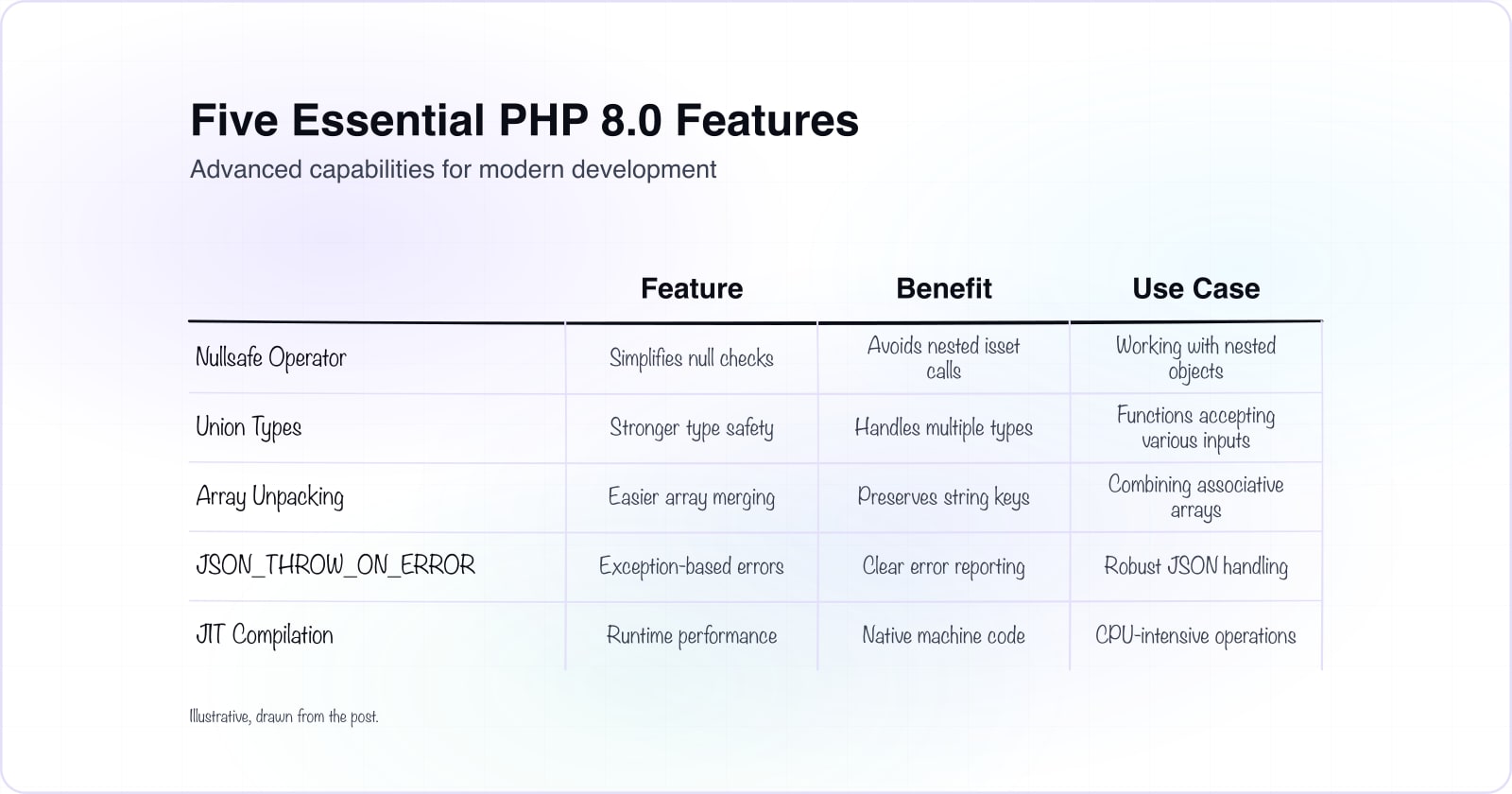
Advanced PHP features that modern developers should know
In the second part of this exploration, we continue examining the powerful features of PHP that significantly enhance your coding experience. To learn about Readonly Properties, Enums, Match Expressions, Constructor Property Promotion and Named Arguments, read Part 1. These features focus on improving code readability, maintainability, and overall performance, helping you write cleaner and more efficient code. By incorporating these advanced PHP capabilities into your development workflow, you can streamline your processes and build more reliable applications. Whether you manage complex projects or optimize everyday tasks, these PHP features are essential tools for modern developers. To apply this knowledge in production environments, explore how these features contribute to Laravel performance optimization.
Nullsafe Operator#
The nullsafe operator, introduced in PHP 8.0, makes handling null values easier. It helps you avoid null reference errors when working with objects and methods that might be null. This operator removes the need for multiple nested isset or null checks, making your code simpler, more readable, and less likely to have errors.
The nullsafe operator is represented by ?->. When used, it checks if the value before the operator is not null before accessing the property or method on the right. If the value is null, the entire expression returns null without causing an error.
$result = $object?->property?->method();Example: Using the Nullsafe Operator#
Consider a scenario where you work with nested objects and need to access a method of a deeply nested property.
if ($user !== null && $user->profile !== null) {
    $username = $user->profile->getUsername();
} else {
    $username = null;
}$username = $user?->profile?->getUsername();The nullsafe operator simplifies your code by replacing multiple checks to ensure that none of the intermediate objects are null, making the code much shorter and easier to read. Using this feature, you can write cleaner and more maintainable code, especially when working with complex data structures and APIs.
Union Types#
Union types, added in PHP 8.0, let you specify multiple possible types for a function argument, return value, or property. This feature offers more flexibility and type safety by allowing a variable to hold different types of values. Union types make your code more reliable by clearly stating which types are expected, reducing runtime errors, and enhancing readability.
A union type is defined by separating multiple types with the | (pipe) character. This indicates that a variable or a function parameter can accept any of the specified types. Union types can also be applied to function return types, specifying that a function can return different types based on its logic.
function processValue(int|float $value): int|float {
    return $value * 2;
}
Union types are especially helpful when a function needs to handle different types of inputs, like a function that can process both a string or an array. They are also useful for methods or functions that might return null, as union types let you explicitly include null as a possible type, enhancing type safety.
Examples: Using Union Types#
function formatData(string|array $data): string {
    if (is_array($data)) {
        return implode(', ', $data);
    }
    return $data;
}

echo formatData('Hello World'); // Outputs: Hello World
echo formatData(['Hello', 'World']); // Outputs: Hello, Worldfunction getValue(bool $flag): int|string {
if ($flag) {
return 42;
}
return "The answer";
}
echo getValue(true); // Outputs: 42
echo getValue(false); // Outputs: The answerUnion types enhance PHP's type system by providing more flexibility and safety. They allow you to handle different types without sacrificing the advantages of type declarations, making your code cleaner and easier to read. By clearly stating the possible types, union types help avoid bugs, reduce the need for complex type-checking, and improve maintainability. Whether you work with optional values, manage various input types, or build APIs, union types are a great addition to modern PHP development.
Array Unpacking with String Keys#
Array unpacking, introduced in PHP 7.4, lets you expand the elements of one array into another. This makes merging and manipulating arrays much easier. In PHP 8.0, array unpacking was improved to support string keys, adding even more flexibility and power for different scenarios.
The array unpacking operator ... is used to expand an array into individual elements. When used with string keys, it allows you to unpack arrays with associative keys directly into other arrays.
$array1 = ['a' => 1, 'b' => 2];
$array2 = ['c' => 3, 'd' => 4];

$result = [...$array1, ...$array2];

print_r($result);
// Output:
// Array
// (
//     [a] => 1
//     [b] => 2
//     [c] => 3
//     [d] => 4
// )
Key Points About String Keys#
- Preservation of Keys: When unpacking arrays with string keys, the keys are preserved, so key-value pairs are directly merged into the new array.
- Overwriting Keys: If multiple arrays being unpacked have overlapping keys, values from later arrays will overwrite those from earlier ones.
Example with Overlapping Keys#
$array1 = ['a' => 1, 'b' => 2];
$array2 = ['b' => 3, 'c' => 4];

$result = [...$array1, ...$array2];

print_r($result);
// Output:
// Array
// (
//     [a] => 1
//     [b] => 3
//     [c] => 4
// )
Array unpacking with string keys in PHP 8.0 provides a powerful and flexible way to handle arrays. It simplifies merging and manipulating arrays by allowing you to directly expand arrays with string keys into other arrays. This feature improves code readability and reduces boilerplate, making it easier to manage configurations, settings, and associative arrays in your PHP applications.
JSON_THROW_ON_ERROR#
The JSON_THROW_ON_ERROR option, introduced in PHP 7.3, allows you to handle JSON encoding and decoding errors using exceptions. This makes error handling and debugging more effective, as you can catch and manage these errors like regular exceptions instead of relying on older error handling methods. This feature simplifies detecting and responding to JSON-related issues in your code.
When using JSON functions like json_encode() or json_decode(), errors are traditionally handled with json_last_error() and json_last_error_msg() to get error codes and messages. However, with JSON_THROW_ON_ERROR, PHP will automatically throw a JsonException if an error occurs. You can then catch and handle these exceptions using try-catch blocks, making error handling more consistent and easier to manage.
Example: Handling JSON Errors#
// Handling JSON Encoding Errors
$data = ["name" => "Alice", "age" => "30"];

try {
    $json = json_encode($data, JSON_THROW_ON_ERROR);
    echo $json;
} catch (JsonException $e) {
    echo 'JSON encoding error: ' . $e->getMessage();
}

// Handling JSON Decoding Errors
$jsonString = '{"name": "Alice", "age": 30}';

try {
    $data = json_decode($jsonString, true, 512, JSON_THROW_ON_ERROR);
    print_r($data);
} catch (JsonException $e) {
    echo 'JSON decoding error: ' . $e->getMessage();
}Benefits#
- Improved Error Handling: Allows for better error handling through exceptions, which can be caught and managed using try-catch blocks.
- Clearer Error Reporting: Provides clearer and more precise error messages through exceptions, making debugging easier.
- Consistent Error Management: Facilitates consistent error management in your code by using exceptions, aligning with modern PHP practices.
The JSON_THROW_ON_ERROR constant in PHP improves JSON encoding and decoding by throwing exceptions when errors occur. This enhances error handling by allowing you to catch and manage JSON errors with exceptions, resulting in cleaner and more maintainable code. It's particularly useful when precise error handling and data integrity are critical.
JIT Compilation#
PHP 8.0 introduced Just-In-Time (JIT) compilation as a significant performance enhancement to improve the execution speed of PHP scripts. JIT compilation compiles code at runtime into native machine code, allowing the CPU to execute it directly. This method contrasts with traditional interpreted execution, where an interpreter processes the code.
How JIT Compilation Works#
- Compilation Process: JIT compilation translates PHP bytecode into native machine code just before execution. This process occurs at runtime, hence the term "Just-In-Time."
- Execution: The CPU runs the compiled machine code directly, eliminating the overhead of interpreting bytecode. This approach can lead to faster performance, especially for frequently executed code.
- Optimization: JIT includes optimizations like function inlining and loop optimization, which can further enhance the performance of PHP applications.
Configuration#
JIT compilation in PHP is managed through the opcache.jit configuration directive. You can enable and configure it either in the php.ini file or dynamically at runtime using PHP functions.
opcache.enable=1
opcache.jit=1205
In this example, JIT is enabled, and the opcache.jit setting is set to 1205, which is one of the predefined JIT levels. The level determines how aggressively the JIT compiler optimizes the code.
Benefits of JIT Compilation#
- Performance Improvement: JIT can significantly boost performance, especially for CPU-intensive tasks and long-running scripts.
- Reduced Execution Time: By translating frequently used code into native machine code, JIT cuts down on the time spent interpreting bytecode, speeding up execution.
- Optimized Code Execution: JIT applies optimizations during the compilation process, leading to more efficient code execution.
Limitations and Considerations#
- Overhead for Short Scripts: JIT may add overhead for short or one-time scripts. Its benefits are more noticeable for long-running or frequently executed code.
- Configuration Complexity: Setting up JIT for optimal performance can be complex, often requiring fine-tuning and experimentation based on specific needs.
- Memory Usage: JIT can increase memory usage because it needs to store the compiled machine code.
JIT compilation in PHP 8.0 is a powerful feature that boosts performance by translating code into native machine code at runtime. This can speed up CPU-intensive operations and long-running scripts, optimizing your PHP applications. However, it is essential to carefully configure JIT and be aware of its potential impact on memory usage to make the most of its performance benefits.
Implementing These Features in Production#
Adopting PHP 8.0+ features requires understanding how they fit into your architecture and deployment strategy. Whether you are building new applications from scratch or planning for ongoing maintenance and optimization, these modern PHP features provide the foundation for clean, performant code that scales with your business.
Wrapping Up#
PHP has introduced a range of powerful features to enhance development efficiency and performance. Readonly properties enforce immutability after initialization, while enums and match expressions provide clearer and safer ways to handle values and conditions. Constructor property promotion simplifies class definitions, and named arguments improve function calls by allowing parameters to be specified by name. The nullsafe operator makes null checks more straightforward, and union types offer flexibility in handling multiple data types. Array unpacking with string keys streamlines associative array operations, JSON_THROW_ON_ERROR ensures reliable error handling for JSON functions, and JIT compilation boosts performance by converting PHP code into native machine code. These advancements collectively make PHP more effective and modern for software engineers.