Why a healthy work environment is where teams do their best work
We have learned something across years of building software teams. A healthy work environment does not happen by accident. It is built intentionally by people who understand that trust, safety, and clarity matter more than how many hours someone spends at a desk. When we invest in these fundamentals, productivity rises naturally. Absenteeism falls. Team members stay because they want to, not because they are too tired to leave.
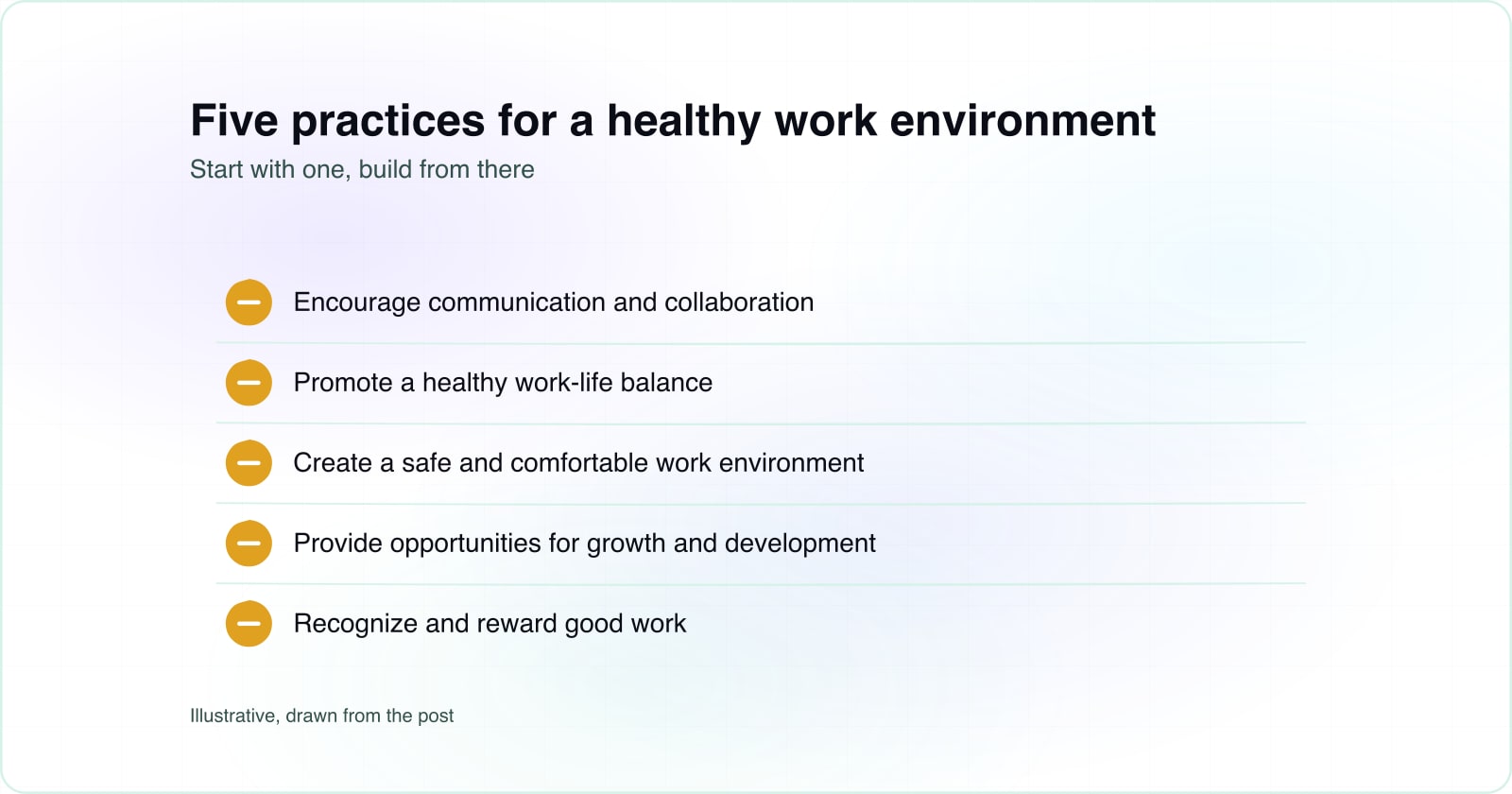
Encourage communication and collaboration#
We thrive when our voices are heard. Communication flows when people feel safe to speak, when leaders visibly act on feedback, and when collaboration is not an afterthought but a core way we work.
This means creating channels for feedback and then actually using them. A Slack channel for team announcements works. So do regular one-on-ones where someone asks hard questions and listens. What matters is consistency. When people see their suggestions lead somewhere, they keep contributing. When suggestions vanish into silence, they stop trying.
We can start here: pick one format for regular feedback and commit to it for three months. A monthly team meeting, a Slack thread, or weekly one-on-ones. The format matters less than the rhythm and the follow-through. Technology leaders recognize communication as a core competency and invest in it deliberately.
Promote a healthy work-life balance#
A person with a life outside work brings their whole self to work. They have energy, perspective, and the mental space to solve hard problems. Someone running on fumes cannot think clearly, no matter how many hours they log.
This means more than allowing breaks. It means expecting people to take them. It means a clear conversation about what done looks like for a project, so people know when to step back. It means flexible hours when life happens, or remote work so people do not lose hours to commutes.
We can start by asking: are our project deadlines realistic? Do people feel pressure to respond after hours? If the answer is yes to either, we have work to do. Realistic deadlines and a real off-switch are the foundation.
Create a safe and comfortable work environment#
Safety is both physical and psychological. A chair that breaks your back after four hours is a safety problem. So is an atmosphere where people fear speaking up about mistakes or asking for help.
On the physical side, we invest in workstations that do not hurt, lighting that does not strain eyes, and air that is clean. These seem basic. A lot of teams skip them. They shouldn\'t.
On the psychological side, we build a culture where a mistake is information, not a failure. Where asking for help is normal. Where someone can say "I do not know" or "I need more time" without their reputation taking damage. Psychological safety depends on a culture of genuine inclusion, which takes effort to build but pays back many times over.
Provide opportunities for growth and development#
People want to get better at what they do. They want to learn new skills and see themselves move forward in their careers. A team that invests in growth retains people far longer than one that assumes people are static.
Growth does not require a huge budget. Industry conferences are one path. So are books, online courses, internal knowledge-sharing sessions, and mentoring relationships. What matters is that we recognize learning as work, give people time for it, and follow up on what they learned. Cross-functional exposure accelerates learning and gives people the perspective they need for bigger roles.
A simple practice: each quarter, ask people what they want to learn. Then help them find the time and resources to do it. That conversation alone shifts how people think about their futures. When we plan product discovery and strategy together, we expand what people learn beyond their own discipline.
Recognize and reward good work#
Recognition is not just about bonuses or promotions. It is about acknowledgment. Saying "I noticed how you handled that client conversation" or "You solved that problem in a way that saved the team a week of work." Those moments matter.
When we fail to recognize good work, a quiet message takes root: hard work does not matter. Mediocrity is fine. That is the fastest way to lose good people.
We can start with conversation. Make recognition visible and regular. Create a space where wins are shared. Thank people genuinely when they go beyond what was asked. Teams that build products deliberately invest in discovery practices that highlight how each person\'s work makes the product better, turning individual effort into visible impact.
An environment is never finished#
Creating a healthy work environment is not a project we complete and move on from. It is an ongoing practice. It requires commitment from everyone, and it shifts as the team grows and changes.
What works for a team of five people looks different at fifty. A practice that served us last year may need updating now. This is not failure. It is learning.
Start somewhere. Pick one of these five areas and focus there for a quarter. Build trust through small wins. Then add another piece. Over time, a healthy environment becomes the way we work, not something we have to think about.
The payoff is real. Teams that feel safe, heard, and invested in do better work. They stick around longer. They attract people who care about quality. A healthy work environment is not soft. It is the hardest competitive advantage a business can build.