AI and developer teams: boosting productivity and capability
Since AI coding assistants became mainstream, one question recurs: will AI replace software developers? The answer is no. What we\'re seeing instead is a shift in how development teams work. AI helps software engineers automate repetitive tasks, speed up development cycles, and focus more on solving business problems rather than writing boilerplate code.
AI can write code. It cannot own the outcome.#
Modern AI tools can generate functions, APIs, tests, and entire application components. But software development has never been only about writing code. Software engineers make architectural decisions, understand business requirements, evaluate trade-offs, and ensure systems remain secure, scalable, and maintainable.
These responsibilities require context and judgment that AI simply does not possess. AI can suggest solutions. Software engineers decide whether those solutions are actually right. An AI may generate working code, but only a human architect can determine whether it fits the broader system design.
The real impact comes from productivity gains#
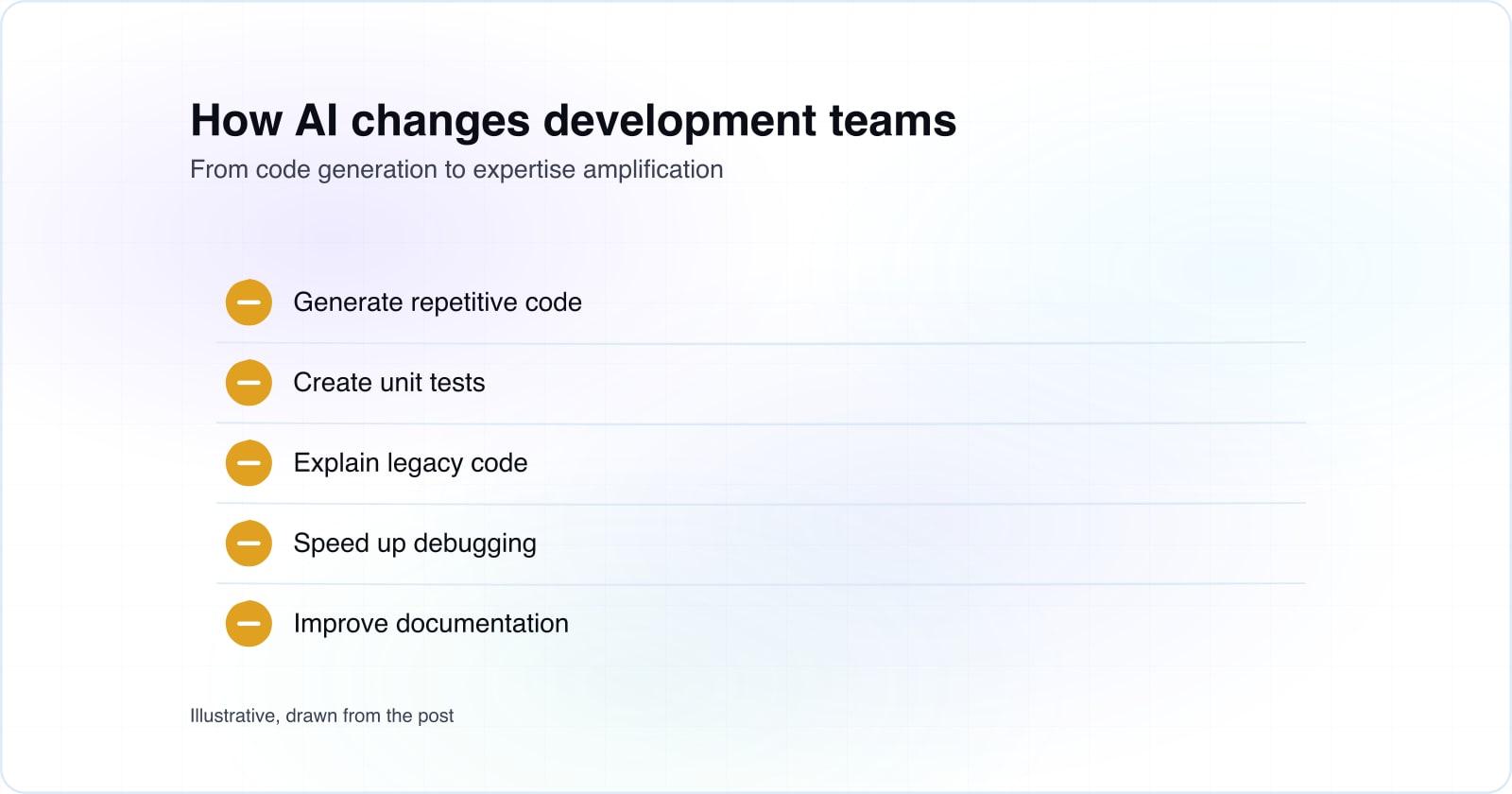
Many development teams are already using AI to generate repetitive code, create unit tests, explain legacy code, speed up debugging, and improve documentation. As a result, software engineers spend less time on repetitive tasks and more time on solving complex problems.
The outcome is not fewer developers. It\'s more productive software engineers who can tackle harder problems. When your team automates the routine work, you free your senior developers to handle the difficult architectural decisions that actually move the business forward. Building and launching a product faster depends on having developers focus on the parts machines cannot handle.
Better software engineers become even more effective#
One interesting pattern has emerged across teams adopting AI tools. Experienced software engineers often gain the most value. A senior software engineer can quickly evaluate AI-generated solutions, identify flaws, and adapt them to fit existing architecture.
Tasks that once required hours can sometimes be completed in minutes. But that speedup depends on judgment only experience brings. A junior developer may struggle to catch subtle problems in AI-generated code, while a senior software engineer spots them instantly. AI does not replace expertise. It amplifies it.
Collaboration remains at the core#
Successful software projects depend on communication between developers, designers, product managers, and stakeholders. AI can help generate code. It cannot align business goals, manage project priorities, or build trust within a team.
The strongest development teams continue to rely on human collaboration while using AI to improve execution. Design and experience work requires the same collaboration. When developers trust each other and understand what the business needs, they make better decisions about which AI-generated code to use and which to rewrite.
What this means for software development teams#
Organizations that treat AI as a replacement strategy may struggle. Organizations that treat AI as a productivity tool are seeing better results. The focus should be on helping developers work smarter, learn faster, and spend more time on high-value work.
This shift applies equally to scaling software systems and building new capabilities. As your team grows, AI handles the code generation and routine tasks. Your best developers handle the decisions only they can make.
The future of software development with AI#
AI is changing software development, but not in the way many predicted. Developers stay essential, and development teams become more efficient, more capable, and better equipped to tackle complex challenges. The future combines AI with human expertise.
It is not AI versus software engineers. It is software engineers using AI to build better software faster. When your team uses AI well, developers focus on judgment, architecture, and business value. Machines handle the rest.