How digital transformation delivers measurable benefits in manufacturing
Manufacturers today face pressure to increase productivity, reduce costs, and respond faster to market demands. Traditional processes like manual reporting, disconnected systems, and legacy software make this increasingly difficult. This is why digital transformation in manufacturing has become a strategic priority. By leveraging data, automation, and intelligent systems, manufacturers gain better control over operations and long-term scalability. For companies planning modernization, investing in custom software is often the first and most impactful step toward measurable transformation benefits.
Why manufacturers are investing in digital transformation#
Manufacturers across the USA and India are adopting digital transformation to solve real business problems, not just modernize technology.
Key drivers include rising operational costs, increasing competition, supply chain disruptions, and growing customer expectations for quality and speed. Digital transformation helps manufacturers transition from reactive operations to proactive, data-driven decision-making.
In today's manufacturing industry, companies that delay adoption often struggle to maintain efficiency and profitability compared to digitally mature competitors. The cost of staying behind is higher than the investment in transformation.
Operational efficiency gains through digital transformation#
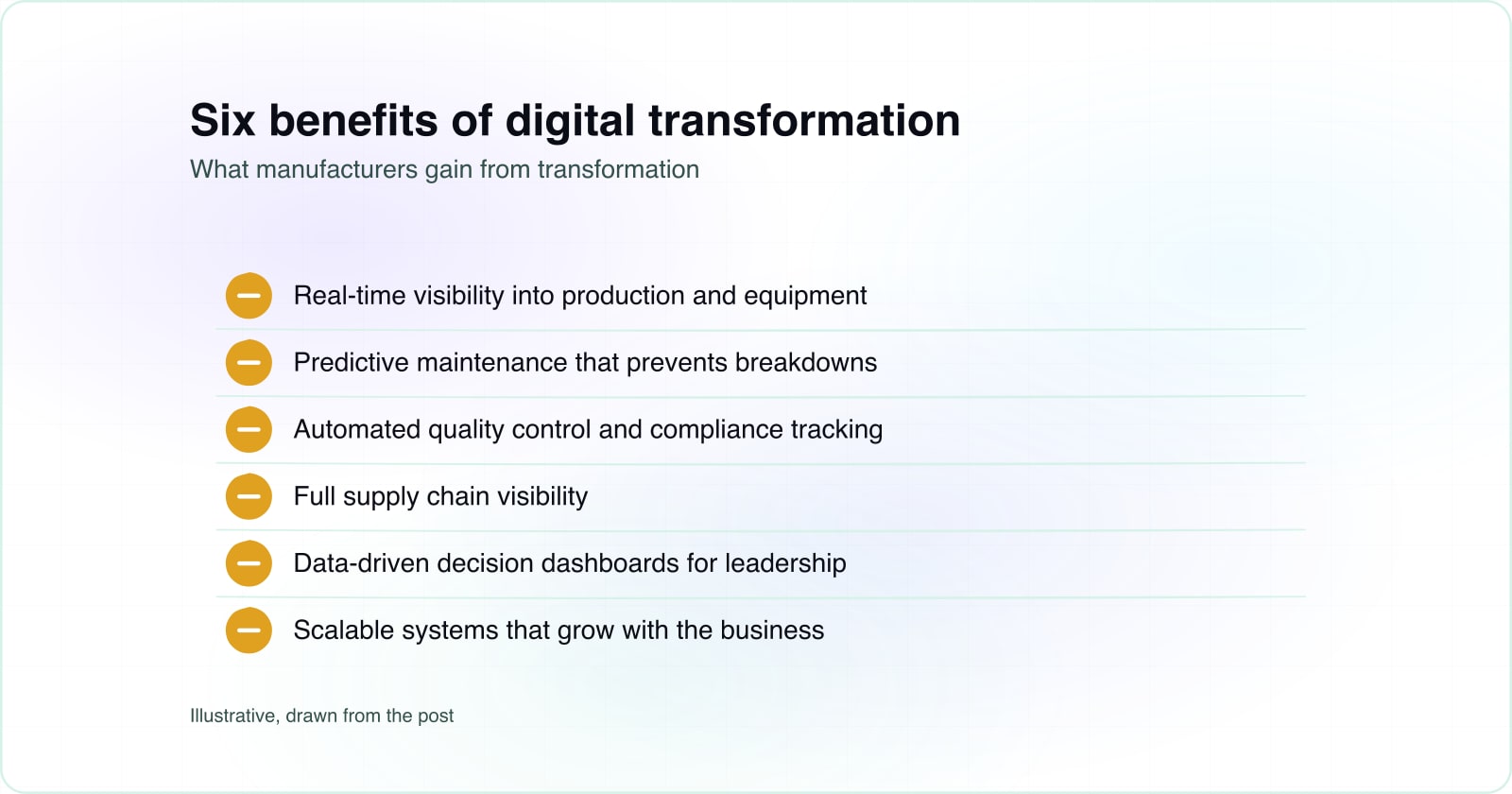
One of the biggest benefits is improved operational efficiency across the factory floor. Digital systems provide real-time visibility into production performance, machine utilization, and workflow bottlenecks.
This enables teams to optimize scheduling, reduce idle time, and improve throughput without increasing labor costs. Manufacturers implementing digital transformation typically report:
- 15-25% improvement in production efficiency
- Faster issue identification and resolution
- Better coordination between departments
These gains compound over time as systems mature and teams gain confidence in the data they receive.
Reduced downtime and smarter maintenance#
Unplanned downtime is one of the most expensive challenges in manufacturing. Digital transformation introduces predictive maintenance capabilities that significantly reduce this risk.
By collecting machine data through sensors and analytics platforms, manufacturers can detect early warning signs of equipment failure before breakdowns occur. This proactive capability is a core advantage of digital transformation for manufacturing companies.
Business impact includes:
- 20-40% reduction in unplanned downtime
- Lower repair and replacement costs
- Extended equipment lifespan
Predictive maintenance shifts manufacturers from fixing problems after they happen to preventing them before they cost money.
Improved quality control and compliance#
Quality issues increase waste and damage customer trust. Digital transformation improves quality control by automating inspections, tracking defects, and maintaining detailed audit trails.
With centralized data and real-time alerts, manufacturers can identify quality deviations early and take corrective action immediately. This improves consistency, compliance, and traceability across production lines.
In regulated environments, digital systems also simplify audits and reporting. Auditors can access complete records instantly rather than searching through manual logs. This reduces audit time and demonstrates compliance rigor.
Better supply chain visibility and inventory optimization#
Supply chain inefficiencies often lead to excess inventory or production delays. One of the most valuable benefits of digital transformation is full supply chain visibility.
Digitally connected systems enable manufacturers to:
- Forecast demand more accurately
- Optimize inventory levels
- Track supplier performance
- Reduce carrying and storage costs
Many manufacturers see a 20-30% reduction in inventory costs after implementing digital transformation initiatives. This frees up capital for other strategic investments.
Faster and smarter decision-making#
Traditional manufacturing decisions are often based on delayed or incomplete data. Digital transformation replaces guesswork with real-time insights.
Digital dashboards and analytics platforms provide leadership teams with accurate performance metrics across production, quality, maintenance, and supply chain operations. This enables faster responses and more confident strategic planning.
To align technology initiatives with business objectives, many manufacturers rely on AI-augmented software development during their transformation journey. The right partner ensures systems answer the right questions.
Scalability and long-term business growth#
As manufacturing businesses grow, operational complexity increases. Manual systems and rigid software tools struggle to scale efficiently.
Digital transformation enables scalability by standardizing processes, automating workflows, and integrating systems. Custom digital solutions adapt to evolving business needs without disrupting production.
This flexibility is critical for manufacturers expanding operations, entering new markets, or increasing production capacity. A system built for today's volume must handle tomorrow's without replacement.
Why custom software maximizes digital transformation benefits#
Off-the-shelf manufacturing tools often limit the full potential of digital transformation. They may lack flexibility, integration capabilities, or industry-specific features.
This is why building an ERP system significantly increases transformation success rates. Custom manufacturing software enables:
- ERP, MES and legacy system integration
- Tailored workflows and reporting for your business
- Higher security and scalability than generic tools
- Better long-term return on investment
The key is choosing a partner who understands manufacturing workflows and can design systems that align with your specific operations.
Real-world results manufacturers achieve#
Manufacturers that successfully implement digital transformation consistently report measurable outcomes. These improvements are not theoretical. They reflect what teams see when systems go live and data becomes actionable.
The timeline varies by manufacturer size and complexity. Smaller operations may see results within 3-6 months. Larger operations with more complex supply chains may take 12-18 months to fully realize benefits. But every month of transformation brings visible improvements.
For a more detailed look at how to approach a transformation project, see what CTOs need to know about custom enterprise software and types of custom software development available.
Final thoughts for manufacturing leaders#
The benefits of digital transformation in manufacturing extend beyond technology upgrades. They include cost control, operational resilience, and sustainable growth.
Manufacturers that invest today position themselves to compete effectively in an increasingly digital industry. Those that delay risk falling behind. The first step is understanding where your operations stand today and what transformation could deliver for your business.